- Planned maintenance shutdown at leading mills lifts HRC, rebar prices
- Rebar prices surge on stronger demand, HRC buying remains need based
- Rebar gains likely to outpace HRC in Sep’26 too, narrowing spread further
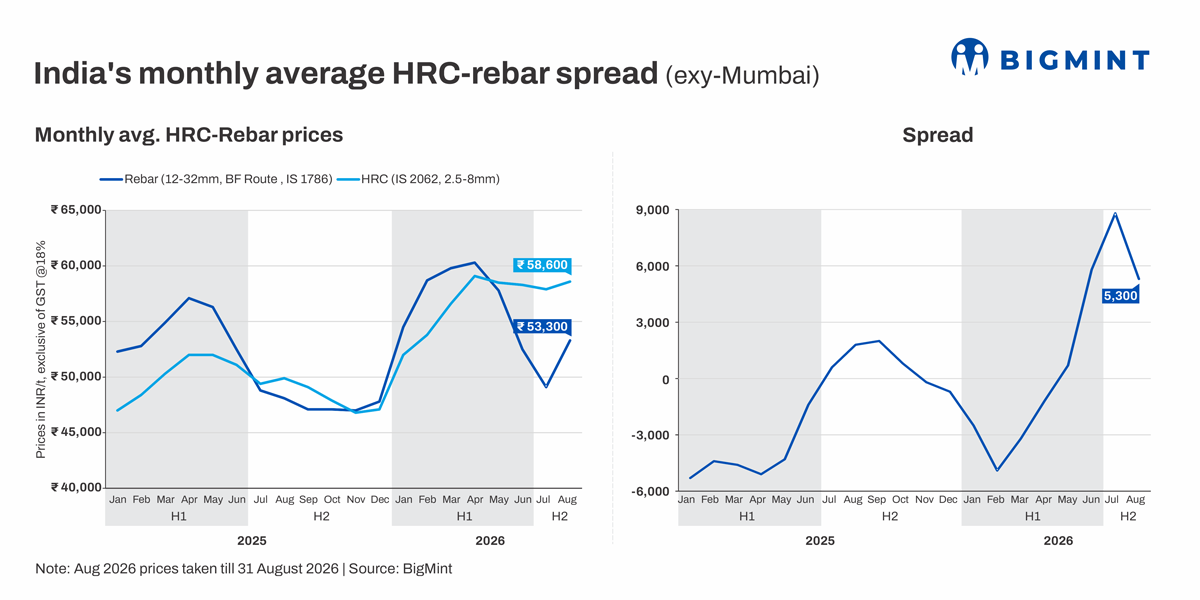
Morning Brief: The price spread between Indian hot-rolled coil (HRC) and blast furnace (BF)-route rebar prices narrowed sharply to INR 5,300/tonne (t) in August from an over 4.5-year high of INR 8,800/t in July. The contraction was driven by a much stronger rise in rebar prices, as maintenance-led supply constraints and improved retail and project bookings lifted rebar prices.
Trade-level BF-route rebar prices increased by INR 4,200/t m-o-m to a monthly average of INR 53,300/t in August, while HRC prices rose by INR 700/t to INR 58,600/t, both ex-Mumbai and excluding 18% GST. The spread has, therefore, returned to its historical norm of around INR 4,000-5,000/t, with HRC typically securing a premium because of its wider use in manufacturing and downstream applications.
Rebar prices surge on tighter supply, stronger bookings
BF-route rebar prices rose primarily on lower availability, as several integrated steelmakers undertook planned maintenance during August. Multiple plants took rolling mills and related facilities offline, while a certain producer diverted output towards alloy steel, and others stopped accepting fresh bookings. This encouraged mills to raise list prices by INR 1,000-2,000/t in the beginning of the month even when demand remained moderate.
Supply remained tight through the second half despite some mills restarting. Mill inventories stayed at around 8 days, with available material being absorbed largely by retail buyers. Major integrated mills also raised rebar prices again by up to INR 1,000/t during the month, strengthening trade-level prices.
Demand also improved in the second half amid expectations of a gradual recovery in construction activity. Some buyers brought forward purchases as expectations of further price increases strengthened, with project rebar prices reaching INR 55,000-56,000/t landed by 27 August.
IF-route rebar prices also increased, reinforcing the broader rebar rally. Prices in Mumbai rose by INR 3,900/t m-o-m to INR 49,200/t in August, supported by stronger buying, higher iron ore and coal costs, and tight mill margins. Mill inventories fell to around 8 days, limiting sales pressure.
HRC prices rise at slower pace
HRC prices increased more modestly after major mills announced list price hikes of INR 750-1,000/t at the start of the month, as some steelmakers were to undertake planned maintenance during August. Leading mills also withdrew rebates of around INR 750-800/t that had been offered in July, lifting effective transaction prices and improved trade parity by narrowing distributor losses.
The market strengthened further in the second half as leading mills raised HRC prices by around INR 500-750/t. Controlled dispatches and a shift in allocations towards automotive and B2B customers reduced availability through the trader channel, while supply of select grades and thicknesses also became tighter.
Additionally, while demand improved gradually, it remained largely requirement driven. Buying from value-added and downstream segments, particularly CRC users, picked up, and expectations of further mill price increases also strengthened buying interest. Procurement for pre-festive manufacturing activity also provided some support towards the end of August.
Bulk HRC imports remained elevated, totalling 301,131 t as of 21 August (with a further 187,909 t expected to arrive by the first week of September) against 339,040 t during the whole of July, but a substantial share was linked to Advance Authorisation and captive consumption by pipe and tube manufacturers for exports to overseas oil and gas projects. This limited the impact of imports on the domestic spot market.
Export demand remained mixed, with stronger EU bookings ahead of quota exhaustion offset by weaker buying interest in the Middle East and Southeast Asia. Exports stood at 367,994 t as of 21 August, with an additional 126,059 t expected to be shipped by the start of September. Consequently, exports in August are likely to surpass July’s 369,304 t.
Outlook
BigMint expects the HRC-rebar spread to narrow further in September, with rebar likely to outperform HRC. We believe trade-level rebar prices could increase by around INR 2,000/t this month, or potentially more, as maintenance-related supply constraints continue. Mills are likely to announce list price increases of around INR 1,500-2,000/t in the first week of September, with a leading Indian steelmaker having already announced an INR 1,750/t hike.
Supply is likely to be the main driver of the price increase in September. One major mill has shifted towards alloy steel production, reducing its market supply, while another has remained under maintenance for around two months. Although the latter could restart in the final week of September, some mills have already stopped accepting fresh project orders because of strong order backlogs. Construction activity is also expected to improve after September as the monsoon retreats, providing additional support to long steel demand.
HRC prices are also expected to rise but by a more modest INR 1,000/t. Major mills could announce INR 500-1,500/t hikes at the start of September, following cumulative increases of around INR 1,500-2,000/t during August. A leading Indian steelmaker has already raised HRC and CRC prices by INR 500/t for September deliveries. Limited distributor availability, as more material is allocated to manufacturing and automotive customers ahead of the festive season, should keep prices supported.
However, the domestic-imported HRC price gap has narrowed to around INR 3,500/t in early September, meaning further domestic increases could bring Indian HRC closer to import parity and encourage buyers to switch towards imports. This is likely to limit the extent of further HRC gains.
HRC demand may also wane later in September as the pre-festive production cycle winds down and labourers pausing work during Ganesh Puja and other festivals later in the month. Additionally, India’s manufacturing PMI fell to a five-year low of 52.8, pointing to softer demand momentum and subdued business confidence.
Coking coal prices are also likely to support price increases for both products. However, BF-route rebar might be better placed to pass these costs through because its supply remains tighter and buyers may be more accepting of steep price hikes. This difference in cost pass-through is likely to keep rebar prices rising faster than HRC in September, further compressing the spread.
Leave a Reply