- Guinea bauxite shipments to China rise ahead of potential export restrictions
- Slovalco restarts aluminium smelting capacity after more than three years offline
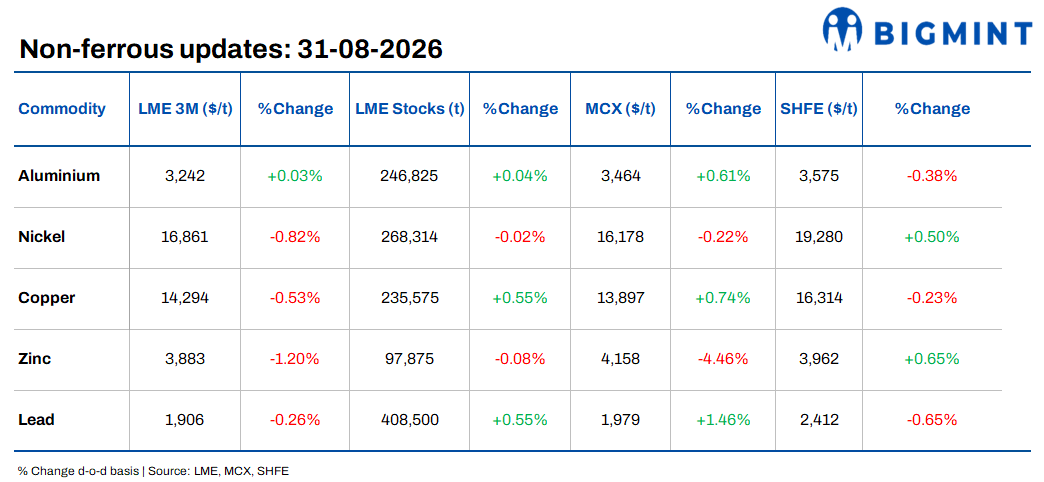
LME base metals traded mixed on 28 August. Zinc recorded the sharpest decline, falling 1.20% d-o-d to $3,883/t, followed by nickel, down 0.82% to $16,861/t, and copper, which slipped 0.53% to $14,294/t. Lead eased 0.26% to $1,906/t, while aluminium edged higher by 0.03% to $3,242/t.
LME inventories recorded mixed trends. Copper and lead stocks posted the largest gains at 0.55% d-o-d to 235,575 t and 408,500 t, respectively, while aluminium stocks rose 0.04% to 246,825 t; nickel inventories declined 0.02% to 268,314 t and zinc stocks fell 0.08% to 97,875 t.
Domestic market overview
India’s non-ferrous scrap market witnessed mixed trends on 30 August. Aluminium tense scrap remained unchanged at INR 251,000/t ex-Delhi and INR 247,000/t ex-Chennai.
Meanwhile, copper armature scrap (Cu 99%), ex-Delhi, declined by INR 5,000/t or 0.4% d-o-d to INR 1,305,000/t from INR 1,310,000/t. The decline came despite LME copper remaining elevated at $14,294/t, while domestic scrap prices reflected the latest local market movement.
Other updates
Middle East tensions raise aluminium supply and logistics risks
Tensions around the Strait of Hormuz pushed Brent crude prices above $90/bbl, increasing concerns over energy, freight and insurance costs. Meanwhile, non-China primary aluminium production fell 4.7% YoY in August as Middle Eastern smelters continued to operate below normal levels, although capacity restarts are underway. Higher energy and logistics costs, together with ongoing production disruptions, could support aluminium prices and regional premiums.
Guinea bauxite flows rise as buyers prepare for possible export curbs
Global bauxite flows rose more than 3% YoY to around 20 mnt in July. Meanwhile, shipments from Guinea to China increased 5%. Buyers accelerated purchases ahead of potential export restrictions. As a result, part of the increase may reflect front-loading. Any curbs on Guinean exports could tighten bauxite availability and raise feedstock costs for Chinese alumina refineries. This could, in turn, add to aluminium supply costs.
China aluminium processing activity shows uneven recovery
China’s aluminium processing activity improved to 48.7 in August. Stronger wire and cable orders pointed to firmer demand from the power-grid sector. However, the overall PMI remained below 50, indicating that the recovery is still uneven. The improvement could support international aluminium prices if downstream demand strengthens further. In India, the impact is likely to come mainly through international prices and import parity, while domestic scrap demand may respond more gradually.
Slovalco begins phased aluminium smelter restart
Slovalco has started restarting aluminium smelting capacity after more than three years offline. The first phase targets around 75,000 tonnes/year, against total capacity of about 175,000 tonnes/year. The restart will gradually add primary aluminium supply to the European market. It could also reduce some regional import dependence. However, the initial capacity is small compared with global production. Further restarts will depend on electricity prices and market conditions.
Leave a Reply