- Coke prices surge on supply tightness; third hike expected
- Elevated inventories signal limited downstream demand recovery
China’s steel market strengthened in the week ended 28 August, driven primarily by higher raw material costs and firmer market sentiment. Rising input costs pushed up steelmaking costs, prompting mills to raise spot offers despite limited improvement in downstream demand. Meanwhile, expectations of further policy support and firmer futures sentiment provided additional support to prices. However, elevated inventories and subdued trading activity continued to indicate that the recovery in underlying demand remains limited.
Steel price trend
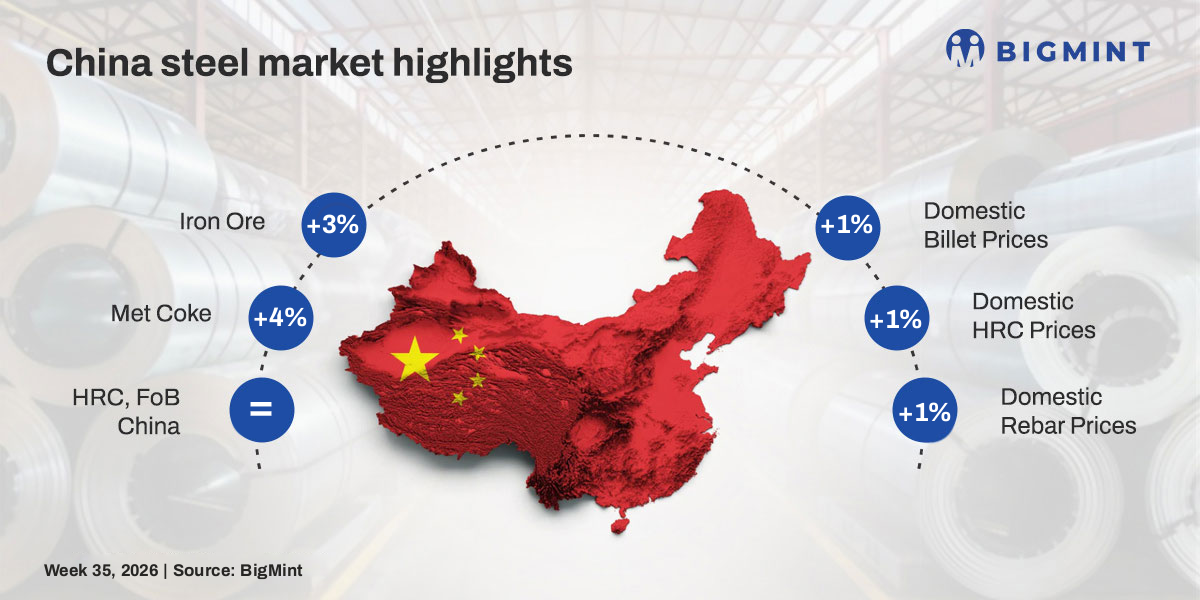
Domestic HRC prices rise w-o-w: China’s domestic HRC prices increased by RMB 40/t ($6/t) w-o-w to around RMB 3,250/t ($484/t) on 27 August, from RMB 3,210/t ($478/t) a week earlier. Moreover, SHFE HRC futures (October 2026 contract) rose by RMB 48/t ($7/t) w-o-w to RMB 3,339/t ($496/t) on 27 August, from RMB 3,291/t ($489/t) a week earlier. The increase in prices was driven primarily by higher raw material costs, particularly coking coal and coke which prompted mills to raise offers amid pressure on margins. Firmer futures sentiment and expectations of further policy measures to support domestic consumption provided additional support to the market.
However, downstream demand remained relatively subdued, while elevated inventories continued to limit the scope for a stronger price recovery. As a result, the recent increase in HRC prices appears to have been driven more by cost pressures and improved sentiment than by a broad-based recovery in demand.
Meanwhile, Chinese HRC export offers remained unchanged w-o-w at around $495/t FOB, as higher production costs supported mills’ price levels, while weak overseas demand limited upward price movement.
Domestic rebar prices increase w-o-w: China’s domestic rebar prices increased this week, supported by higher raw material costs despite limited improvement in downstream demand. Prices rose by RMB 40/t ($6/t) w-o-w to around RMB 3,250/t ($484/t) on 27 August, from RMB 3,210/t ($478/t) a week earlier. Moreover, SHFE HRC futures (October 2026 contract) rose by RMB 42/t ($6/t) w-o-w to RMB 3,080/t ($458/t) on 28 August, from RMB 3,038/t ($452/t) a week earlier, reflecting firmer futures sentiment.
Coking coal prices increased sharply during the week, putting further pressure on steelmaking costs. With production costs rising and steel mill margins remaining low, mills raised offers to protect margins. However, buying interest remained moderate, with market transactions yet to show a meaningful improvement.
Meanwhile, rebar inventories remained elevated, indicating that demand has not yet been strong enough to absorb available supply. The divergence between firmer mill offers and subdued buying suggests that the recent rise in rebar prices has been driven more by higher input costs than by a broad-based recovery in downstream demand.
Raw materials front
Iron ore spot prices gains upward momentum w-o-w: Iron ore fines benchmark prices for Fe 61% rose by $4/t w-o-w to $99/dmt CFR China on 28 August 2026. Prices surged amid strengthening sentiment in the ferrous market and better interest in medium-grade fines supported prices.
The iron ore market closed the week with a more constructive tone, as improving portside conditions in China provided additional support to seaborne cargoes. Although overall transaction volumes remained subdued, stronger prices in the domestic port market improved the economics of imported material in Northern China, contributing to a more positive market outlook.
Steel mills largely maintained a hand-to-mouth procurement strategy as profitability concerns continued to restrict bulk restocking activity.
a) Spot pellet premium stable w-o-w: Spot pellet premium for Fe 65% grade pellet remained firm w-o-w at $25.85/t CFR China on 26 August.
b) Spot lump premium rose w-o-w: Spot lump premium gained marginally w-o-w to $0.2860/t CFR China on 28 August.
Coke market remains firm as third price hike comes into focus: China’s coke market remained firm following the full implementation of the second round of price increases of RMB 100-110/t, taking cumulative gains to RMB 150-165/t. Despite improved coke realisations, most producers continue to face margin pressure, with some curtailing output. Meanwhile, slightly higher pig iron production and improved steel-mill procurement have strengthened coke demand, while tight coking coal availability continues to constrain supply.
Expectations of a third round of coke price hikes remain a key bullish market signal. Seaborne coking coal prices strengthened sharply, with Australian PHCC rising $13/t w-o-w to $261/t FOB and BigMint’s index increasing $15/t to $280/t CNF Paradip, supported by stronger Chinese buying and supply disruptions in Shanxi.
Billet, rebar prices rise w-o-w on firmer sentiment: Chinese billet and rebar prices rose in the week ended 27 August, supported by firmer raw-material costs, falling social inventories and expectations of stronger September demand. However, downstream buying remained uneven and mills continued adjusting output amid higher costs.
Standard billet prices at Tangshan Qian’an Leading Steel Mill rose to RMB 3,000/t ($446/t) on 27 August from RMB 2,960/t ($440/t) on 21 August, up RMB 40/t ($6/t) w-o-w. Moreover, SHFE October rebar futures (RB2610) increased to RMB 3,088/t ($459/t) from RMB 3,039/t ($452/t), gaining RMB 49/t ($7/t) w-o-w.
Sentiment improved on expectations of seasonal demand, although daily rebar trading remained around 90,000 t. Iron ore rose to around $98/t, while coke prices advanced further, providing cost support. Meanwhile, EAF output increased around 3.2% in some regions, although some mills reduced output to manage costs.
In the export market, billet offers rose to around $460/t FOB , up $8/t w-o-w, while HRC demand from Turkey and South Asia provided additional support. Overall, firmer costs and seasonal expectations offset still-muted end-user demand.

Outlook
China’s steel prices are likely to remain firm next week, supported by a continued rise in raw material prices and expectations of stronger seasonal demand as September approaches. Higher steelmaking costs and relatively weak mill margins are likely to encourage mills to maintain firm offers. However, the underlying supply-demand balance remains relatively weak, with construction steel inventories still elevated, HRC inventories continuing to build, and market transactions showing limited improvement. While downstream activity could gradually pick up with the onset of the traditional peak consumption season, a sustained price rally will depend on a meaningful recovery in demand.
Leave a Reply