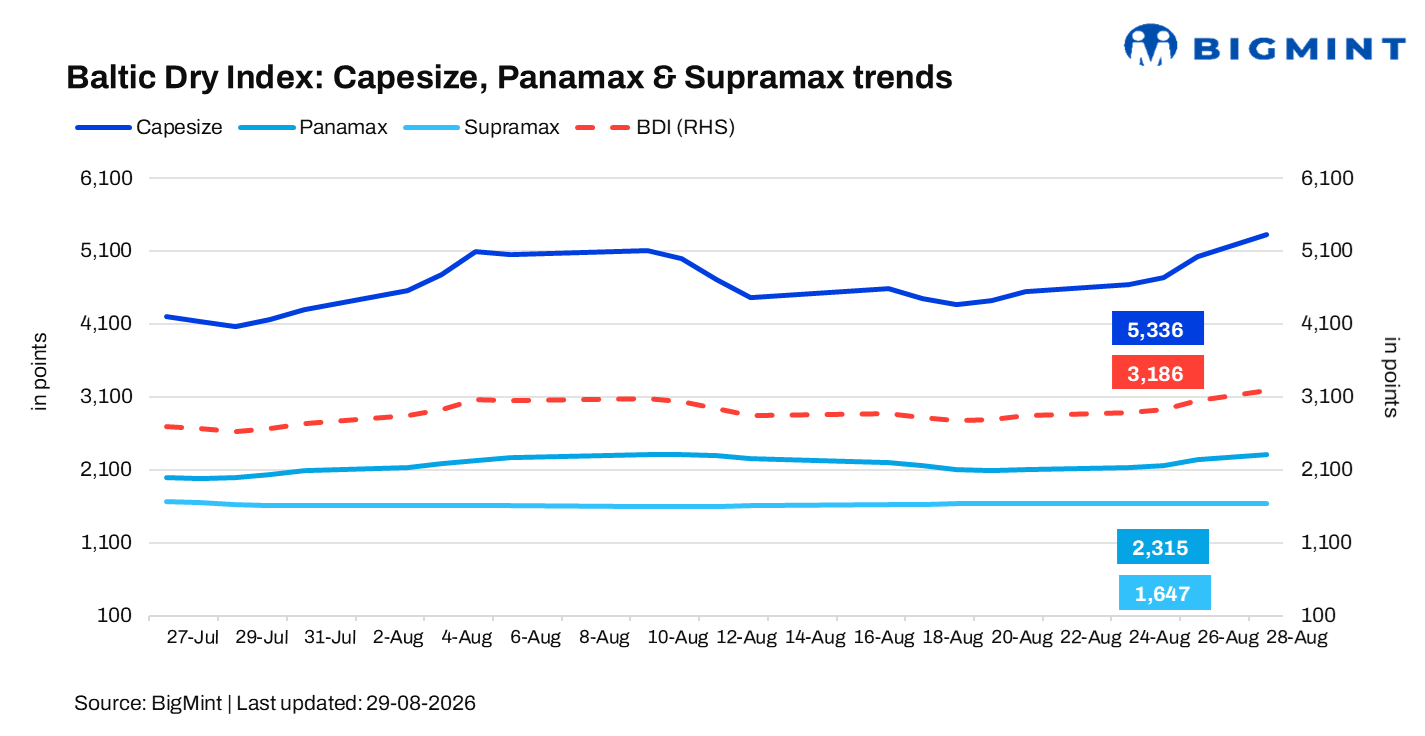
- Capesize leads broad-based gains as freight momentum strengthens
- Panamax continues recovery, while Supramax remains largely stable
The Baltic Dry Index (BDI) strengthened further on 28 August, rising by 130 points (4.3%) to 3,186, from 3,056 on 26 August. The index reached its highest level since 2 June, signalling a significant improvement in dry bulk freight sentiment.
The advance in the latest session remained Capesize-led, although gains were recorded across all three major vessel segments. Stronger Capesize freight sentiment, continued improvement in Panamax activity, and weather-related disruptions across parts of China supported the broader market.
Typhoon-related disruptions have affected coastal and port operations, with Typhoon Saudel making landfall in eastern China on 28 August, while the earlier Typhoon Narra brought severe flooding and disruption across southern China.
Segment-wise performance
- Baltic Capesize Index (BCI): The index climbed by 303 points (6.02%) to 5,336, from 5,033 on 26 August, marking the strongest gain among the major segments. The sharp improvement continues to underpin the overall BDI rally, with firmer freight sentiment in the larger vessel segment providing the main support to the market.
- Baltic Panamax Index (BPI): The index increased by 69 points (3.07%) to 2,315, from 2,246, extending its recovery. The continued improvement suggests that the recovery is gradually broadening beyond Capesize, although momentum remains considerably stronger in the larger vessel segment.
- Baltic Supramax Index (BSI): The index edged up by just 3 points (0.18%) to 1,647, from 1,644, remaining broadly stable. The limited movement indicates that smaller vessel markets continue to lag the stronger momentum seen in Capesize and Panamax. Supramax, therefore, continues to show signs of a more balanced dry bulk recovery.
Outlook
The near-term outlook for BDI remains firm, supported by sustained Capesize momentum and improving Panamax rates. The BDI’s move to 3,186, its highest level since early June, together with the seventh consecutive d-o-d gain, indicates that the current rally has developed beyond a short-lived rebound.
Weather disruptions across China could continue to provide temporary support by affecting vessel movements and port operations. However, the sustainability of the rally will increasingly depend on underlying cargo demand, iron ore and coal flows, vessel availability and chartering activity rather than weather-related factors alone.
Leave a Reply