- Russian supply disruptions support CIS billet prices
- Middle East markets remain mixed amid weak demand
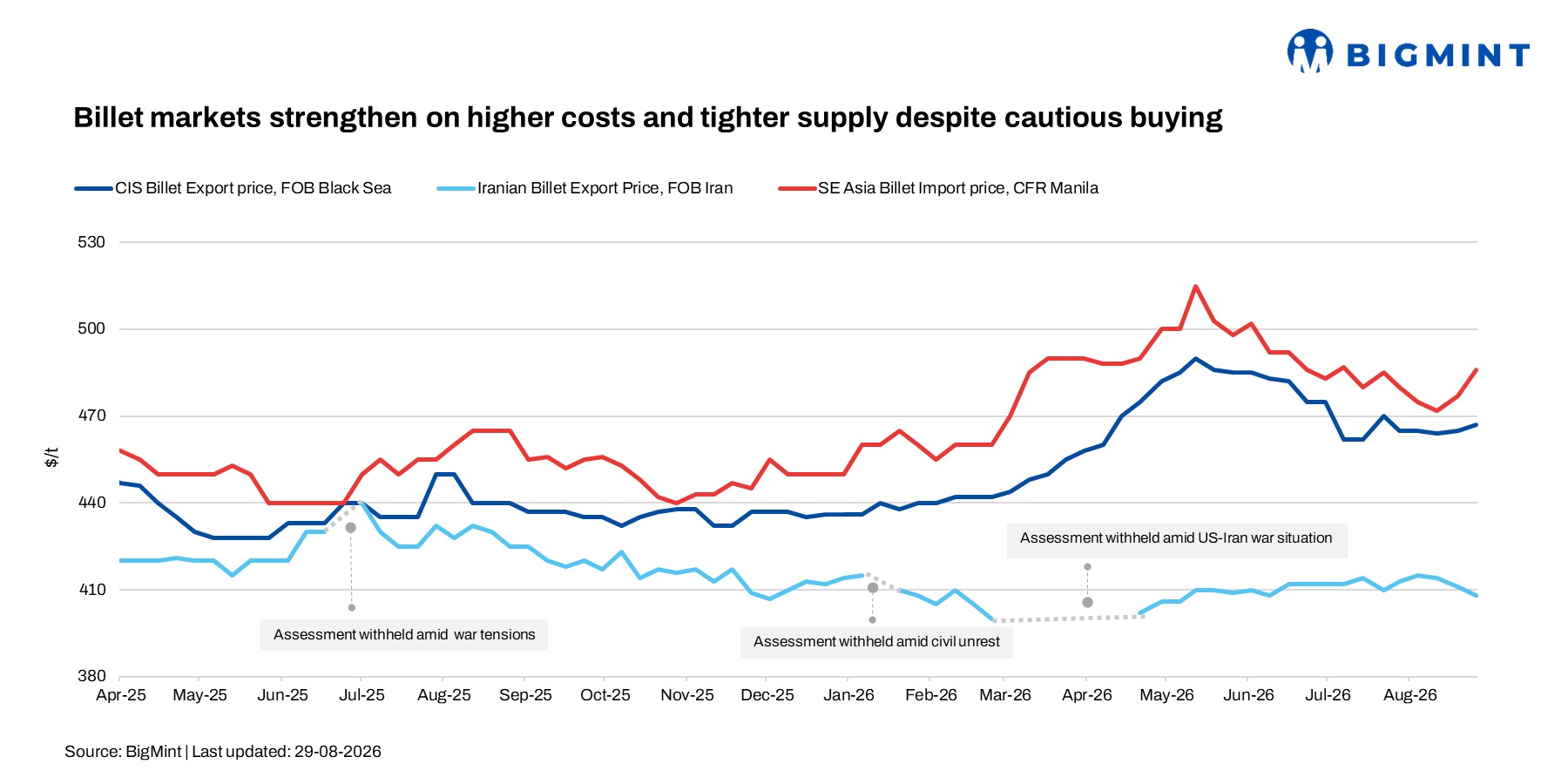
Global billet markets showed a mixed trend during the week ended 29 August, supported by higher raw-material costs, tighter spot availability and expectations of stronger seasonal demand. Asian markets strengthened on rising offers, while CIS prices gained support from disruptions to Russian supply and tighter availability in Turkiye. Middle East markets remained mixed, with Saudi Arabia advancing domestic billet capacity, while weak demand and logistical uncertainties kept Iran and the UAE cautious.
In Turkiye, imported deep-sea scrap prices remained broadly stable w-o-w, with limited fresh bookings keeping HMS 80:20 around $375/t CFR. Firmer billet and rebar prices provided underlying support, although weak finished-steel demand and cautious mill buying limited upside, while Turkish buyers also turned to Malaysian billet as higher Black Sea freight costs reduced the competitiveness of Russian material.
Turkish rebar export offers rose to around $590-600/t FOB during the second half of the week as mills sought to offset higher raw-material costs. However, subdued downstream demand limited their ability to fully pass on the increases.
Asia billet market
Asian billet markets turned firmer during the week ended, supported by rising offers and bullish sentiment, although underlying demand remained weak. In China, billet prices at a leading Tangshan mill rose to RMB 3,000/t ($446/t), up RMB 40/t ($6/t) w-o-w. SHFE October rebar futures increased RMB 49/t ($7/t) to RMB 3,088/t ($459/t). Falling inventories, firmer raw-material costs and expectations of stronger September demand supported sentiment, despite daily rebar sales remaining around 90,000 t. Chinese billet export offers rose $8/t w-o-w to around $460/t FOB.
In Southeast Asia, billet prices moved higher following a reported 40,000-45,000 t trade of Chinese 5SP billet at $484-488/t CFR Philippines. Offers subsequently increased to $492-495/t CFR Southeast Asia, while a major Indonesian blast furnace-based producer raised its November billet offer by $5/t to $475/t FOB. Chinese 3SP billet offers were around $455/t FOB, while major mills were offering base-grade material at $460-470/t FOB China. The CFR Manila assessment rose $5-10/t to $485-486/t, while Indonesia widened upward to $475-490/t CFR.
Despite firmer offers, buying interest remained limited, with some buyers unwilling to chase the sharp price increases and maintaining bids around $470/t CFR Southeast Asia or below. In Manila, 5SP 130 mm billet was offered at around $490/t CFR. Seaborne rebar markets were also largely range-bound, with Chinese offers at around $500-502/t CFR Singapore and $505-510/t CFR Hong Kong.
Overall, sentiment strengthened on tight spot availability, higher producer offers and market optimism. However, weak construction demand, cautious buying and stabilising coking coal prices continued to limit the sustainability of the recent price gains.
CIS billet market
CIS billet market sentiment remained firm during the week, with Russian export activity constrained by heightened security risks in the Black Sea. Recent drone and missile attacks on vessels and port infrastructure disrupted shipments and pushed up freight and insurance costs. Russian suppliers were heard exploring alternative routes, including the Baltic Sea, although limited suitable loading infrastructure and higher logistics costs remain key challenges.
Black Sea billet offers to Turkiye were reported at $508-515/t CFR, equivalent to $465-480/t FOB, while offers to Egypt were around $520-530/t CFR. Turkish bids were heard at $480-490/t CFR, but no fresh deals were confirmed. The BigMint CIS billet export assessment remained unchanged at $467/t FOB Black Sea.
Turkiye’s domestic billet market strengthened as the absence of Russian and Iranian suppliers tightened availability. Kardemir sold around 120,000 t almost immediately after raising its offers to $535-540/t exw for S235JR billet and $545-550/t exw for B420, up by $10-15/t from its previous sale. Other domestic producers increased offers to $540-555/t exw from $535-545/t previously, supported by firmer rebar prices and limited availability.
With key suppliers absent, Turkish buyers continued to explore alternative origins. Indian billet was reportedly sold at $495-500/t CFR, while another 50,000 t Indian cargo was heard at around $492-494/t CFR Iskenderun. Overall, tight domestic supply and restricted Russian and Iranian availability supported the market, while weak downstream demand and elevated logistics costs limited the scope for further price gains.
Middle East billet market
Middle East billet markets showed mixed sentiment during the week, with Saudi Arabia advancing its domestic steelmaking capacity while trading activity remained subdued in Iran and cautious in the UAE.
In Saudi Arabia, Al Yamamah Steel secured SAR 500 million ($133 million) in Islamic financing from Arab National Bank to develop a new billet plant. The project, backed by a SAR 270 million ($72 million) contract with Danieli, will include a 1 mnt/year melt shop integrated with the company’s existing rolling mill and is expected to contribute financially from H2 2028. The investment will strengthen domestic semis supply and reduce reliance on imports.
Iran’s billet market remained subdued, with export prices easing slightly to $408-410/t FOB amid weak demand and shipping constraints. Domestic activity was firmer, with all 61,225 t of billet offered on the Iranian Mercantile Exchange sold, compared with a 73% sales ratio the previous week. A temporary navigation corridor agreed between Iran and Oman through the Strait of Hormuz offered some logistical relief, although commercial shipping remained restricted amid ongoing security concerns.
In the UAE, billet import prices edged higher at the top end, with GCC-origin material quoted at $640-650/t CPT Jebel Ali, while workable buyer levels were around $610-625/t CPT. Overall, cautious buying, elevated seller expectations and persistent logistics and geopolitical uncertainties kept regional billet trade subdued.

Leave a Reply