- Concentrate imports up 48% y-o-y, while blister and anode imports decline
- China and Malaysia emerge as new suppliers, Japan retains largest share
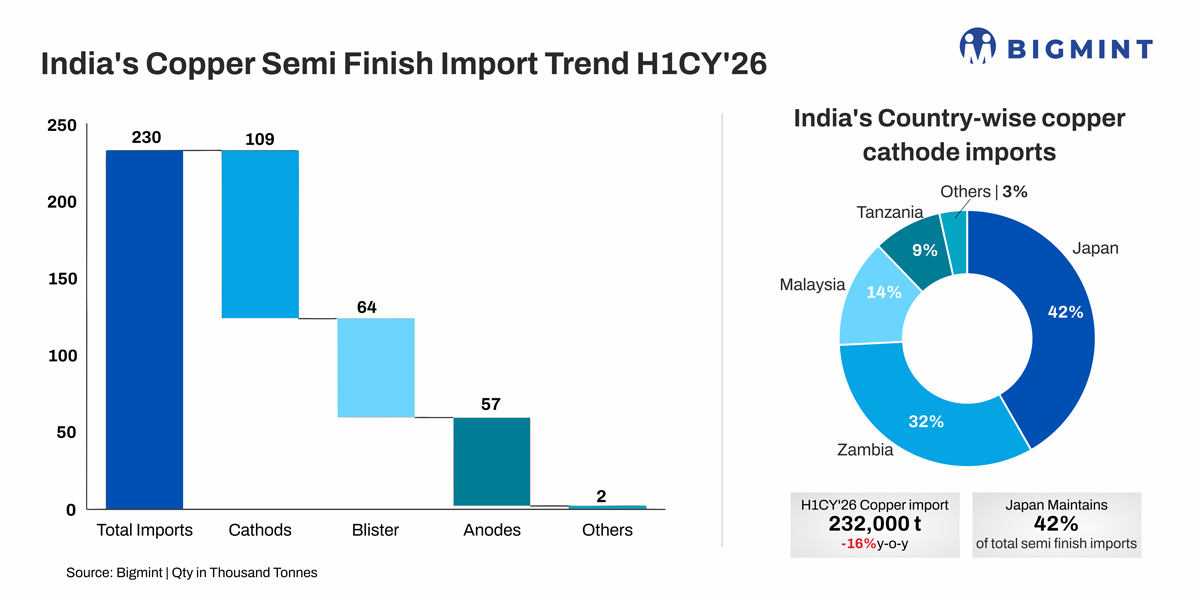
India’s copper market saw a notable shift in trade and supply patterns during January-June 2026 (H1CY26). Cathode imports remained broadly stable at around 108,600 t, compared with 107,200 t in H1CY25, despite higher domestic production.
Meanwhile, copper concentrate imports rose around 48% y-o-y, while blister and anode imports declined, indicating a shift towards importing copper at the concentrate stage and processing more material domestically.
Domestic copper production rises 11.6% in H1CY26
India imported 232,349 t of semi-finished copper during H1CY26, down 16% y-o-y from 276,757 t in H1CY25. In contrast, domestic semi-finished copper production rose 11.6% to 352,000 t from 315,300 t.
The increase in domestic output was mainly driven by Kutch Copper Ltd. (KCL), whose production rose to 78,000 t in H1CY26 from 12,300 t a year earlier. The 65,700 t increase more than offset a combined 29,000 t decline at Hindalco and Sesa Sterlite.
Hindalco’s output fell to 193,000 t from 215,000 t, while Sesa Sterlite’s production declined to 81,000 t from 88,000 t. KCL therefore accounted for most of the incremental domestic supply during the period.
Adani’s Kutch Copper is ramping up its new copper complex at Mundra, which is planned for phased capacity of around 500,000 t/year. The company also received London Metal Exchange registration for its Grade-A copper cathode brand in July, supporting its participation in international markets.

Concentrate imports rise as domestic smelters ramp up
India’s copper concentrate imports increased by around 48% y-o-y in H1CY26, highlighting a shift in the country’s copper raw-material sourcing.
With smelting capacity expanding, particularly at Adani’s Kutch Copper and Hindalco, domestic producers are increasingly sourcing concentrate directly for processing in India. This allows a larger part of the smelting and refining process to be carried out domestically, reducing the need for imported intermediate materials such as blister and anode.
The trend also indicates that the rise in domestic copper production is being supported increasingly by imported concentrate rather than imported semi-processed copper.
Cathode imports remain resilient
Cathode imports remained broadly stable at around 108,600 t in H1CY26, compared with 107,200 t in H1CY25. The stability suggests that rising domestic production has not yet been sufficient to fully meet India’s refined copper requirements.
India’s copper consumption reached around 1.88 mnt in FY25, up 9.3% y-o-y, supported by infrastructure, construction, renewable energy, power and consumer industries.
Therefore, the fall in overall imports does not necessarily indicate weaker copper consumption. Instead, it reflects a combination of higher domestic production, changing raw-material sourcing and more cautious procurement at elevated copper prices.
LME copper reached around $14,527/t in January 2026, increasing working-capital requirements for buyers and encouraging more disciplined inventory management.
Major consumers reduce imports
BigMint data show substantial declines in shipments recorded against several major Indian consumers.
Vedanta’s mapped imports fell to 28,580 t in H1CY26 from 126,077 t a year earlier. Hindalco’s imports declined to 11,574 t from 82,516 t, while imports mapped to other major players fell to 4,477 t from 41,937 t.
Market conditions favoured lower spot buying as high copper prices increased financing and inventory costs. Buyers increasingly relied on contracted supplies and domestic availability rather than aggressive spot purchases.
Hindalco’s copper metal sales also fell 16% y-o-y to 105 kt in Q1 FY27, although the company reported record copper EBITDA. Planned major smelter maintenance during the quarter also affected volumes.
US tariff uncertainty reshapes global copper flows
US tariff uncertainty remained an important factor influencing global copper trade during H1CY26.
The US was already operating with a 50% tariff on specified semi-finished copper products, while copper cathodes, anodes, concentrates and scrap were excluded.
Market attention subsequently shifted towards the possibility of additional tariffs on refined copper. The uncertainty encouraged traders to move material towards the US, where copper prices and premiums offered stronger returns.
US refined copper imports had already doubled in Q1CY26, tightening availability in other regional markets and contributing to differences between US and global copper prices.
For Indian buyers, this increased competition for merchant copper, particularly when international premiums became more attractive in other markets.
China emerges as new supplier
China emerged as a notable supplier of copper cathodes to India during H1CY26. Chinese shipments rose to around 12,647 t, compared with just 72 t in H1CY25, with most volumes arriving during February and March.
India’s cathode imports doubled m-o-m to around 17,200 t in February, from 8,600 t in January. In the same period, Chinese shipments increased sharply to around 8,000 t in February from about 300 t in January.
The increase was supported by competitive Chinese offers amid strong domestic refined copper availability.
China’s refined copper output at 60 major smelters increased 6.85% y-o-y during January-April 2026, while demand rose only 0.23%. The faster increase in production improved metal availability for exports.
China’s refined copper output subsequently reached a record 7.61 mnt in H1CY26, up 5.2% y-o-y, despite severe concentrate shortages. Smelters increasingly relied on scrap and blister to maintain production as treatment charges weakened sharply.
Malaysia also gained importance as a supplier, rising to become the third largest cathode supplier for India while Japan retained the largest share of India’s cathode imports.
Outlook
India’s copper market is undergoing a structural change as domestic smelting capacity expands. Concentrate imports are rising as producers increasingly process raw material within India, while imports of blister and anode are declining.
At the finished-product level, however, cathode imports remain relatively stable as domestic refined copper production has yet to fully meet growing consumption.
With Kutch Copper continuing to ramp up, India’s dependence on imported intermediate copper products could decline further. However, the country is likely to remain heavily dependent on imported concentrate to feed its expanding domestic smelting capacity.
Strong demand from power, infrastructure, renewable energy and electrification should continue to support copper consumption, while high prices and volatile global trade flows are likely to keep buyers cautious on inventory.
Leave a Reply