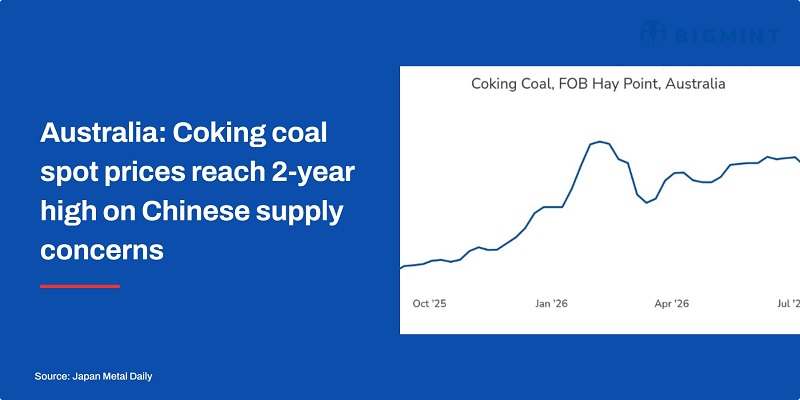
- Prices rise 20% in 1 month on supply concerns post multiple mine accidents in China
- Mongolian, Russian supply disruptions lift demand for Australian material
Spot prices of Australian premium hard coking coal have surged to their highest level in around two years, with benchmark Grade 1 hard coking coal exceeding $260/t FOB this week, up approximately 20% over the past month. Renewed supply concerns in China, weaker Mongolian inflows, and disruptions to Russian exports have increased buying interest in Australian material, raising procurement costs for blast furnace operators.
Supply concerns in China have intensified following another coal mine accident this month. An explosion at a coal mine in Shanxi Province in May had already disrupted market sentiment and raised concerns over domestic supply. Although these concerns eased temporarily, a subsequent accident at a coal mine in Hunan Province has renewed uncertainty over availability.
Mongolian coal imports, an important source of coking coal for China, have also slowed, adding to procurement difficulties. Market participants indicated that shrinking fuel supplies affecting mining operations have constrained Mongolian supply.
Multiple supply constraints support Australian prices
Supply disruptions have extended beyond China and Mongolia. Russian coking coal exports through the Black Sea have been affected by the prolonged Russia-Ukraine conflict, particularly for pulverised coal injection coal and other coking coal grades.
The combination of supply constraints has increased enquiries for Australian cargoes, supporting a sharp rise in spot prices.
Australian Grade 1 hard coking coal serves as an important reference for quarterly contract negotiations with Japanese steelmakers. The benchmark price for April-June loading stood at $232/t FOB.
The benchmark for July-September loading has yet to be finalised and is expected to be settled by the end of August. Despite the recent spot market rally, the immediate impact on the upcoming quarterly benchmark is expected to be limited, with any increase potentially restricted to a few percentage points.
Steelmakers monitor Oct-Dec contract costs
The stronger spot market could have a greater impact on the October-December loading period if prices remain above current levels through September. In that scenario, quarterly contract prices may rise more sharply, increasing raw material costs for blast furnace-based steel producers.
Note: This article has been published in accordance with a content exchange agreement between Japan Metal Daily and BigMint.
Leave a Reply