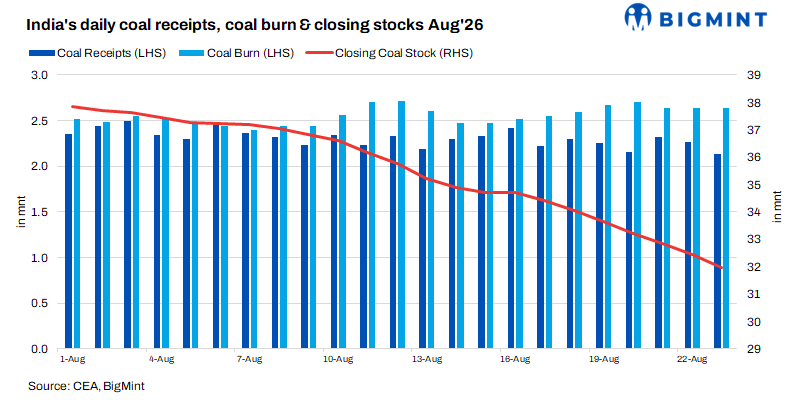
- Power plants burn 6.53 mnt more coal than received during 1-23 August
- Closing inventories fall below 32 mnt as supply stress intensifies across key states
India’s thermal power plants drew down coal inventories sharply during the first 23 days of August as coal consumption continued to outpace supplies. Central Electricity Authority (CEA) data show monitored power plants received around 52.93 million tonnes (mnt) of coal during 1-23 August while consuming approximately 59.46 mnt, leaving a cumulative receipts-versus-consumption deficit of around 6.53 mnt. Receipts covered only 89% of coal burn during the period.
The supply imbalance accelerated an inventory draw that had already begun in July. Coal stocks at monitored thermal power plants declined from 37.83 mnt on 1 August to 31.95 mnt by 23 August, a reduction of 5.88 mnt, or 15.5%, in just 22 days. On 23 August alone, receipts stood at 2.13 mnt against consumption of 2.63 mnt, leaving a daily deficit of approximately 0.5 mnt. Total inventories were equivalent to only 52% of normative requirements, while 38 plants were classified as having critical stock.

Daily supply deficit widens through August
The imbalance between coal receipts and consumption widened steadily during the month. During 1-10 August, average daily receipts stood at approximately 2.36 mnt, against average consumption of around 2.48 mnt, resulting in a daily deficit of about 0.12 mnt.
During 11-23 August, average daily receipts declined to around 2.26 mnt, while average coal burn increased to approximately 2.61 mnt/day. The average daily deficit consequently widened to roughly 0.36 mnt, three times higher than during the first ten days of the month, accelerating inventory depletion.
The decline follows a similar trend in July. CEA data showed power plant inventories falling from around 44.11 mnt at the beginning of July to approximately 38 mnt by month-end, leaving the sector with lower opening inventories entering August.
Inventory pressure concentrates across key states
Several power plants across Rajasthan, Maharashtra and southern India reported inventories well below normative levels, although the underlying supply constraints differed across regions.
In Rajasthan, Chhabra-II held only 25% of normative stock by 23 August, while Chhabra-I Phase 1 stood at 30%, Phase 2 at 26%, Kalisindh at 23%, Kota at 26%, Suratgarh STPS at 30% and Suratgarh TPS at 31%. CEA directed Chhabra-II and Kalisindh to augment supplies from their captive mines.
The deterioration was significant compared with end-July, when Chhabra-II held around 124,000 tonnes, Kalisindh approximately 141,000 tonnes, Suratgarh STPS around 100,000 tonnes and Suratgarh TPS roughly 124,000 tonnes. High plant load factors during August continued to outpace replenishment.
In Maharashtra, Koradi held only 18% of normative stock by 23 August, while Khaparkheda stood at 27% and Parli at 28%. CEA directed generation-company rakes to be diverted to Koradi and asked the plant to improve unloading performance. Maharashtra’s state utility plants were collectively holding only around 41% of normative inventories.
In southern India, Dr N Tata Rao TPS held 20% of normative stock, Rayalaseema 15% and Damodaram Sanjeevaiah only 8%. CEA directed Eastern Coalfields Limited, Mahanadi Coalfields Limited and the Railways to ensure supplies under the subgroup plan. Bellary TPS in Karnataka stood at 24%, with Singareni Collieries Company Limited asked to augment supplies while the plant increased coal from captive sources.
The region had already entered August with comparatively weaker inventories. CEA’s July cumulative report showed southern power plants holding around 10.5 days of coal compared with more than 17 days in the eastern region.
Supply constraints extend beyond coal availability
Plant-level directions issued by CEA indicate that inventory pressure reflected more than elevated coal consumption. Some stations were directed to increase production from captive mines, while others required additional supplies from Coal India subsidiaries. Several plants were also instructed to improve rail logistics, increase rake availability or reduce unloading times.
Adani Power’s Tiroda plant, for example, held only 22% of normative stock, with the Railways asked to prioritise rakes while the plant reduced unloading time. Amravati stood at 14%, with South Eastern Coalfields Limited (SECL) and the Railways directed to ensure supplies.
Vizag TPP held only 11% of normative stock, with Mahanadi Coalfields Limited asked to improve deliveries, while Vedanta’s plant stood at 21%. Among NTPC-linked stations, North Karanpura held 26%, Nabinagar STPP 29% and Patratu 19%, with Central Coalfields Limited instructed to ensure coal supplies to Patratu.
Outlook
Thermal power plants consumed approximately 59.46 mnt of coal during 1-23 August, against receipts of only 52.93 mnt, while inventories declined from 37.83 mnt to 31.95 mnt over the same period.
The 6.53 mnt cumulative receipts-versus-consumption deficit exceeds the observed inventory draw of 5.88 mnt, indicating that daily reported stock movements do not fully reconcile with the simple receipts-minus-consumption calculation. The difference may reflect reporting adjustments, changes in the monitored plant universe or other reconciliation factors within the daily CEA dataset. Both measures, however, point to the same underlying trend: coal consumption continued to exceed replenishment throughout the period.
The imbalance also intensified during August. Average daily coal burn increased from around 2.48 mnt during 1-10 August to 2.61 mnt during 11-23 August, while receipts declined from approximately 2.36 mnt to 2.26 mnt. The average daily supply deficit consequently widened from 0.12 mnt to 0.36 mnt.
Plant-level data further show that inventory pressure is becoming increasingly concentrated around specific rail corridors, unloading bottlenecks and plants dependent on individual Coal India subsidiaries or captive-mine production.
Matching daily coal burn would stabilise inventories, but rebuilding stocks will require receipts to exceed consumption for a sustained period. As the final week of August begins, increasing mine-to-plant deliveries remains the immediate operational priority for restoring inventory levels.
Leave a Reply