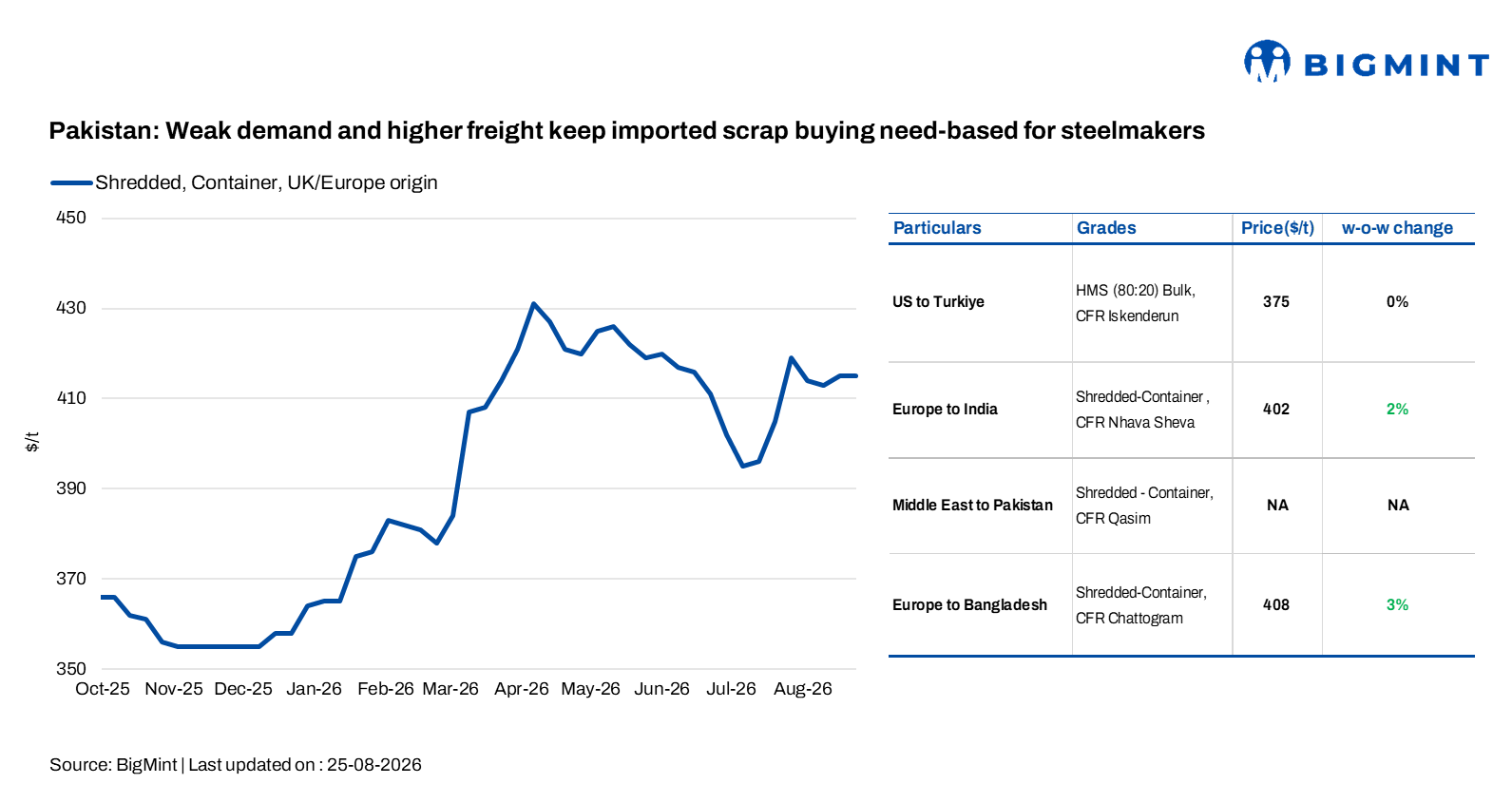
- Monsoon rains slow down construction activity, limit mill operations
- Tax changes improve economics of imported scrap, to support near-term demand
Pakistan’s imported shredded scrap market remained cautious during the week ended 25 August, with mills limiting purchases amid weak downstream steel demand, higher freights, monsoon disruptions, and ongoing adjustments to the revised sales tax mechanism. EU/UK-origin shredded scrap offers were heard at $415-420/t CFR Qasim, while buyers remained focused around $410-412/t CFR, keeping the bid-offer gap relatively narrow.
A 2,000-3,000 t UK-origin shredded scrap cargo was booked at $414-415/t CFR Qasim, confirming workable market levels near the lower end of current supplier offers. Despite the transaction, overall spot liquidity remained thin as mills continued to buy selectively.
BigMint assessed shredded scrap at around $415/t CFR Port Qasim, up by $2/t w-o-w.
Market updates
As per a UK-based trader, freights are expected to increase by around $400-500/container in September, with tighter container availability and some shipping lines reportedly cancelling previously booked slots. Current freights of around $1,450-1,500/20-ft container could rise towards $1,800-1,850/container, adding to replacement costs and supporting seller expectations.
A Peshawar-based mill said that the SRO 1245(I)/2026 notification is creating uncertainty among mills. The FBR has notified 99 registered melters, re-rollers and composite units for sales tax of PKR 5/unit of electricity consumed, with eligibility linked to mills having imported more than 70% of their eligible scrap requirements during the previous 12 months. The list can be revised by FBR (Federal Board of Revenue), while mills facing issues can approach the concerned Commissioner Inland Revenue for review.
Meanwhile, Karachi port congestion and transportation disruptions have complicated scrap deliveries, while higher logistics costs continue to support imported scrap offers despite subdued buying interest.
Domestic market
Domestic scrap demand remained weak as heavy monsoon rains continued to weigh on construction activity and rebar sales. Mill operating rates were around 35%, while steel sales were only 40-45% of normal levels, keeping scrap purchases largely need-based. High inventories also reduced the urgency for fresh September bookings.
Local scrap prices were reported at PKR 145,000-147,000/t ($522-530/t), while billet stood at PKR 216,000-218,000/t ($778-786/t) exw and rebar at PKR 234,000-236,000/t ($843-850/t) exw. Weak finished-steel demand continued to limit mills’ ability to absorb higher scrap costs.

A Karachi-based mill said the mill-side market remains slow, with monsoon conditions continuing to affect construction activity, steel movement and operations. Mills are buying scrap mainly against immediate requirements and avoiding inventory buildup. The source added that mills operating on local scrap cannot compete with those using imported scrap, particularly under the current tax structure. With limited scope to reduce the tax burden through other means, the mill expects imported scrap purchases to increase as producers shift towards imported material to remain competitive.
Outlook
Pakistan’s imported shredded scrap market is likely to remain cautious through the coming week, with weak rebar demand, low mill operating rates, high inventories and continued monsoon-related disruption limiting fresh bookings. However, rising September freights, tighter container availability, and the growing preference for imported scrap under the revised tax mechanism should keep seller offers supported.
Leave a Reply