- Oilmeal exports rise to 373,907 t in May 2026
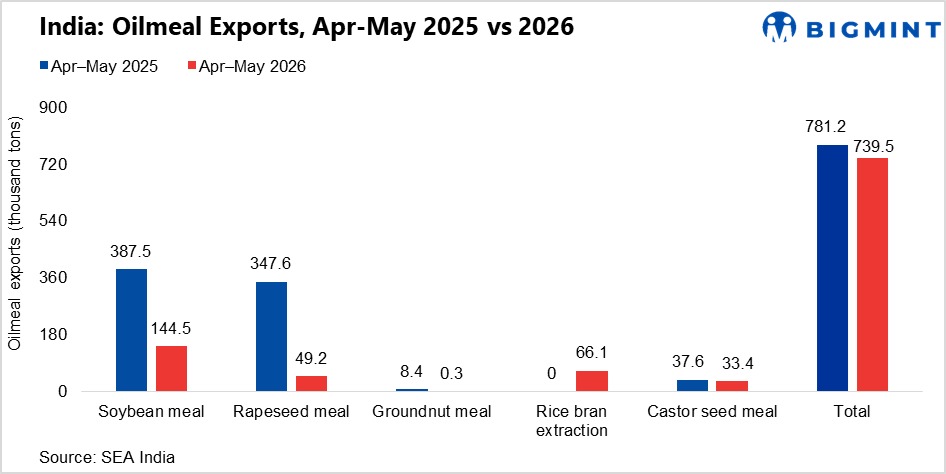
- Apr-May exports fall 5.34% y-o-y to 739,467 t
India’s oilmeal exports recovered in May 2026 after a weak start to the financial year, with shipments rising 19% y-o-y to 373,907 t. However, cumulative exports during April-May remained 5.34% lower at 739,467 tons against 781,189 t a year earlier, as weaker April shipments offset the May recovery.
Rapeseed meal supports May exports
May rapeseed meal exports rose to 247,000 t from 241,000 t a year earlier, while soybean meal shipments increased to 81,629 t from 61,829 t. Rice bran extraction exports stood at 28,100 t and castor seed meal at 17,177 t.
During April-May, exports comprised 495,154 t of rapeseed meal, 144,473 t of soybean meal, 66,104 t of rice bran extraction, 33,418 t of castor seed meal and 318 t of groundnut meal.
April shipments fell 21.53% y-o-y to 365,560 t from 465,863 t, mainly due to disruptions in Red Sea shipping routes and elevated freight costs.
Asian demand supports shipments
Asian markets remained key destinations for Indian oilmeals during April-May, with China emerging as the largest buyer at 276,147 t, up 135.24% from 117,388 t a year earlier.
Shipments to Vietnam more than doubled to 80,231 t from 40,040 t, while Bangladesh imports remained largely stable at 102,100 t against 102,642 t.
Exports to South Korea declined 29.89% to 59,570 t from 84,966 t, while shipments to Thailand fell 44.20% to 32,152 t from 57,616 t.
Strong demand from Asian markets, particularly China, supported Indian rapeseed meal exports, while higher Indian soybean meal prices continued to limit competitiveness against overseas suppliers.
Soybean meal prices remain elevated
Indian soybean meal prices rose to $617/t in July 2026 from $594/t in May and $385/t in July 2025. Rapeseed meal prices increased to $253/t in July from $241/t in May and $196/t a year earlier.
Castor seed meal prices reached $108/t in July from $84/t in May and $88/t in July 2025, while de-oiled rice bran was assessed at $177/t against $172/t in May.
The rupee weakened to INR 95.85/USD in July from INR 95.53/USD in May and INR 86.17/USD a year earlier.
Higher soybean meal prices have reduced India’s competitiveness in global markets. Tight domestic availability has been partly offset by increased availability of distillers dried grains with solubles (DDGS), although rising DDGS prices are adding to feed-cost pressure.
Soybean area edges lower
Soybean planting stood at 121 lakh hectares as of 14 August 2026, marginally below 123 lakh hectares a year earlier. Groundnut acreage increased to 48.03 lakh hectares from 47.01 lakh hectares.
Production and yield prospects for soybean will depend on weather conditions during the coming months, making crop output a key factor for domestic availability and export competitiveness.
Outlook
May’s strong export growth indicates improving demand for Indian oilmeals, particularly rapeseed meal, but cumulative shipments remain below last year’s level. Export performance in the coming months will depend on soybean availability, crop prospects, international meal prices, DDGS costs, freight rates and competition from overseas suppliers.
Leave a Reply