- Australian coal prices climb as Shanxi supply disruptions continue
- Indian mills reluctant to chase rally amid monsoon steel market lull
The global metallurgical coal complex has tightened sharply in the week ended 21 August, with coking coal, metallurgical coke, and pulverised coal injection (PCI) prices all strengthening. The common driver is not a surge in steel production, but tightening raw material availability, led by China.
Safety-related production restrictions in Shanxi, falling inventories and higher Mongolian coal prices have pushed Chinese domestic coking coal sharply higher. That has made seaborne Australian coal more attractive, drawing China back into the import market and tightening availability for other buyers, particularly India.
The resulting cost pressure is now moving through the blast-furnace chain: coking coal prices are rising, coke producers are seeking higher realisations, and PCI is becoming more valuable both because supply is tight and because it can partly substitute coke consumption.

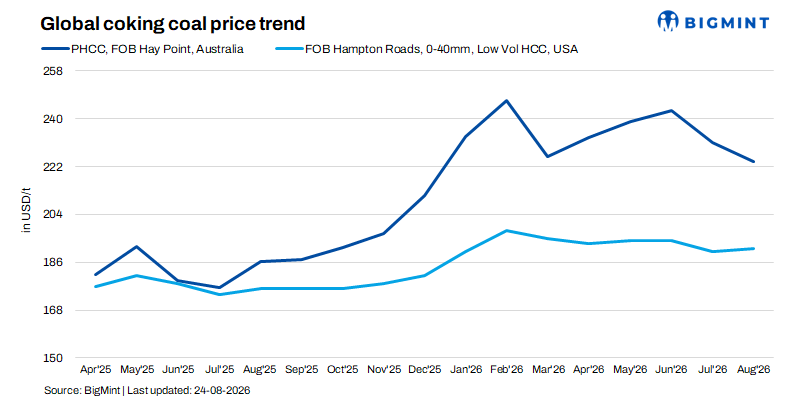
Premium hard coking coal reached $251/t FOB Australia and $270.50/t CFR China on 21 August, with the China-delivered price reaching its highest level since March 2024.
China has become central market catalyst
The current rally is unusual because it is occurring despite relatively weak Chinese steel production. China produced 76.93 mnt of crude steel in July, down 4% y-o-y and the lowest monthly output of 2026, while January-July production fell 3%.
The catalyst instead lies on the supply side. Safety inspections in Shanxi have disrupted coking coal production. More than 130 mnt/year of capacity was reportedly suspended during earlier inspections, with an estimated 50-60 mnt/year still offline. The expected recovery has been slower than anticipated.
Domestic prices have consequently risen sharply. By 19 August, the equivalent price of premium Shanxi coal was around $304/t CFR China, almost $40/t above comparable seaborne material. That differential has turned a Chinese domestic supply problem into a global seaborne demand event.
Mongolian coal has also tightened, further reducing China’s alternative supply options. Chinese traders have therefore competed more aggressively for Australian premium cargoes.
Australia benefits, but also becomes China-dependent
Australia is the principal beneficiary. Premium low-vol hard coking coal rose above $250/t FOB, while lower-quality hard coking coal strengthened even faster. Low-vol HCC jumped from $205.60/t on 19 August to $223.60/t by 21 August.
That widening strength down the quality curve indicates buyers are increasingly searching for substitution options as premium supply tightens. Forward prices also remain supported, with Q4 premium HCC around $253/t and Q1CY’27 around $255/t.
However, Australian prices are increasingly dependent on Chinese buying. If Shanxi production normalises quickly, some of this incremental import demand could disappear.
India remains structurally exposed but price resistant
India presents the opposite dynamic. Its blast-furnace steel sector remains heavily dependent on imported coking coal, but mills have been reluctant to chase the recent Australian rally because domestic steel prices have not risen enough to absorb the higher raw-material cost.
The seasonal monsoon lull has also kept Indian buying subdued. This creates an important near-term risk. If Indian mills return more aggressively during September-October while China remains active, both markets could compete for the same Australian cargoes.
That would tighten the seaborne market further.
But the natural ceiling is steel profitability. Every $10/t increase in coking coal can add roughly $7-9/t to blast-furnace steelmaking costs. Without stronger finished-steel prices, mills will increasingly resist further raw-material increases.
Atlantic supply is tightening indirectly
The Atlantic market is also firming. US East Coast low-vol HCC reached around $200/t FOB by 21 August, with several major suppliers reportedly sold out of prompt material.
The US cannot directly participate in the Chinese market, so the transmission mechanism is indirect: China absorbs Australian coal, leading to less Australian coal being available elsewhere, which could prompt India and other buyers to examine US and Canadian alternatives.
This is increasing India’s importance as a destination for Atlantic metallurgical coal.
Coke producers are trying to pass through higher coal costs
Metallurgical coke is now responding to the coking coal rally. Chinese coke producers have sought price increases of RMB 50-55/t, with some mills accepting the first round while discussions emerged around further increases.
The mechanism is straightforward: higher coking coal costs compress coke margins, forcing producers either to raise prices or reduce output.
India is experiencing the same effect. Blast-furnace grade coke in eastern India recently rose to around INR 35,800/t ex-Jajpur, while Indonesian 65/63 CSR coke was around $313/t CFR India.
Higher imported coke and coal replacement costs are supporting domestic merchant coke producers, although end-users are already showing resistance at current levels.
PCI tightens as substitution value rises
PCI has strengthened more quietly but is increasingly important. Russian mid-tier PCI traded at $174/t CFR India on 20 August and at $180/t CIF India the following day for October delivery. Russian availability has tightened while both Chinese and Indian demand have strengthened.
PCI also benefits from rising coke costs because higher injection rates allow blast furnaces to reduce coke consumption. As coke becomes more expensive, mills have greater incentive to maximise PCI use where technically possible.
This means PCI demand can strengthen precisely when coking coal and coke prices rise.
Outlook
The underlying market is therefore a supply-driven squeeze rather than a conventional steel-demand bull market. Shanxi restrictions have lifted domestic Chinese coal prices, encouraged seaborne buying, tightened Australian availability, strengthened Atlantic alternatives and raised coke and PCI costs.
The near-term outlook remains supportive while Chinese domestic supply remains constrained and India approaches its post-monsoon restocking period. But the rally carries its own limiting mechanism.
If Shanxi mines restart quickly, Chinese seaborne buying could ease. Alternatively, if raw-material costs keep rising without stronger steel prices, blast-furnace margins could deteriorate enough to force production cuts.
For now, metallurgical coal has the strongest momentum, coke is attempting to recover rising feedstock costs, and PCI is benefiting from both tight supply and its substitution value.
The key question is whether steel prices can rise fast enough to absorb the raw-material inflation now moving through the blast-furnace chain.
Leave a Reply