- India’s iron ore imports seen surpassing 80 mnt by 2030
- Steel capacity expansion, rising BF share to drive demand
Mysteel Global: In its latest ‘Economic and Commodity Outlook’ released on August 18, Australian mining giant BHP has painted a resilient picture for the iron ore market through the next decade. Notably, with Chinese steel production plateauing, the company is increasingly looking to India as being the next major driver of seaborne iron ore demand.
From net exporter to major importer: structural shift
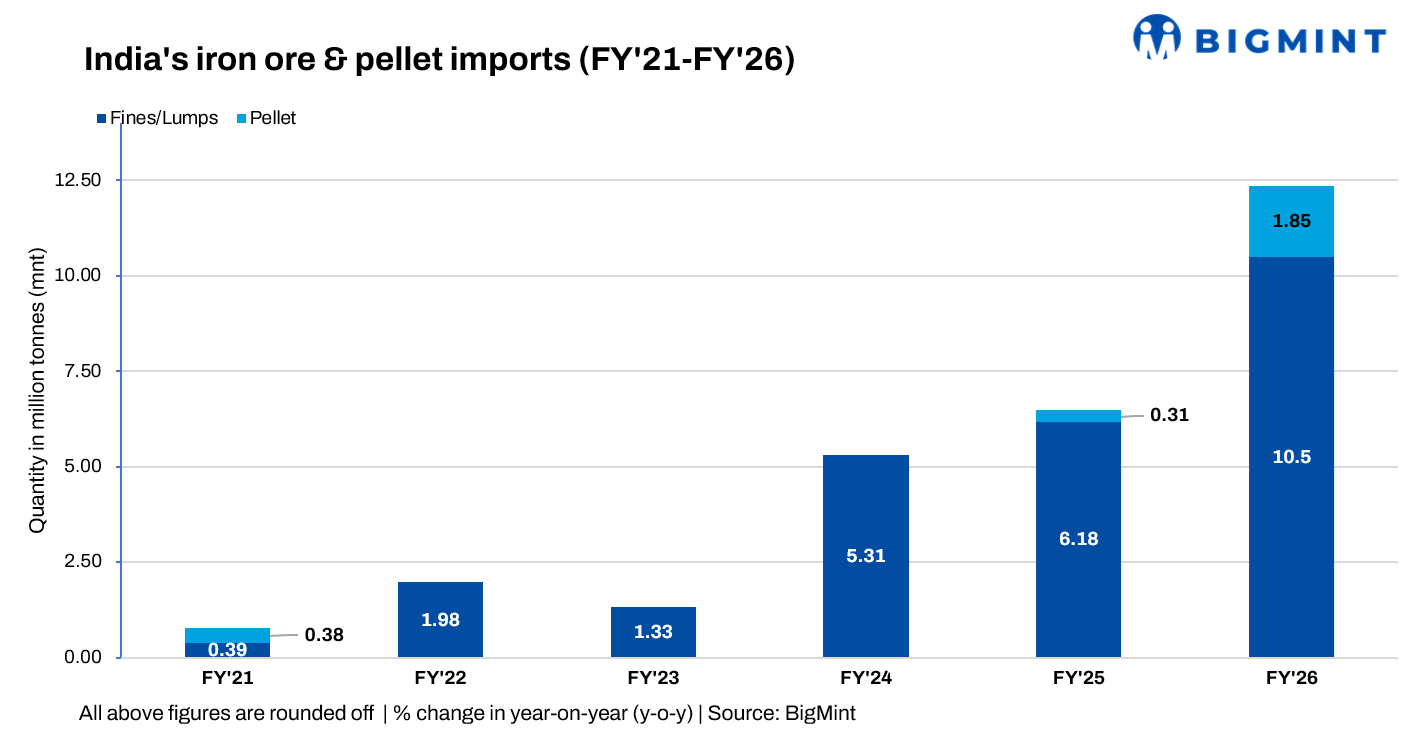
India’s growing influence in the global iron ore market is clearly reflected its dramatic reversal in trade flows. At its peak in 2009, the country exported 98 million tonnes of iron ore while importing less than 1 million tonnes, according to BHP. Today, the picture could hardly be more different. India’s imports skyrocketed to 12 million tonnes in 2025, more than double the previous year’s level, while its exports fell to 27 million tonnes, down 25% on year, data from India’s Ministry of Commerce and Industry show.
The rapid shift from net exporter to major importer indicates that “India is emerging as a strategically significant participant in the seaborne market”, BHP noted. And this, the company believes, is only the beginning. Industry consultants it cites predict that India’s iron ore imports could surpass 80 million tonnes by 2030.
Steel capacity expansion: a multi-decade build-out
Behind India’s surging import demand lies a massive and sustained expansion of domestic steel capacity. The country had already ramped up its steelmaking capacity to approximately 220 million tonnes/year in FY2026, a 10% increase on year, BHP notes.
But this is merely a waypoint. India’s ultimate ambition is a staggering 500 million t/y by 2047 – a roughly 4% compound annual growth rate over the next two decades. Crucially, a significant share of this capacity will be blast furnace-based, the most iron ore-intensive production route, BHP points out. The implication is clear: India’s industrial strategy is set to generate sustained, long-term demand for seaborne iron ore.
Room to grow: the steel stock gap
While China remains at the core of the commodity’s growth outlook, demand is increasing from India and other emerging economies as they build out their industrial capacity, BHP said. For India, the long-term optimism is underpinned by the country’s exceptionally low base for steel stock.
The report notes that developed economies like Japan and Germany have accumulated 11-13 tonnes of steel stock per person, while China has reached around 10 tonnes. India, however, sits at only 2 tonnes per capita.
This huge gap points to decades of infrastructure and industrial development ahead for India, and the country’s physical build-out is already accelerating, it argues. India’s public capital expense has increased more than fourfold over the past decade, and the pace of highway construction has more than doubled. “These will only grow from here,” BHP states, signaling a sustained demand pull for steel and, by extension, iron ore.
Market in transition
Globally, the centre of gravity for iron ore demand growth is gradually shifting. While Chinese steel production is expected to hold steady at around one billion tonnes for the remainder of the decade, India is poised to take on a central role in reshaping the seaborne iron ore market, driven by its ambitions to become a global manufacturing hub. For an industry long reliant on Chinese demand, iron ore demand is expected to remain resilient, with new support emerging from blast furnace capacity growth in other developing economies, led by India, BHP suggests.
India’s demand story, however, is only one side of the equation. BHP’s firm outlook is also reinforced by a strengthening cost-support foundation and mounting supply-side constraints, according to the report. The company estimates that approximately 260 million tonnes/year of seaborne supply now require prices above $80/t CFR to remain economic, up from 180 million tonnes in 2025. Were prices to fall materially below $80/t, BHP notes, the market would need both weaker steel demand and faster low-cost supply growth, a combination it views as “difficult to sustain over time.”
Meanwhile, roughly 250 million tonnes of operating supply will be depleted from the seaborne market over 2026-2035, driven by grade decline and reserve exhaustion, BHP said, quoting Wood Mackenzie estimates.
When combined with India’s rising demand and a higher cost floor, these supply-side constraints point to a market that is likely to become tighter than many expect, Mysteel Global suggests.
Note: This article has been written in accordance with a content exchange agreement between Mysteel Global and BigMint.
Leave a Reply