- Transpacific rates firm on tight capacity
- Asia-Europe and Med rates weaken on softer demand
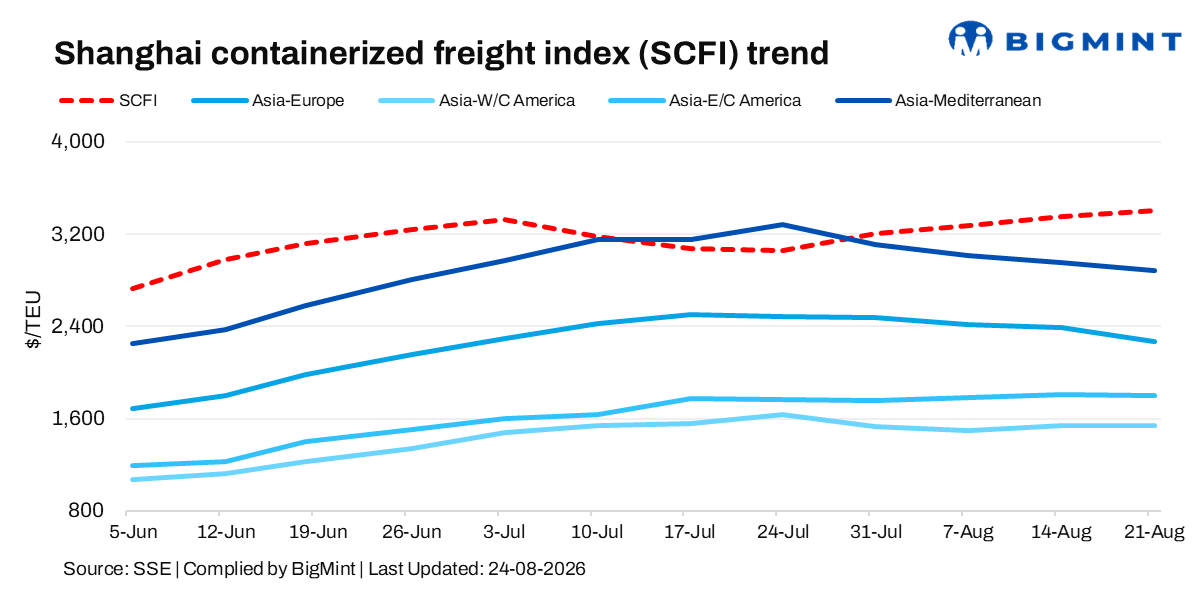
The Shanghai Containerized Freight Index (SCFI) rose 1.62% w-o-w to 3,409.63 on 21 August 2026 from 3,355.24 on 14 August. The increase was supported by the relatively firm transpacific market, even as Europe-bound trades continued to weaken, highlighting a widening divergence across major shipping lanes.
Transpacific markets remain resilient
Asia-US West Coast and East Coast freight rates saw only marginal declines w-o-w, indicating continued stability in US-bound trades despite moderating seasonal demand.
Steady cargo flows and carrier capacity management have helped support the transpacific market, keeping rates near recent levels.
Europe-bound trades weaken
Asia-Europe freight rates recorded the sharpest decline among the major trade lanes, while Asia-Mediterranean rates also fell. The weakness points to softer demand and fading pricing momentum following earlier peak-season gains.
The contrast with the relatively stable transpacific market highlights the increasingly uneven conditions across major container shipping routes.

Capacity management cushions the decline
Carrier capacity discipline remains a key factor limiting the broader correction in freight rates. Blank sailings and service adjustments are helping align available capacity with uneven demand, although support appears stronger on transpacific routes than on Europe-bound services.
Outlook
The divergence across container shipping markets is likely to persist in the near term. Transpacific rates could remain comparatively resilient, supported by steady cargo flows and capacity management, while softer demand and rising capacity may keep Asia-Europe and Asia-Mediterranean rates under pressure in the coming weeks.
Leave a Reply