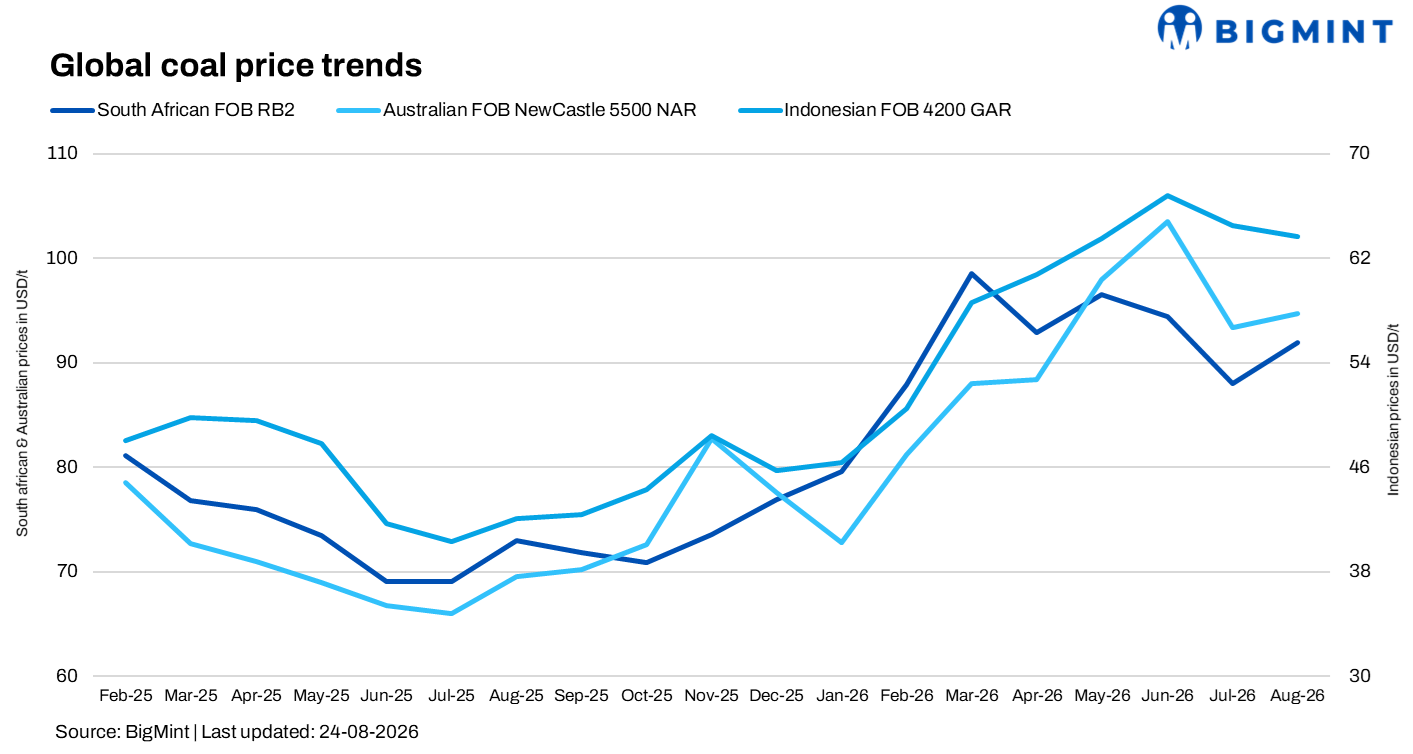
- Indian buyers remain largely absent from the recent rally
- Indonesian export constraints provide the strongest price support
Asian thermal coal prices strengthened further in the week ending 21 August, although the rally is becoming increasingly differentiated by coal grade and consuming market. China continues to provide the principal demand support, while tightening Indonesian availability is helping sellers maintain higher offers even as Indian buyers remain reluctant to chase prices.
Australian high-calorific value coal recovered from its early-August correction, Newcastle 5,500 kcal/kg NAR strengthened, and Indonesian low- and mid-calorific value material remained firm. Chinese domestic coal prices also stayed elevated, although the pace of increase slowed during the latest week.

*Latest Australian 5,500 NAR transaction was for October delivery and is therefore indicative rather than directly comparable with the previous week’s September trade.
The physical data point to a market that has recovered substantially from early August rather than an uninterrupted rally. Australian 6,000 kcal/kg NAR traded at $124.50/t in the week ending 7 August, $125/t the following week and $127.50/t by 21 August.
China continues to set the marginal tone
China remains the most important source of support for the Asian market.
The Qinhuangdao (QHD) 5,500 kcal/kg NAR domestic marker climbed from $121.87/t on 31 July to $127.46/t by 21 August, while 6,000 kcal/kg NAR increased from $135.60/t to $141.56/t.
Tighter domestic mine availability and safety-related production constraints have contributed to higher northern Chinese port prices, encouraging buyers to supplement domestic supplies with imported coal.
This has provided support to both Australian and Indonesian material.
However, there are signs that the upward momentum is moderating. Between 14 and 21 August, QHD 5,500 NAR gained only $0.45/t, while the 5,000 kcal/kg NAR marker eased marginally.
Peak summer power demand is also beginning to ease, while resistance to higher seaborne offers is becoming more apparent.
China therefore continues to provide a firm floor for the Asian market, but its ability to drive another rapid leg higher may be weakening.
Indonesian supply provides stronger fundamental support
While Chinese demand remains important, the more durable source of support currently appears to be Indonesia.
Export availability has tightened amid uncertainty surrounding revised 2026 production quotas. Some producers receiving revised allocations may also have to direct a greater proportion of output towards the domestic market, restricting material available for export.
Physical logistics have compounded the situation.
Low river levels in parts of Kalimantan have affected coal transportation, while forest fires have created additional disruptions. Some producers have reported limited prompt material available for sale, pushing availability towards later September loading windows.
This has allowed Indonesian sellers to maintain firm offers despite uneven regional demand.
The tightness is also not confined to one grade. China remains active in lower-calorific value coal, Vietnam and Bangladesh are supporting mid-CV material, while South Korea and Taiwan have shown interest in higher-CV cargoes.
Indonesia’s own domestic requirements are simultaneously competing with exports.
The result is an increasingly segmented market in which several grades are receiving support from different buyers.
Australian coal benefits from regional displacement
Australian coal is also benefiting from the stronger regional environment.
Japan and South Korea have joined Chinese buyers in seeking Australian cargoes, helping Newcastle 5,500 kcal/kg NAR move towards $98/t by the latest week.
Higher-energy coal has also recovered, with physical 6,000 kcal/kg NAR transactions rising from $124.50/t in early August to $127.50/t by 21 August.
Yet there is an important difference between Australia and Indonesia.
For Indonesia, there is clear evidence of physical supply restrictions. Australia’s recent strength appears more closely associated with stronger regional demand and the tightening elsewhere in the Asian market.
Australian prices could consequently prove more sensitive to any retreat in Chinese buying.
India remains the major missing buyer
India provides the most obvious counterweight to the rally.
Indian demand has remained limited, with buying concentrated largely in selected lower-CV Indonesian coal and prompt short-covering requirements. Forward buyers have generally been reluctant to follow prices higher.
This is important for the broader Asian market.
At present, producers are increasingly dependent on China and Northeast Asian buyers to sustain higher prices. If Chinese demand weakens before Indian post-monsoon restocking develops, upward momentum could fade.
The opposite scenario presents the principal upside risk.
If Indian buying returns materially during September and October while Indonesian supply remains constrained, the market could face simultaneous demand from China, India and Southeast Asia against limited prompt Indonesian availability.
India may therefore determine whether the current rally develops into a broader regional tightening or begins to lose momentum.
Outlook: firm, but resistance is building
Asian thermal coal has clearly moved away from the weaker conditions seen at the end of July. The broader regional rebound in imports had already been led by China, Japan and South Korea, while India remained the notable exception.
However, current conditions are better characterised as firm and supply-supported rather than uniformly bullish.
Indonesian availability provides the strongest fundamental support. Elevated Chinese domestic coal prices continue to encourage seaborne buying, while demand from Japan, South Korea and Southeast Asia is creating competition across different calorific-value segments.
But resistance is beginning to emerge.
Chinese domestic price gains slowed during the latest week, buyers are becoming increasingly reluctant to chase Australian offers, and Indian consumers remain largely absent.
The near-term market is therefore likely to remain supported but volatile rather than extend into an unchecked rally.
The most important upside trigger will be Indian post-monsoon restocking before Indonesian supply normalises.
The principal downside risk is a recovery in Chinese domestic production combined with easing seasonal power demand.
For now, Indonesia is tightening the physical market, China is setting the marginal tone, and India could determine whether the next leg higher materialises.
Leave a Reply