- Better export realisations lead to tight domestic availability
- Higher coking coal and coke costs strengthen cost support
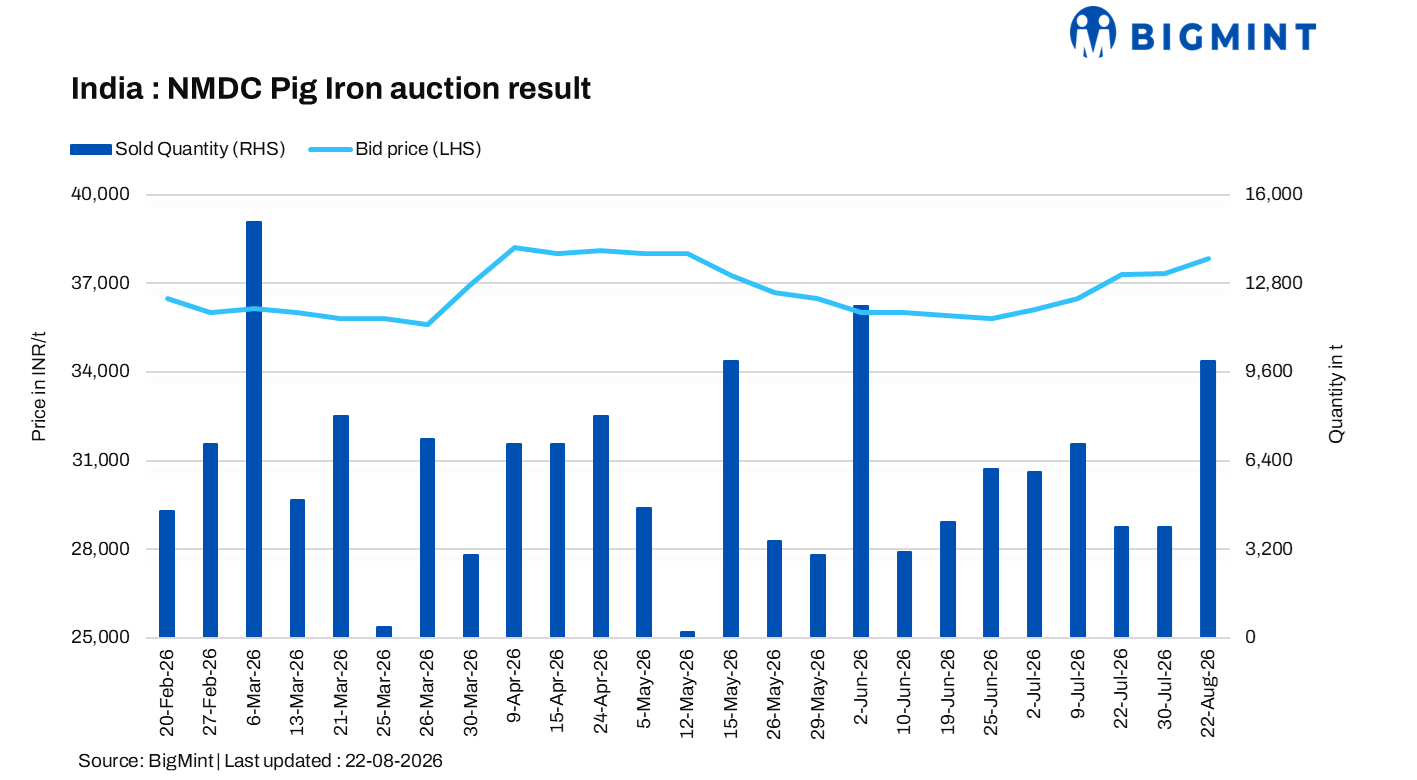
The latest pig iron auction from NMDC Nagarnar on 22 August saw the entire 10,000 tonnes (t) offered booked at an average INR 37,850/t ex-works Nagarnar, up INR 500/t from the previous auction on 30 July. The earlier 4,000 t lot was also fully sold at INR 37,350/t, indicating sustained buying interest despite higher auction realisations.
Export parity limits domestic availability
The auction outcome needs to be viewed against the relative attractiveness of domestic and export realisations. Export-oriented producers are continuing to favour overseas shipments where net realisations are more attractive than domestic sales, encouraging a greater allocation of available pig iron towards exports. This reduces spot availability for domestic buyers and increases competition for material offered locally.
The supply impact is particularly relevant as buyers continue to procure despite elevated prices. With export economics providing an alternative outlet for producers, the opportunity cost of selling domestically has increased. This is allowing sellers to maintain firmer domestic offers even as buyers remain price-sensitive.
Higher coking coal costs add support
Cost pressures are also strengthening the floor for pig iron prices. BigMint’s coking coal index for 0-20 mm premium hard coking coal, CNF Paradip, India, rose by $20/t w-o-w to $265/t. The increase in coking coal costs, alongside firm coke costs, raises the input cost for blast furnace-based pig iron production and limits the scope for producers to reduce offers.
The combination of tighter domestic availability, stronger export economics and higher raw material costs provides a stronger explanation for the INR 500/t increase in the latest NMDC auction. The full booking of the 10,000 t auction lot also indicates that buyers remain willing to absorb higher replacement costs despite elevated prices.
Outlook
The direction of domestic pig iron prices will depend on the relative movement of export and domestic realisations through the coming weeks. If export parity remains attractive, producers may continue allocating a larger share of output overseas, keeping domestic availability constrained. At the same time, higher coking coal costs are likely to provide additional cost support. A weakening of export economics or a material increase in domestic supply would be required to ease the current price pressure.
Leave a Reply