- Indonesia’s quota policy supports market sentiment
- Rising inventories limit further nickel price gains
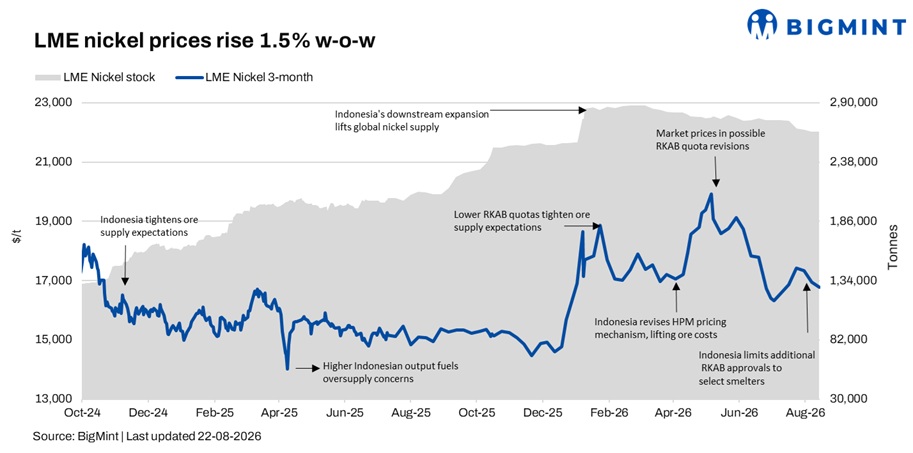
London Metal Exchange (LME) three-month nickel prices increased 1.5% w-o-w to $17,025/t in the week ended 21 August 2026, from $16,785/t a week earlier. The rise was supported by continued uncertainty over Indonesia’s nickel mining quota policy and expectations around future ore availability.
However, the upside remained limited as LME nickel inventories increased around 1% w-o-w to 268,488 t, from 264,732 t previously, indicating that exchange stocks remain elevated. Market sentiment remained mixed, with supply-side developments such as the production quota policy in Indonesia providing intermittent support, while rising inventories and uncertainty over global demand continued to cap gains.
Indonesia plans strategic minerals exchange
Indonesia is preparing to establish a new Strategic Minerals and Commodities Exchange, targeted to begin operations on 1 January 2027, as part of its efforts to strengthen domestic influence over commodity price formation, improve transaction transparency and establish reference prices for key exports.
President Prabowo Subianto, in his 14 August speech to the DPR RI (Dewan Perwakilan Rakyat Republik Indonesia) highlighted Indonesia’s ambition to move from being primarily a commodity producer and exporter toward becoming a price setter for strategic commodities, including nickel, tin, gold, coal, gas, oil and coffee.
The exchange is expected to operate under the supervision of the Financial Services Authority (OJK), with detailed regulations targeted for 17 September, 2026. However, the final product coverage and trading framework remain unclear.
Potential impact on nickel pricing
For nickel, the planned exchange could provide a centralised platform for price discovery, standardised domestic reference prices, and greater transaction transparency. The Indonesian benchmark could potentially complement, rather than immediately replace, international benchmarks such as the LME.
It remains uncertain which nickel products will be included in the exchange. Potential products could include nickel metal, ferro nickel, nickel pig iron (NPI), nickel intermediates and nickel ore.
Benchmark formation remains key
The effectiveness of the proposed exchange will depend on its trading mechanism, benchmark methodology, market liquidity, and participation from miners, smelters, traders and buyers. Its relationship with existing international benchmarks, particularly the LME, will also remain an important factor.
If nickel ore is eventually included, the exchange could gradually shift Indonesian ore pricing from predominantly negotiated transactions toward a benchmark-based system. Such pricing could incorporate factors including nickel grade,HMA (Harga Mineral Acuan) , smelter demand, ore availability, mining costs, freight and production quota (RKAB) availability.
However, in the near term, negotiated prices and existing international benchmarks are likely to remain dominant as regulations, product specifications and participation requirements have yet to be finalised.
Outlook
The planned Indonesian exchange represents a structural development for the nickel market rather than an immediate change in supply-demand fundamentals. Its short-term impact on LME nickel prices is likely to remain limited, while the market continues to focus on Indonesian mining policies, ore availability and global inventories.
In the longer term, successful inclusion of nickel ore or other nickel products could strengthen Indonesia’s influence over regional price discovery and potentially create a new domestic reference alongside established international benchmarks.
Leave a Reply