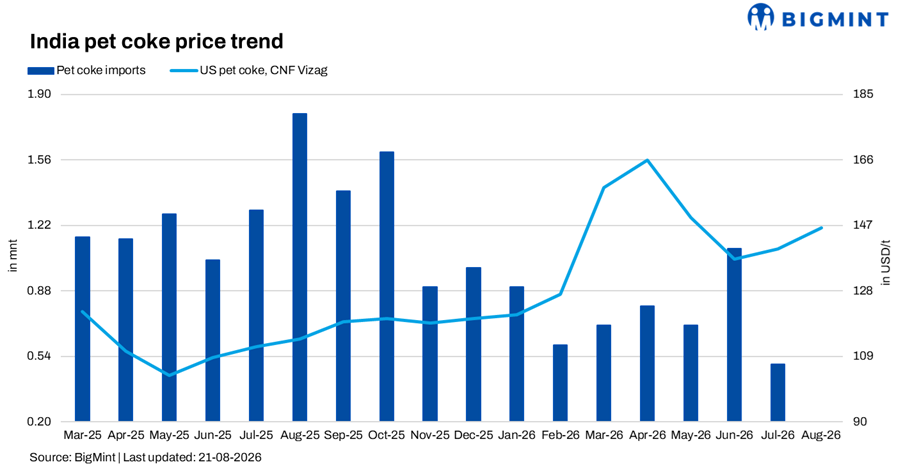
- Imported petcoke offers approach $150/t CFR India
- NAPP scarcity narrows cement industry’s fuel-switching options
India’s cement industry is entering the post-monsoon procurement period with an increasingly difficult fuel equation. Imported petcoke prices have climbed towards $150/t CFR India, while US Northern Appalachian (NAPP) coal — one of the principal high-calorific-value alternatives — is itself tightening as Indian port inventories fall to unusually low levels.
Cement producers have already responded to expensive petcoke by increasing their reliance on domestic and imported coal. But with NAPP stocks now below 0.15 Mnt and replacement costs rising, the economics of that substitution are becoming less compelling.
The result is an increasingly active three-way optimisation between imported petcoke, US NAPP and domestic coal, rather than a straightforward switch from one fuel to another.
Latest India fuel market indications

Cement buyers resist petcoke at $145-150/t
The clearest signal is coming directly from Indian cement consumers.
By 21 August, imported petcoke indications were clustered around $145-150/t CFR India. Individual market indications included around $148/t for Nuvoco, $149/t for JSW Cement and $150/t for Ramco, while an offer was reported at $147/t.
More important than the offers themselves is the response from buyers.
Ramco indicated that while cement volumes were healthy, cement pricing remained difficult and the company was currently relying on domestic coal and US NAPP. MyHome said it was not
using imported petcoke because prices were too high, while JK Lakshmi similarly indicated that it was using domestic coal instead.
The import data show how aggressively cement producers have already responded. Cement-sector petcoke imports fell to just 0.21 Mnt in July, down 82% y-o-y, while January-July imports declined 59% to 2.66 Mnt.
Fuel-grade petcoke imports across all consumers similarly fell 47% y-o-y during January-July.
The message from buyers is therefore clear: at current prices, petcoke is struggling to defend its traditional share of the cement fuel basket.
Petcoke’s energy-cost advantage has eroded
Petcoke remains an attractive kiln fuel because of its high calorific value and low ash. But cement producers ultimately compare fuels on delivered energy cost and operational performance, rather than simply $/t.
That equation has deteriorated.
The 19 August seaborne assessment for 6.5% sulphur USGC petcoke stood at $83.50/t FOB, while CFR India was around $144/t. Physical discussions in India subsequently moved towards $145-150/t CFR. The CFR assessment has risen from a four-week average of $141.63/t.
Domestic petcoke has provided only partial relief. RIL’s basic price increased from INR 17,650/t in July to INR 18,090/t in August, while Nayara moved from INR 17,760/t to INR 18,200/t.
Cement companies have consequently become increasingly flexible — using whichever combination of petcoke, imported coal and domestic coal produces the lowest acceptable kiln-fuel cost.
Indian NAPP retail stocks tell another story
The Indian retail market provides perhaps the strongest evidence that NAPP availability is becoming tighter.
SADA Resources data show NAPP and ILB ground stocks falling dramatically during 2026.

July stocks were consequently 72% below July 2025’s 602,004 t.
The weekly series shows the tightening becoming progressively more acute. Ground stocks declined from 255,653 t in week 27 to 226,030 t in week 28, 193,000 t in week 29 and 168,301 t in week 30.
By 17 August, NAPP stocks at Kandla and Tuna had fallen further to just 147,695 t, comprising 84,205 t at Kandla and 63,490 t at Tuna. Week-33 lifting was only 36,379 t.
BigMint’s market feedback shows the consequences. On 11 August, retail NAPP was indicated at INR 12,000-14,000/t, with stocks around 156,000 t and monsoon-affected dispatches of approximately 3,600 t/day.
By 18 August, indications had moved markedly higher. Market feedback placed US thermal coal around INR 14,600-14,850/t, with participants describing inventories as historically low. Spot buying was emerging despite generally subdued demand, partly because expensive and constrained petcoke was pushing some consumers towards NAPP.
Actual transactions provide some nuance. On 19 August, a 3,000 t parcel was reported purchased at INR 14,200-14,300/t, while replacement or future cargoes were being indicated substantially higher at INR 14,700-14,800/t. Daily lifting had slowed to only 2,000-3,000 t/day because of the monsoon.
This is perhaps the clearest signal in the current market: demand is not exceptionally strong, yet NAPP prices are rising. Scarcity, rather than consumption growth, is driving the market.
Replacement NAPP is no longer cheap
The international market explains the rise in Indian retail replacement values.
Latest NAPP offers were around $91-92/t FOB, while USEC-India Panamax freight was around $49-50/t. That places simple replacement economics at approximately $140-142/t CFR India, before other commercial and inland costs.
This matters because NAPP had provided cement companies with an effective escape route when petcoke prices became unattractive.
At petcoke offers of $145-150/t CFR and NAPP replacement approaching $140-142/t CFR, that gap has narrowed substantially. Once calorific value, ash, sulphur, handling and plant-specific kiln economics are considered, neither fuel now presents an obvious universal advantage.
Existing NAPP stocks can still trade below replacement value, but with inventories below 0.15 Mnt, that buffer is rapidly diminishing.
Domestic coal becomes the third leg
Domestic coal is therefore gaining relevance.
For cement plants capable of accommodating its lower calorific value and higher ash, domestic coal can provide protection against expensive imported fuels. Recent buyer feedback indicates that several cement companies are already relying more heavily on domestic coal or blending it with NAPP.
This is not necessarily a permanent structural shift away from petcoke. It is fuel optimisation in response to price.
Petcoke’s superior energy density and low ash mean it retains considerable operational advantages. But those advantages must compensate for its higher delivered cost.
Outlook: fuel switching approaches its limits
The cement industry’s response to expensive petcoke has been remarkably clear: imports have collapsed and coal consumption has increased.
But the alternative fuel market is now tightening.
Petcoke is being offered at $145-150/t CFR India. NAPP replacement values are approaching $140-142/t CFR. Indian NAPP retail stocks have fallen below 0.15 Mnt, and future cargoes are being offered around INR 14,700-14,800/t even while monsoon demand remains subdued.
That creates an important setup for the post-monsoon market.
If cement production and industrial fuel demand strengthen from September while fresh NAPP arrivals remain limited, retail coal prices could rise further. The resulting narrowing of the NAPP-petcoke differential may eventually bring some cement buyers back into the seaborne petcoke market.
Petcoke has not become cheap. What has changed is that the alternatives which allowed cement producers to reject expensive petcoke are themselves becoming scarcer and more expensive.
The next phase of India’s cement fuel market may therefore be determined less by outright demand growth than by which of petcoke, NAPP and domestic coal offers the lowest delivered cost per unit of usable energy.
Leave a Reply