- Middle East tensions lift oil and aluminium cost concerns
- China’s copper cathode imports fell by 16% in July
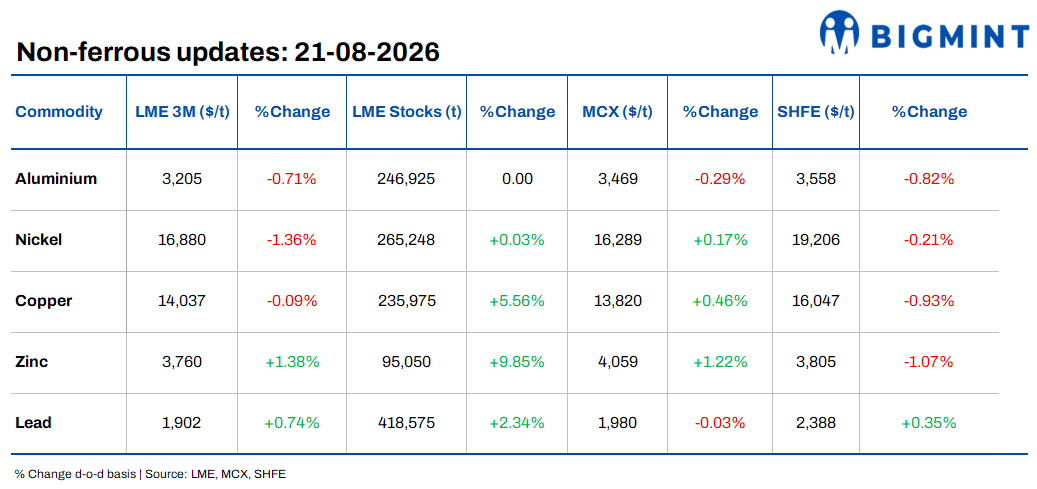
LME base metals traded mixed on 20 August. Zinc recorded the strongest gain, rising 1.38% d-o-d to $3,760/t, while nickel registered the steepest decline, falling 1.36% to $16,880/t. Lead advanced 0.74% to $1,902/t, while aluminium slipped 0.71% to $3,205/t and copper edged lower by 0.09% to $14,037/t. Meanwhile, MCX zinc gained 1.22% to $4,059/t, while SHFE lead rose 0.35% to $2,388/t.
LME inventories recorded mixed trends, with zinc stocks posting the sharpest rise. Zinc inventories climbed 9.85% d-o-d to 95,050 t, followed by copper stocks at 235,975 t, up 5.56%, lead at 418,575 t, up 2.34%, nickel at 265,248 t, up 0.03%, while aluminium stocks were unchanged at 246,925 t.
Domestic market overview
India’s non-ferrous scrap market remained largely stable on 20 August. Aluminium tense scrap remained unchanged at INR 247,000/t ex-Delhi and INR 245,000/t ex-Chennai.
Meanwhile, copper armature scrap (Cu 99%) rose by INR 10,000/t, or 0.8%, to INR 1,300,000/t from INR 1,290,000/t. The move came despite a marginal decline in LME copper prices, indicating firmer domestic scrap values.

Other updates
Middle East conflict pushes oil higher
Brent crude was around $93.25/bbl on August 21, 12:00 AM UTC, while WTI stood at $86.30/bbl, with both benchmarks reaching their highest levels since July 24. Meanwhile, disruption risks around the Strait of Hormuz have raised concerns over supply and shipping flows. Higher energy and freight costs are particularly relevant for aluminium because smelting is electricity-intensive. Consequently, sustained energy inflation could lift production and logistics costs across non-ferrous metals, with aluminium likely to remain most exposed.
China’s copper cathode imports fall sharply
China imported 279,557.9 t of copper cathode in July, down 16.07% month-on-month and 16.44% year-on-year. Imports from the Democratic Republic of Congo fell 32.48% MoM, while shipments from Chile declined 36.34%. Meanwhile, Russian imports rose 48.09% MoM to around 52,923 t. China’s refined copper exports also fell sharply. The weaker import flow points to softer domestic demand, sufficient local availability or inventory adjustments. However, lower exports could reduce copper availability in overseas markets.
India’s private-sector growth improves slightly
India’s HSBC Flash Composite PMI rose to 54.6 in August from 54.3 in July, recovering modestly from a more than four-year low. However, the improvement was driven mainly by services, while manufacturing PMI fell to 52.9 from 53.5, its lowest level since August 2021. Goods output and new orders also recorded their weakest growth in five years. Therefore, the data provides broader economic support, but the weaker manufacturing trend suggests near-term physical demand for aluminium, copper and other non-ferrous metals may remain restrained.
US announces $500 million for critical-mineral projects
The US Department of Energy is providing $500 million in grants to seven companies developing lithium, cobalt, battery recycling and mineral-processing projects. The programme seeks to strengthen domestic supply chains and reduce dependence on China. Major allocations include $100 million each for Lilac Solutions, Jervois and Nth Cycle. However, the projects are focused mainly on critical minerals rather than conventional aluminium or base-metal smelting. As a result, the immediate impact on non-ferrous spot prices is limited, while the longer-term effect could be greater supply-chain diversification.
WBMS reports global aluminium surplus in June
The global primary aluminium market moved into surplus in June 2026, although the broader balance remained tighter than a year earlier. Q1 2025 recorded a 538,700-t surplus, while Q1 2026 swung to a 363,700-t deficit — a 902,400-t deterioration, or 167.5% shift. Production fell 2.57% YoY to 17.5 mnt, while consumption rose 2.52% to 17.9 mnt. Consequently, the June surplus marks a reversal from the Q1 deficit, but the year-on-year balance remains materially tighter.
Leave a Reply