- Portside prices rise despite widening bid-offer gap
- Domestic coal shortages keep imported demand requirement-based
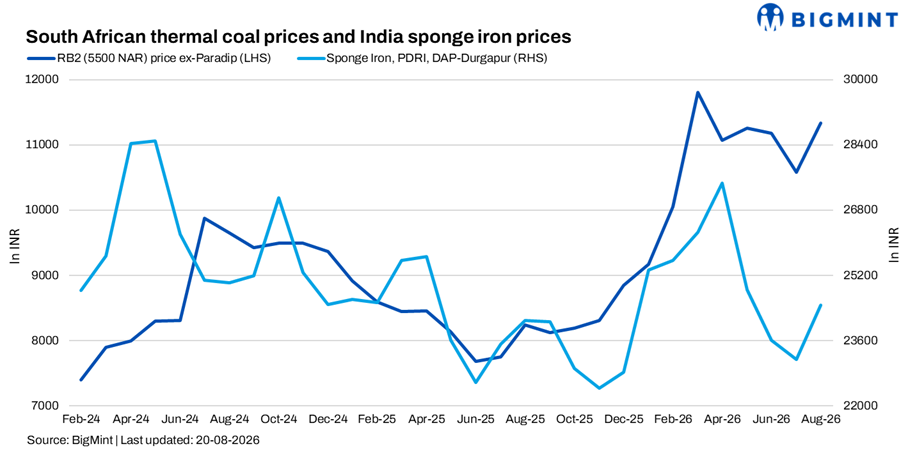
South African thermal coal prices at Indian ports continued to rise on 20 August 2026, supported by higher sponge iron prices, monsoon-related domestic coal shortages, limited availability of preferred grades and firmer international offers. BigMint assessed RB2 (5,500 NAR) ex-Paradip at INR 11,800/t, up INR 350/t w-o-w, while ex-Vizag RB2 increased by the same amount to INR 11,700/t. RB3 (4,800 NAR) ex-Paradip rose INR 400/t w-o-w to INR 9,800/t, while ex-Vizag increased INR 300/t to INR 9,700/t. However, higher FOB offers and freight costs continued to restrict fresh import bookings, with most buyers purchasing only against immediate requirements.
FOB offers firm, but Indian bids remain lower
Offers for South African 5,500 NAR coal for September-October shipment increased to $92-96/t FOB RBCT, up around $2.5/t w-o-w. Trading companies were willing to book cargoes at around $89-90/t FOB, while some Indian importers continued to target $86-87/t FOB.
However, the market also showed that higher buying levels were possible for available cargoes. A 20,000 t RB2 quantity was sold at Vizag at around INR 11,700/t, while a separate Panamax lot of South African mid-CV coal was reported traded at around $91/t FOB for September loading last week. Another seller reported a sale at $95/t FOB, with multiple buyers indicating interest around $94/t.
The different indications reflected a fragmented market rather than a single clearing level. Indian buyers were still hearing bids around $91-92/t FOB-equivalent with CFR levels around $112/t, while suppliers remained firm following higher international offers. The wide bid-offer gap continued to discourage larger-volume procurement.
At Indian ports, RB3 offers at Mangalore were around INR 9,600-9,800/t. RB3 at Krishnapatnam port was around INR 10,200/t, while RB2 at Krishnapatnam port was around INR 12,000/t. RB2 at Ennore was also around INR 12,000/t. A separate RB3 cargo arriving at Dhamra on 20 August was reported sold at around INR 10,000-10,300/t CNF, with the corresponding market indication at around $90-95/t.
Domestic supply constraints support import enquiries
Despite higher import costs, South African coal continued to receive some interest because domestic coal availability remained uneven. Monsoon conditions have slowed Coal India subsidiary dispatches, while auction frequency has also declined. Buyers reported difficulty securing preferred grades, particularly for industrial and steel plant requirements.
Rake availability has remained a problem for the industry for the past 3-4 months, with power plants receiving priority. This has constrained movement of domestic coal to some industrial consumers and kept imported coal relevant despite its higher cost.
Recent SECL auctions also showed firm participation and higher premiums, adding to domestic replacement costs. However, some market participants noted that domestic coal movement to steel plants remained low. Consequently, South African coal demand was still present, but actual transactions remained small and requirement-based.
Several consumers were also reported to be shifting towards Indian coal, including Chandrapur and SCCL G9-G11, or using existing stocks rather than accepting current imported coal prices. Market participants described prevailing imported coal prices as difficult to sustain for large-volume procurement.
Sponge iron rally improves coal buying sentiment
Sponge iron prices strengthened sharply across regions, providing some additional support to imported coal enquiries. PDRI DAP-Durgapur increased INR 1,450/t w-o-w to INR 26,200/t, while PDRI ex-Raipur rose INR 1,050/t to INR 27,000/t.
In eastern India, limited ECL coal availability tightened sponge iron production and increased costs. Southern prices benefited from improving finished steel demand and expectations of stronger post-monsoon consumption. Northern producers saw support from tight scrap availability, while central producers faced higher pellet costs and limited spot availability.
The higher sponge iron prices encouraged producers to raise offers and improved coal enquiries. However, buyers remained cautious because imported coal had become expensive. Market participants said some consumers were increasingly using domestic coal or existing stocks, while imported cargoes were being purchased only in small quantities.
India’s thermal coal inventories at major ports had risen 14.3% w-o-w to 13.48 mnt in Week 33 from 11.79 mnt in Week 32, as fresh arrivals exceeded evacuations. The increase indicated replenishment at key ports but did not necessarily represent stronger import demand.
Overall, South African coal sentiment remained firm because domestic supply constraints and higher sponge iron prices supported underlying demand. However, elevated FOB offers, freight costs and the wide bid-offer gap kept buying selective. With monsoon disruptions continuing to affect domestic dispatches and preferred-grade availability, imported coal remained relevant, but buyers were largely unwilling to build inventories at current price levels.
Leave a Reply