- Domestic scrap rises as imports sharply decline
- Quality scrap emerges as India’s future challenge
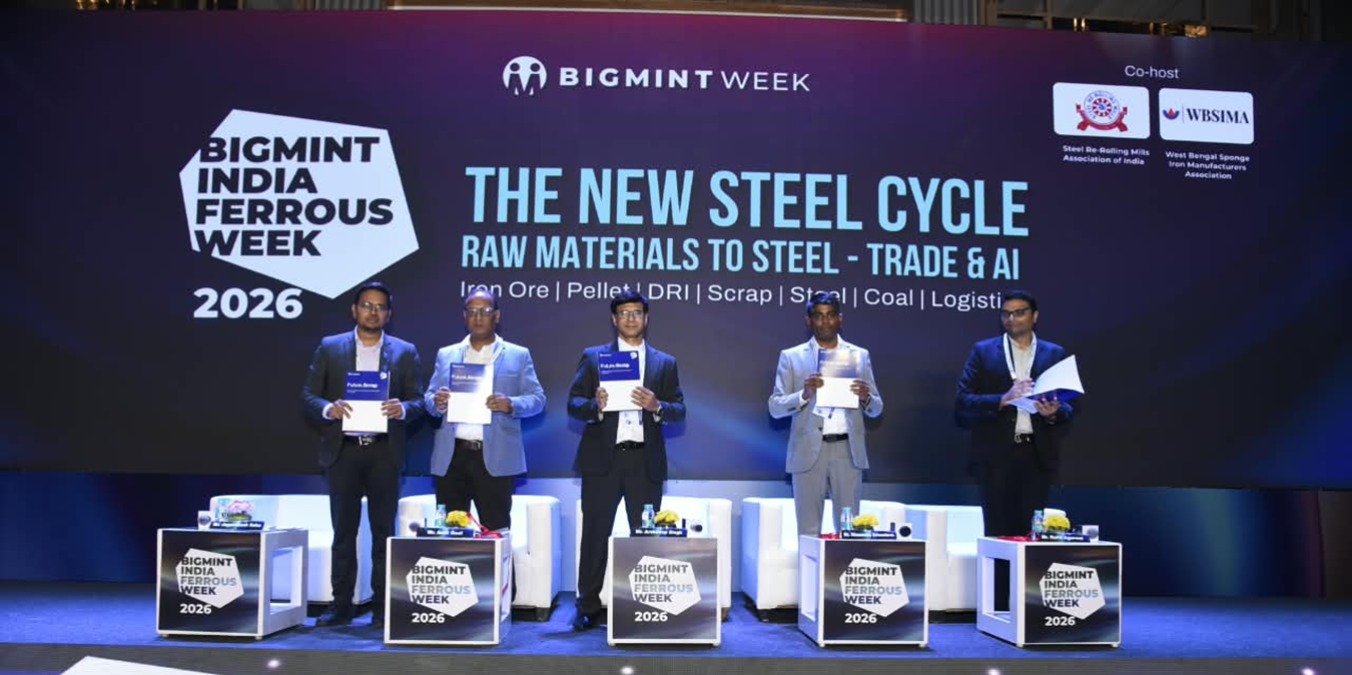
At BigMint India Ferrous Week 2026, held from 19-21 August in Kolkata, industry leaders discussed shifting global ferrous scrap trade dynamics, including tightening supply, changing trade routes, freight uncertainty and India’s evolving sourcing strategy. A dedicated session explored new supply routes, export restrictions and alternative procurement options.
The discussion was moderated by Jayprakash Sahu, GM, BigMint, with insights from Mr. Arshdeep Singh, Director, Vital Solutions; Mr. Amit Goel, GM – Scrap Sourcing, Jindal Stainless; Mr. Himanshu Shrivastava, Head – Operations & New Projects, Tata Steel Recycling Business; and Rohit Agarwal, GM, JSW Steel.
A shrinking global scrap pool
Opening the session, Mr. Arshdeep Singh outlined how the global seaborne scrap trade is gradually becoming tighter. While final 2025 trade numbers were still being consolidated, the broader trend pointed towards declining availability of internationally tradable scrap.
 The US and Europe, accounting for over half of global seaborne scrap exports among major suppliers, are increasingly retaining material domestically. US exports have declined as new EAF capacity absorbs more scrap, while Europe plans tighter export regulations from 2027. Meanwhile, several countries are also introducing restrictions to retain scrap for domestic steelmaking.
“The availability and trade of scrap are starting to come down,” was the central concern raised during the discussion. Japan, Mexico and Singapore may absorb part of the gap as alternative or swing suppliers, but these markets too face growing domestic demand and new capacity additions.

India: Scrap consumption rises despite falling imports
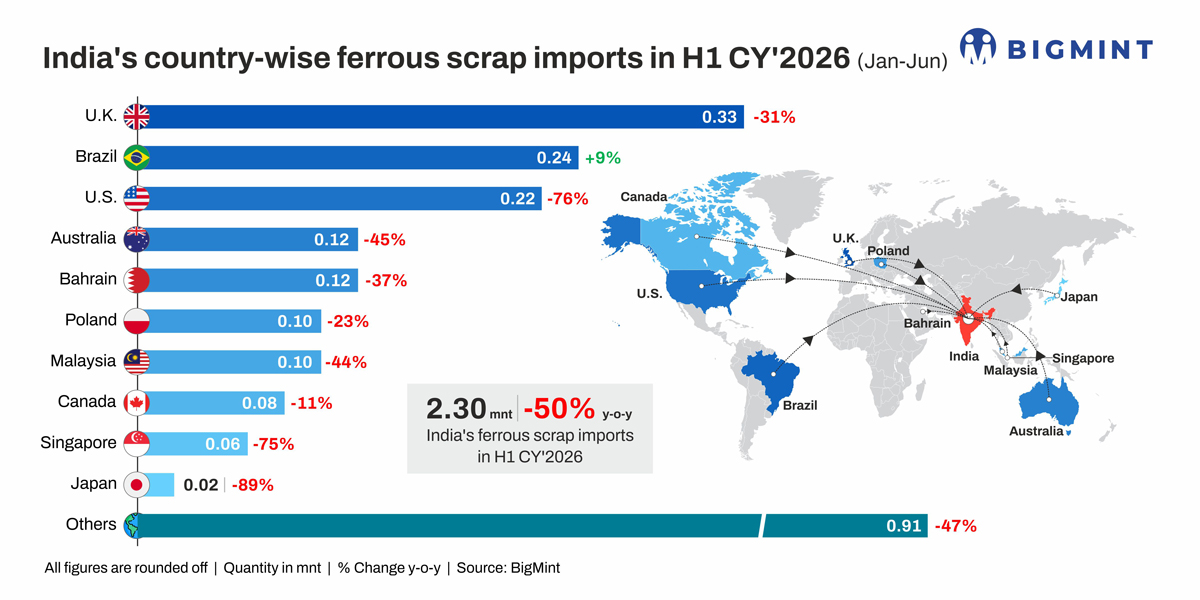
A key theme was India’s changing scrap equation, with consumption rising despite lower imports. Domestic scrap availability increased to around 20 mnt, while H1 2026 imports fell sharply to approximately 2.5 mnt.
BigMint’s recent market analysis has similarly highlighted that India’s ferrous scrap imports fell to a five-year low in H1CY’26, with a wider imported-versus-domestic price gap and higher DRI usage reducing the attractiveness of overseas material.
According to Mr. Amit Goel, this does not necessarily mean India has structurally abandoned imported scrap.
“It is a completely price-driven market. If imported scrap becomes competitive, Indian mills will buy it,” he said, highlighting that the current imported-domestic differential had widened to around INR 4,000-5,000/t in some cases.
Instead, Indian mills increased domestic scrap and DRI use, while improved collection, formalisation, GST compliance and greater visibility of unorganised material boosted reported domestic scrap availability.

Domestic collection: The untapped opportunity
Mr. Himanshu Shrivastava focused on the evolution of India’s domestic scrap ecosystem and argued that the country’s challenge is not necessarily the absolute availability of scrap.
Drawing on Tata Steel Recycling Business’ experience, he pointed towards the large, fragmented collection network spread across kabadiwalas, automobile clusters and industrial centres.
“The problem is not with the volume. If you are a buyer and can buy with the right terms and give confidence to the market, volume is not a problem,” he noted.
The discussion highlighted that India’s collection efficiency still has significant room for improvement. Greater formalisation, better aggregation and processing infrastructure could bring more material into organised supply chains.
End-of-life vehicles were also identified as a future growth area. Although their contribution remains limited today, investments in registered vehicle scrapping facilities and the gradual expansion of India’s manufacturing base could significantly increase long-term domestic scrap availability.
Japan and alternative supply routes
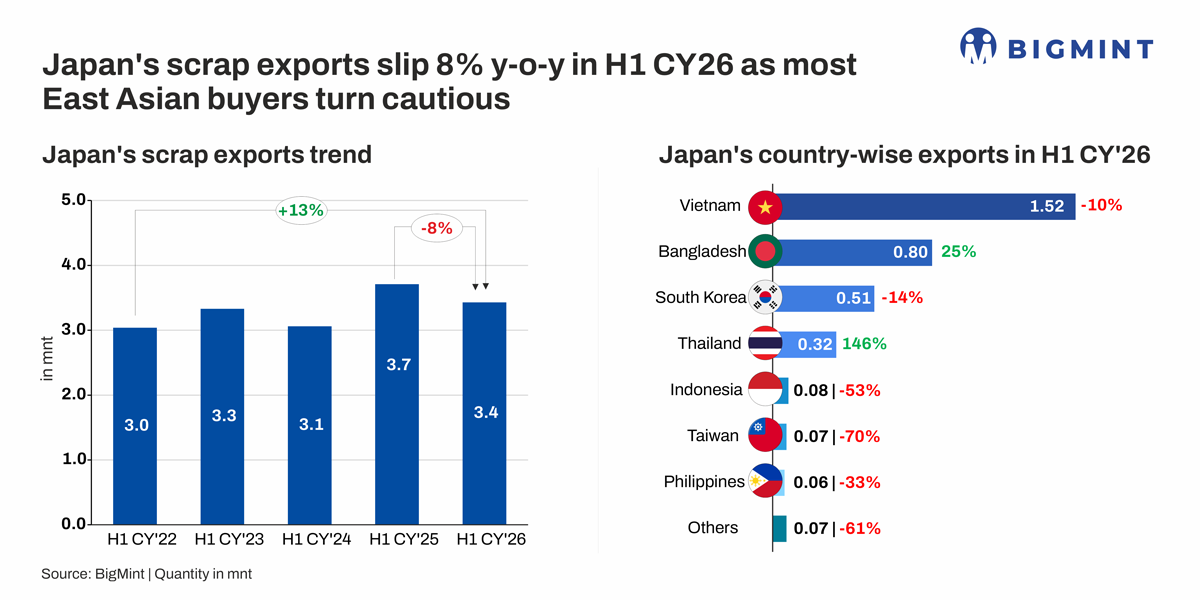
Japan has emerged as one of the key alternative origins for Indian buyers, but the panel cautioned against assuming that Japanese material will automatically fill the supply gap.
Japan increased exports in recent years, but nearby markets such as Vietnam, Bangladesh, South Korea and Taiwan remain strong competitors because of their geographical advantage and established buying patterns.
Mr. Arshdeep Singh noted that India likes Japanese scrap quality, but commercial viability remains the deciding factor.
“The Indian buyer likes the product, but commercially it works sometimes and sometimes it doesn’t,” he said.
The panel also discussed alternative sourcing opportunities in Singapore, Malaysia, the Philippines and Australia, although each market has its own limitations. New EAF capacities are also being developed in several traditional exporting regions, meaning future export availability could tighten further.
The broader message was clear: India cannot rely on a single replacement source if Europe and the US become less accessible.
Freight becomes a strategic part of procurement
Freight is increasingly shaping India’s scrap procurement, accounting for around 20% of landed value. Red Sea disruptions, longer routes, vessel shortages, higher insurance and geopolitical risks have increased freight costs and volatility.
However, Mr. Arshdeep Singh also pointed towards a possible longer-term correction. A substantial global vessel order book built up after the pandemic could eventually create excess shipping capacity once new vessels enter the market.
For Indian buyers, the recommendation was to maintain flexibility between containerised and bulk procurement.
“If India has to look at optionality for scrap, it also has to look at optionality in freight,” he said.
Price versus supply security
The panel produced an interesting debate around whether Indian steelmakers should prioritise price or long-term supply security.
Mr. Amit Goel argued that different types of steelmakers require different procurement strategies.
Integrated steel producers, for whom scrap represents a smaller portion of the overall metallic input, may benefit from securing consistent, long-term supplies even at slightly higher prices. Large trading companies with captive steelmaking operations may also find value in securing supply chains.
However, smaller secondary steelmakers may remain better positioned as flexible spot buyers.
“Scrap prices are ultimately back-calculated from the finished steel market,” he said, arguing that finished steel demand remains the underlying driver of scrap affordability.

The discussion suggested that India’s flexible procurement approach could be an advantage, as expanding domestic collection while retaining the ability to switch to imports when prices become competitive may strengthen long-term scrap security.
Mr. Rohit Agarwal highlighted that India’s domestic scrap market has significant untapped potential, with the formal market estimated at around 75-80% and the remaining 20-25% still largely informal. He noted that scrap collection efficiency is around 75%, indicating scope to bring more material into the formal system. His experience with JSW Steel’s scrap-collection initiatives showed that the key challenge is not necessarily availability, but building an efficient collection network and giving suppliers confidence through the right buying terms.
He also pointed out that the current decline in imports is strongly influenced by price competitiveness. With imported scrap currently around INR 4,000-5,000/t more expensive than domestic material, Indian mills have a clear incentive to source locally. However, he stressed that imports will continue to have a role: if global prices become competitive and the price gap narrows, buyers can quickly switch back to imported scrap. This highlights the flexibility of India’s procurement market rather than a complete structural shift away from imports.
Should Indian companies invest overseas?
The question of overseas scrap processing facilities generated mixed views.
The panel broadly agreed that integrated steelmakers and larger companies may selectively benefit from investments or joint ventures in overseas processing operations. Such facilities can provide greater control over quality, volume and supply consistency.
However, overseas integration may not be suitable for every buyer because of capital requirements, logistics costs and operational risks. The alternative, particularly for smaller steelmakers, could be to strengthen domestic collection and processing capabilities first.
A key discussion point was that direct mill supply requires strict quality and sizing, while processing facilities can handle a wider range of material and convert it into usable scrap. Greater supply-chain control could therefore improve procurement security.
Outlook: India needs flexibility, not dependence
The session concluded that India’s future scrap strategy must balance stronger domestic availability with continued import flexibility. While improved collection, formalisation, manufacturing growth, ELV dismantling and processing investments will increase domestic supply, imports will remain important.
With export restrictions, expanding EAF capacity in traditional supplier markets and geopolitical freight disruptions reshaping global trade, India needs diversified sourcing routes and greater procurement flexibility. The focus should be on maximising domestic scrap recovery while maintaining access to multiple overseas origins.
The discussion highlighted a potential FY’30 gap, with domestic scrap demand projected to reach around 62 mnt against supply of about 47 mnt, underlining the continued role of imports. Ultimately, India’s scrap security will depend on stronger collection systems, quality infrastructure, freight flexibility and supplier relationships, allowing buyers to switch between domestic and imported metallics as market economics change.
Leave a Reply