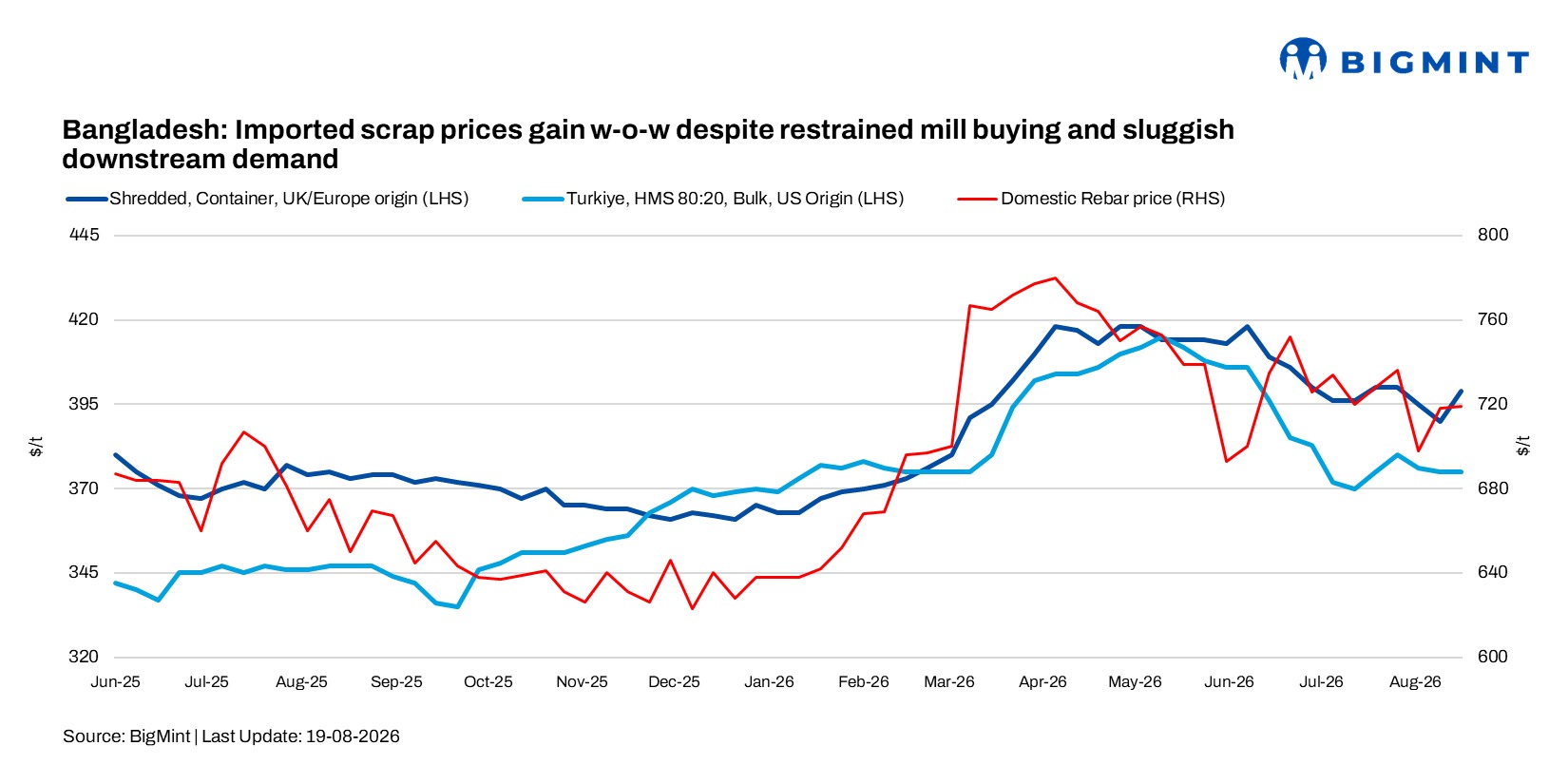
- Weak steel demand and lower mill utilisation curb fresh scrap procurement
- Shipbreaking activity improves, but international scrap buying remains measured
Bangladesh’s ferrous scrap market remained subdued during the week ended 18 August, with weak steel demand, slow construction activity, and monsoon-related disruptions keeping mill procurement cautious. While Chattogram’s shipbreaking market saw stronger interest in specialised tanker and container vessels, scrap buyers largely focused on immediate requirements amid subdued international market sentiment.
BigMint’s weekly assessments, CFR Chattogram
- European-origin containerised HMS 80:20: $366/t, up $8/t w-o-w
- European-origin containerised shredded: $399/t, up $9/t w-o-w
- Japanese-origin bulk H2: $376/t, up $3/t w-o-w
- US-origin bulk HMS 80:20: $381/t, down $9/t w-o-w
Imported scrap market
Australia/New Zealand-origin deep-sea bulk cargoes were booked at around $380/t CFR Chattogram for HMS 80:20 and $390/t CFR for shredded scrap, below the previous week’s levels. US West Coast HMS 80:20 was offered around $380/t CFR, while Singapore-origin bulk HMS was heard at $390-395/t CFR. Australia-origin bulk HMS was around $380/t CFR.
A Chattogram-based trader said, “US West Coast bulk HMS is around $380-385/t, while Singapore-origin bulk is around $395/t. Japanese H2 is around $380-385/t, which looks unreasonably expensive, possibly due to the weaker yen. Australian HMS bulk is around $380-382/t.”
Containerised Australia-origin HMS 80:20 was heard at around $370-375/t CFR, while shredded scrap offers were around $395-400/t CFR. Japan-origin H2 bulk was quoted near $382-385/t CFR, with market participants considering the material relatively expensive.
Domestic steel and scrap market
Bangladesh’s domestic steel market remained relatively firm despite slower sales caused by rainfall. Local scrap prices were heard at BDT 50,000-54,000/t ($409-442/t), with billet prices stood at BDT 70,000-71,000/t ($573-581/t) at Dhaka factories.
A Dhaka-based mill source said, “Steel sales have been slightly affected by rainfall. Rebar is around BDT 83,000-84,000/t ($679-688/t) in Dhaka and BDT 87,000-88,000/t ($712-720/t) in Chattogram. Billet is around BDT 70,000-71,000/t ($573-581/t), while local scrap is around BDT 50,000-53,000/t ($409-434/t).”
Rebar prices were reported at BDT 83,000-84,000/t ($679-688/t) in Dhaka and BDT 87,000-88,000/t ($712-720/t) in Chattogram. However, broader economic weakness continued to constrain steel consumption. Less than half of surveyed mills were reportedly operating, with some running at around 25% capacity, while larger producers continued to operate relatively better.
Chattogram shipbreaking market
Chattogram’s shipbreaking market strengthened as recyclers showed aggressive interest in specialised tanker and container vessels. The August 12-15 tide window operated normally, while the next major window is scheduled for August 28-31, indicating that monsoon-related logistical disruptions have eased.
Quotes for specialised vessels increased by around 4.5% w-o-w, although demand for standard bulkers remained subdued. Local plate prices briefly rose to BDT 64,500/t ($528/t) before easing to BDT 64,000/t ($524/t), suggesting that vessel demand was the main driver of the improved sentiment.
Outlook
Bangladesh’s imported scrap buying is likely to remain measured in the coming week, with softer international sentiment, weak steel sales and reduced mill utilisation limiting fresh bookings. Mills are expected to remain price-sensitive and requirement-driven, particularly while competitive domestic scrap remains available. However, stable shipbreaking activity and normalising tide windows should support metallic availability and provide some underlying demand support.
Leave a Reply