- China’s July aluminium output and exports rise, weighing on prices
- Hormuz uncertainty lifts energy and supply-chain risks for Gulf aluminium
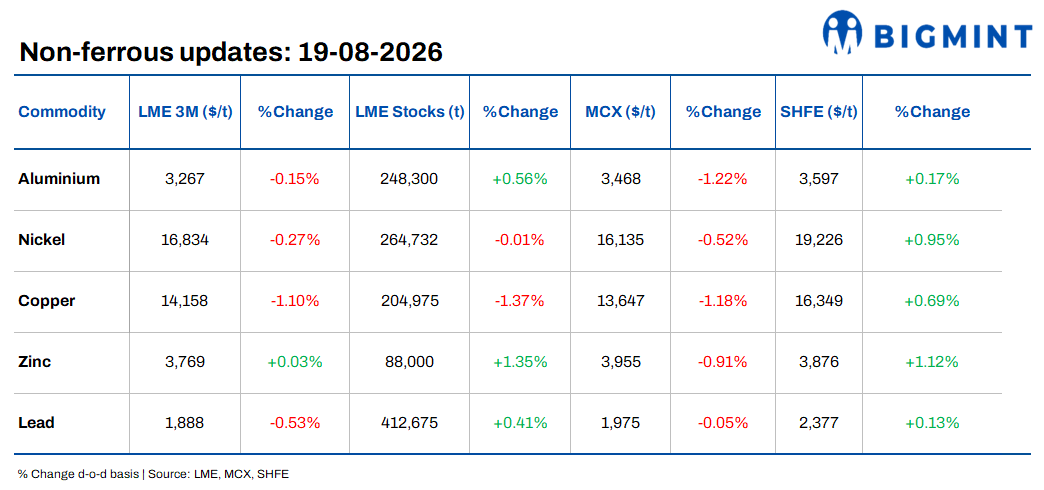
LME base metals traded mixed on 18 August. Copper recorded the sharpest decline, falling 1.10% d-o-d to $14,158/t, followed by lead, which slipped 0.53% to $1,888/t. Nickel eased 0.27% to $16,834/t, while aluminium edged lower by 0.15% to $3,267/t and zinc gained 0.03% to $3,769/t.
LME inventories recorded mixed trends on 18 August. Zinc stocks recorded the steepest rise, gaining 1.35% to 88,000 t, followed by aluminium, up 0.56% to 248,300 t, and lead, which rose 0.41% to 412,675 t. Meanwhile, copper stocks fell 1.37% to 204,975 t, while nickel inventories edged lower by 0.01% to 264,732 t.
Domestic market overview
India’s non-ferrous scrap market was largely stable d-o-d on 18 August. Aluminium tense scrap remained unchanged at INR 247,000/t ex-Delhi and INR 245,000/t ex-Chennai.
Meanwhile, copper armature scrap (Cu 99%) was unchanged at INR 1,300,000/t. The domestic market showed no daily price movement across the reported aluminium and copper scrap grades.

Other updates
Oil prices rise as Hormuz uncertainty persists
Oil prices gained on 19 August as uncertainty over shipping through the Strait of Hormuz continued. Brent rose 0.8% to $91.45/bbl, while WTI advanced 0.9% to $85.70/bbl on 19th august. Shipping activity has slowed as operators remain uncertain about the waterway’s reopening, while two major Chinese shipping companies have halted oil tanker movements through Hormuz and Bab el-Mandeb. Consequently, prolonged disruption could raise energy, freight and logistics costs for energy-intensive Gulf aluminium smelters.
China’s July aluminium output and exports rise
China’s aluminium production rose 3.8% year on year to 3.9 million tonnes in July, while unwrought aluminium and semi-finished exports climbed 18.6% to 643,000 tonnes. Stronger domestic output and higher exports have added to supply availability, while improving Gulf supply expectations also weighed on aluminium prices. However, tight LME inventories continue to provide support to the market. The combination of higher Chinese production and exports could influence regional flows and pricing across the global aluminium market.
Copper physical tightness intensifies as LME spread widens
Copper’s nearby market has tightened, with the LME near-term spread signalling a growing premium for prompt metal. Strong demand from buyers in China and the US is increasing competition for available units. Declining LME inventories are also reducing the buffer of readily available copper. Meanwhile, tariff-driven trade flows are drawing additional metal toward the US market. As a result, persistent strength in the prompt market could support copper prices and physical premiums. It may also strengthen sentiment across the wider non-ferrous complex.
US-Canada tariff tensions ease temporarily
US-Canada trade tensions eased after President Donald Trump announced a three-day pause on the planned 50% tariffs. The measures would cover around $20 billion of Canadian imports. Trump cited progress in negotiations with Ottawa, although several issues remain unresolved. Aluminium and copper products already covered by Section 232 are excluded from the additional tariffs. Therefore, the direct impact on these metals remains limited for now. However, continued uncertainty could affect North American procurement, regional premiums and trade flows. A breakdown in talks could revive concerns over supply-chain disruption.
Leave a Reply