- Leading mills’ INR 500/t price hike provides support to domestic HRC prices.
- Automotive allocations increase, limiting trader-channel availability.
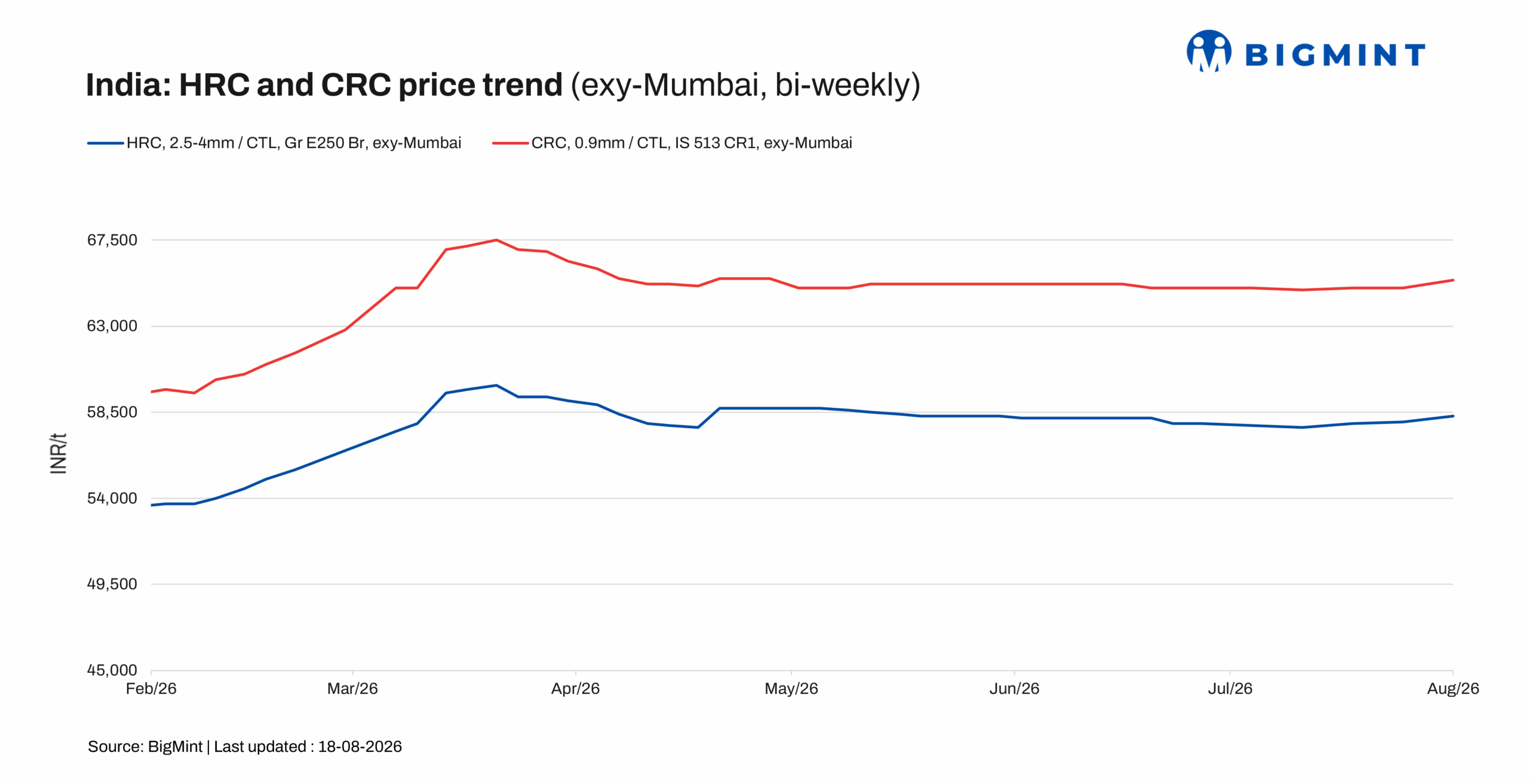
India’s hot-rolled coil (HRC) market edged up during the week ended 18 August 2026, with prices increasing by around INR 300-700/t across select markets amid cautious buying activity, with trade-level offers broadly at INR 55,800-59,000/t ($589-616/t).
BigMint’s bi-weekly benchmark assessment for HRC (IS2062, Grade E250, 2.5-8 mm/CTL) increased w-o-w by INR 300/t ($3/t) to INR 58,300/t ($610/t) ex-Mumbai as of 18 August 2026, from INR 58,000/t ($607/t) in the previous week.

Similarly, the benchmark assessment for CRC (IS513, Grade O, 0.9 mm/CTL) increased w-o-w by INR 400/t ($4/t) to INR 65,400/t ($683/t) ex-Mumbai, from INR 65,000/t ($679/t) in the previous week.exclusive of 18% GST.
Market Update
India’s trade-level HRC market saw a modest increase in spot prices, supported by improved buying from value-added and downstream segments, particularly CRC users. Better trade parity following recent mill price adjustments encouraged selective replenishment, while a major domestic mill’s INR 500/t price increase further strengthened price indications and supported spot offers. Controlled mill dispatches and supply-chain constraints also resulted in tighter availability of certain grades and thicknesses in select markets, lending additional support to prices.
Mill allocations have also seen a slight shift towards the automotive or B2B segment, with relatively lower volumes available to the trader channel. This follows a period of higher material availability that had weighed on prices, while the current allocation pattern has helped bring spot supply into better balance. Overall availability remains manageable, although select specifications have seen tighter availability.
A market participant quoted, “Buying activity is normal to slightly improved, while MSME buyers continue to take a wait-and-watch approach,” monitoring whether current price levels can sustain through the week before committing to larger purchases. Underlying demand, however, has not shown a broad-based recovery, with most buyers continuing to procure against immediate requirements.
Overall, controlled dispatches, a more balanced allocation mix, firmer mill price indications and improved trade economics have provided support to spot prices. Stable underlying demand and cautious buying are likely to limit the pace of further gains, leaving the market with a slightly positive but measured undertone.
Imports and Exports
India’s bulk HRC imports stood at 118,036 t as of 12 August, with a further 238,539 t expected to arrive by the end of the first week of September.

India’s bulk HRC exports stood at 182,274 t as of 12 August, with an additional 118,259 t expected to arrive by the end of August. Export offers showed divergent trends across key destinations.
Indian HRC export offers remained unchanged w-o-w across key destinations, with EU buying activity stalled after the Q4CY26 quota was fully booked. Middle East negotiations remained ongoing, however it has yet to translate into concluded bookings, while weak downstream demand in Vietnam kept transaction activity subdued.
Market Outlook
India’s trade-level HRC prices are expected to remain stable to firm in the near term, supported by controlled mill dispatches, tighter availability of select grades and continued demand from value-added segments.With the pre-festive buying period approaching and no significant issues reported in value-added products, downstream procurement is expected to provide some support to trade-level market activity.Overall, the combination of firm mill indications, selective supply tightness and improving downstream enquiries is expected to provide a supportive base for trade-level prices in the near term.
Leave a Reply