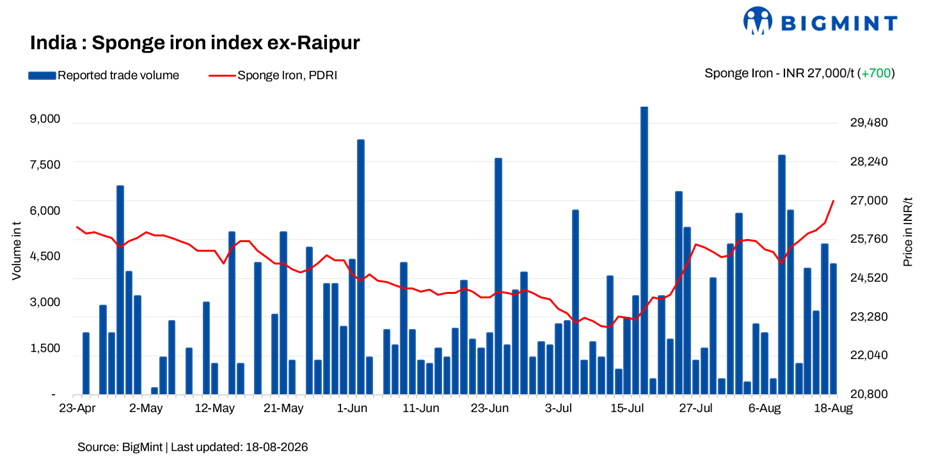
- Healthy buyer participation keeps trade movement positive.
- Eastern markets witnessed major price increases recently
Domestic sponge iron prices strengthened by around INR 100-800/t, supported by improved buying activity and healthy buyer participation. Raipur PDRI prices settled at INR 27,000/t exw-raipur, up by around INR 700/t. Strong enquiries and better trade movement have boosted seller confidence, prompting producers to raise offers. Overall market sentiment has turned positive, although bulk purchases remain limited as several buyers have already covered their immediate requirements.
Raw material constraints amid the ongoing monsoon season are providing additional support to sponge iron prices. Limited availability of key inputs, along with higher pellet and coal prices, has increased production costs for sponge iron manufacturers. At the same time, improved buying activity in the finished steel segment is supporting overall market sentiment and strengthening demand for sponge iron.
Trade activity remains healthy, with good enquiries reported across major markets. While buyers are largely focusing on small-quantity bookings after completing their bulk requirements, trade movement continues to remain positive. BigMint recorded around 25,000 tonnes of sponge iron trade in the previous session, reflecting firm market activity and sustained buyer participation.
In eastern India, prices witnessed notable increases amid tighter raw material availability. Odisha Mining Corporation (OMC) is scheduled to auction 1.831 million tonnes (mnt) of iron ore on 19 August 2026, including 1.21 mnt of fines and 0.62 mnt of lumps. The reduced offer quantity due to monsoon-related mining disruptions has pushed lump prices up by INR 100-250/t, while fines prices for Fe below 62% have increased by INR 100/t.
Rationale
Prices have been derived based on transactions, offers, bids, and indicative price data sets. Transactions are considered as T1 and given a weightage of 50%, whereas other data sets are considered as T2 and given a weightage of the balance 50%.
Click here for detailed methodology


Leave a Reply