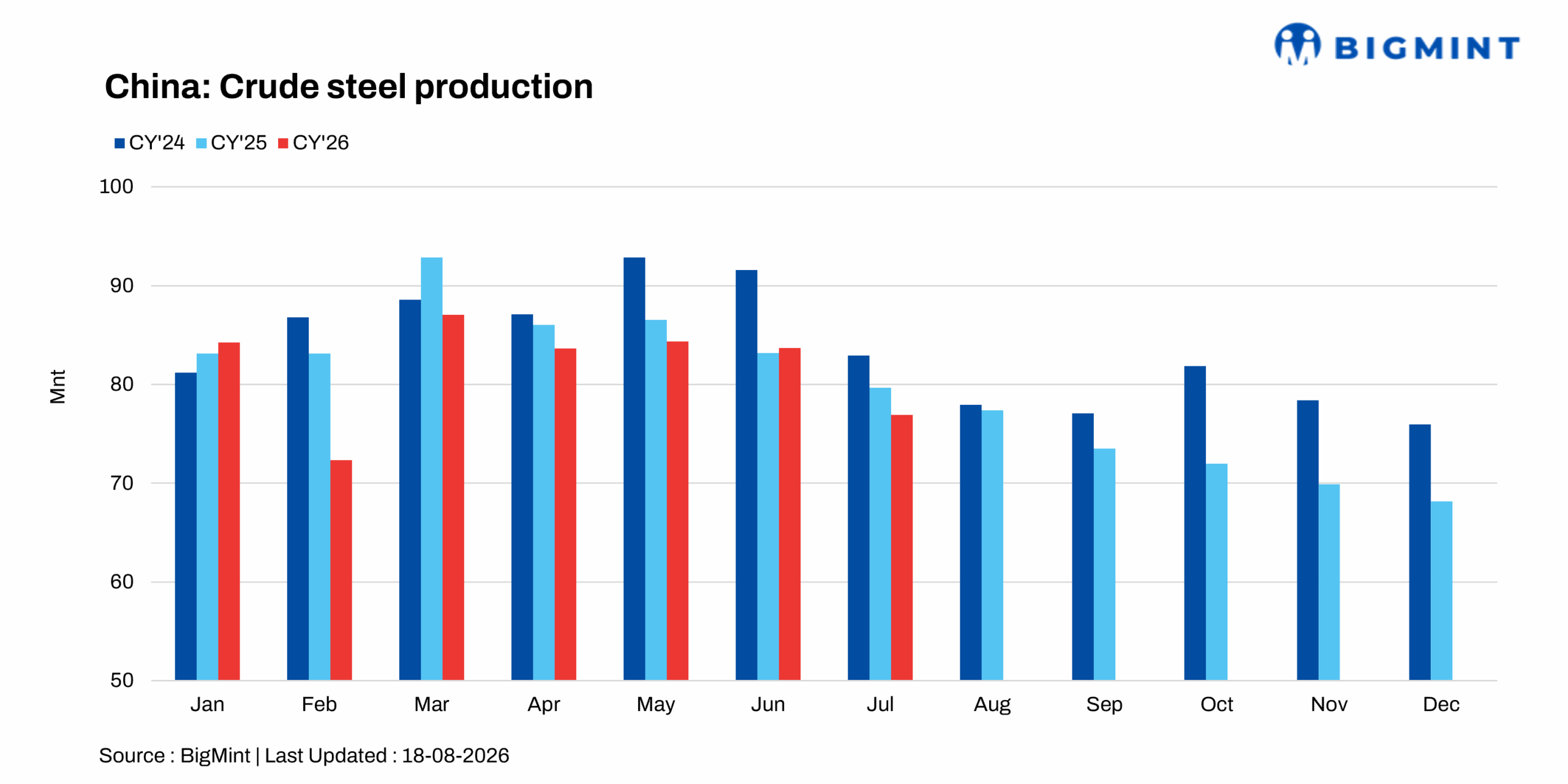
- Air pollution curbs, seasonal demand weakness weigh on production
- Steel inventories rise despite production curbs amid weak demand
China’s crude steel production fell 3.6% y-o-y to 76.93 million tonnes (mnt) in July 2026, according to statistics released by the National Bureau of Statistics (NBS) on 17 August. Average daily crude steel output was estimated at around 2.48 million tonnes (t), down about 310,000 t from June, marking one of the lowest monthly production rates of the year.
Production cuts deepen in July
Steel production was affected by tighter operating restrictions and weaker seasonal demand during July. As part of air pollution control measures, authorities in Tangshan, Hebei Province, ordered blast furnace operations to be reduced by 20% for five days from 25 July.
The seasonal slowdown during the rainy period also weighed on steel demand. The China Iron and Steel Association (CISA) reported that average daily crude steel production among its member mills was around 1.97 mnt in July, nearly 100,000 t lower than in June.
As summer heat continued to weigh on construction activity and the property market remained sluggish, demand for construction steel was weak. At the same time, manufacturing sectors such as wind power, shipbuilding, and construction machinery provided some support to flat steel demand. However, long steel products, particularly rebar and wire rod, continued to feel the pressure from the prolonged property-sector downturn.
Rising inventories highlight weak demand
The inventory trend suggests that production adjustments have not yet fully aligned supply with demand. Steel inventories held by manufacturers increased by around 410,000 t from early July to 17.18 mnt in mid-July.
The rise in inventories came despite lower crude steel output, indicating that weak domestic consumption continued to constrain the market. Real estate investment remained weaker than expected, while recovery in domestic steel demand was limited.
January-July output remains lower
China’s pig iron production fell 4.5% y-o-y to 58.35 mnt in July, while steel product output declined 4.1% to 116.46 mnt.
During January-July, pig iron production decreased 3% y-o-y to 495.77 mnt. Crude steel production fell 3.1% to 577.04 mnt, while steel product output declined 1.2% to 836.16 mnt.
Market faces conflicting demand signals
The domestic steel market faced a combination of weaker demand and external uncertainties in July. Global economic recovery expectations remained mixed, while escalating geopolitical tensions in the Middle East added uncertainty to commodity markets.
Domestically, economic activity remained broadly stable, supported by resilient exports and a marginal improvement in industrial production. However, the slower recovery in real estate investment continued to weigh on construction-linked steel demand.
At the same time, expectations for additional counter-cyclical policy support increased as demand recovery remained below expectations.
Outlook
China’s crude steel production has started to recover in August after restrictions on blast furnace operations in Tangshan ended. Average daily crude steel output at CISA member mills rose by around 110,000 t from late July to 1.97 mnt.
As raw material prices have fallen in August, reducing steelmakers’ losses, some blast furnaces that had been shut down for maintenance are now being restarted.
However, rising inventories indicate continued pressure from subdued consumption, with output expected to remain lower y-o-y. Industry reports forecast average daily crude steel output at around 2.5 mnt in August.
In the raw materials market, port inventories of iron ore remain high and steelmakers’ purchases are limited; furthermore, with prices for coking coal and coke also falling, steel production costs are decreasing. While this may encourage steelmakers to resume production, it could also exert downward pressure on steel prices.
Flat steel products are expected to perform relatively better, supported by manufacturing demand, while construction steel remains under pressure. The pace of capacity release and the government’s approach to production controls will remain key factors for steel prices and market balance.
Leave a Reply