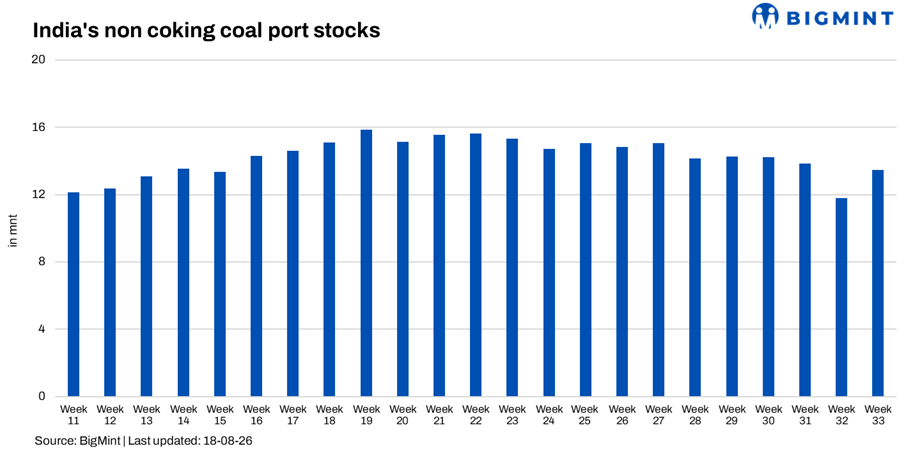
- Krishnapatnam records sharpest w-o-w inventory increase
- Adani Enterprises rebuilds stocks after last week’s drawdown
India’s thermal coal inventories at major ports increased 14.3% w-o-w to 13.48 million tonnes (mnt) in Week 33 from 11.79 mnt in Week 32, as fresh arrivals exceeded cargo evacuations across the port network. The rise reversed the sharp drawdown seen in the previous week and indicated some rebuilding of imported coal stocks. However, the increase did not necessarily indicate stronger import demand, as buying remained selective and inventory movements were influenced by replenishment at key ports.
Inventory rebuilding becomes more visible
The weekly increase was driven mainly by higher stocks at Krishnapatnam, Mundra, and Hazira. Krishnapatnam recorded the largest rise, with inventories reaching 1.59 mnt from only 0.22 mnt previously. Mundra stocks increased to 1.42 mnt from 1.00 mnt, while Hazira rose to 2.51 mnt from 2.40 mnt.
The broad increase suggests that cargo arrivals and replenishment strengthened during the week after several ports experienced heavy evacuation previously. The movement was therefore more consistent with a replenishment phase following earlier stock drawdowns, rather than a sudden acceleration in end-user consumption.
At the same time, inventories declined at several other locations. Kandla stocks fell to 0.84 mnt from 1.02 mnt, while Navlakhi declined to 0.50 mnt from 0.63 mnt. Vizag and Tuna also recorded notable reductions. This divergence indicates that inventory conditions remained uneven across India’s import network, depending on local cargo arrivals and evacuation requirements.

Major importers rebuild selected inventories
Inventory movements among major holders also pointed towards selective replenishment.
Adani Enterprises’ stocks increased to 4.86 mnt from 3.28 mnt, reversing much of the previous week’s sharp reduction. This was the largest absolute increase among the major inventory holders and contributed significantly to the overall rise in reported stocks.
ArcelorMittal’s inventory also increased marginally to 1.29 mnt from 1.25 mnt, while JSW Steel’s holdings rose to 0.43 mnt from 0.35 mnt. In contrast, Agarwal Coal’s inventory declined to 0.63 mnt from 0.72 mnt, indicating that replenishment was not uniform among traders and consumers.
The contrasting movements suggest that buyers continued to manage inventories according to individual consumption requirements, cargo positions and procurement schedules rather than following a broad market-wide stocking strategy.

Domestic coal continues to limit import urgency
Despite the rise in port inventories, the underlying import demand environment remained cautious. Comfortable domestic coal availability continued to provide consumers with an alternative to imported material, limiting the need for aggressive fresh bookings.
The increase in stocks therefore appeared to reflect a combination of fresh cargo arrivals and selective inventory rebuilding rather than a broad-based improvement in industrial coal demand. Monsoon conditions continued to weigh on construction and industrial activity, while buyers remained sensitive to delivered import economics.
For traders, the rise in port stocks could increase competition for cargo evacuation if downstream demand does not strengthen. However, inventory levels remained well below the peaks seen earlier in the year, meaning the increase was not sufficient to suggest excessive accumulation across the market.
Outlook
Port inventories are likely to remain sensitive to the balance between fresh arrivals and cargo evacuation in the coming weeks. Further increases could weigh on spot buying if industrial demand remains subdued, particularly if domestic coal continues to remain readily available.
However, the current rise should be viewed as inventory replenishment rather than a decisive recovery in import demand. A sustained improvement in industrial activity and stronger post-monsoon consumption would be required for higher port stocks to translate into consistently stronger fresh import bookings.
Leave a Reply