- Peak demand rises sharply despite surging renewable generation
- Coal generation increases as hydro weakness tightens system balance
India’s power system remained under pressure through the first half of August 2026 as electricity demand rose sharply, hydro generation weakened and thermal power plant coal inventories continued to decline.
The most significant feature of the period was how the system accommodated higher demand. Renewable generation surged by almost 40% y-o-y, but weaker hydro output meant coal generation still increased by around 6%. Meanwhile, short-term power market activity strengthened and thermal power plant coal stocks fell by more than 3 mnt between end-July and mid-August.
The data highlight an increasingly important feature of India’s energy transition: rapid renewable growth does not necessarily translate into lower coal generation when electricity demand is expanding and other flexible generation sources underperform.

All-India maximum demand reached 247,843 MW on 13 August 2026, compared with a period high of 229,715 MW during 1-16 August 2025.
Demand rises faster than generation
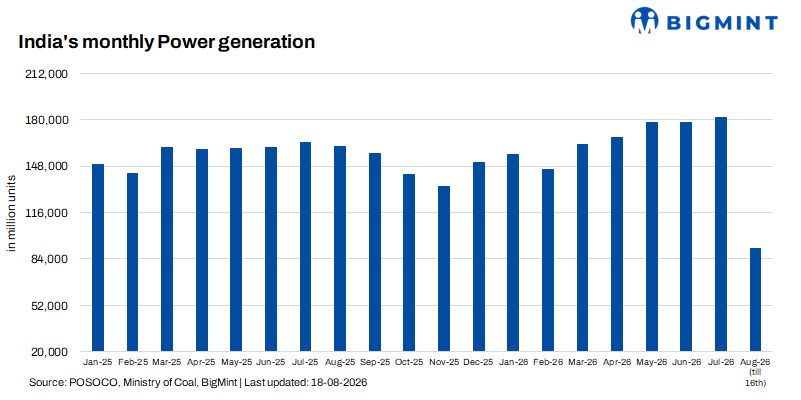
Total electricity generation increased by around 7.6% y-o-y, while average daily maximum demand rose faster, by approximately 9.4%.
This suggests a more pronounced demand profile, with the system required to accommodate higher short-duration peaks alongside strong overall electricity consumption.
Importantly, these peaks were not exclusively an evening phenomenon. On 12 August, maximum demand occurred at 14:48, while the 13 August high was recorded at 09:52.
The current demand pattern therefore cannot simply be attributed to the evening decline in solar generation. India is increasingly experiencing high system loads across different parts of the day.
Renewables surge, but hydro weakness keeps coal in the game
The full generation mix reveals where the additional electricity came from.

Renewables were the standout performer, increasing by approximately 39% y-o-y to 17.3 TWh and raising their contribution to around 19% of generation.
But hydro moved sharply in the opposite direction, declining by around 17% to 11 TWh. Gas and nuclear generation were broadly unchanged, meaning neither provided a meaningful incremental contribution.
The consequence was that coal generation still had to rise by around 6% to 58.1 TWh.
This is the central paradox in the August data: renewable generation surged, yet India still needed to burn more coal.
RES supplied nearly one-fifth of India’s electricity during the period, but coal continued to provide almost two-thirds. Coal’s share edged lower even as its absolute generation increased.
Coal stocks draw down rapidly
Higher coal-fired generation coincided with a substantial drawdown in power plant inventories.
Thermal power plant coal stocks declined steadily through August, falling from 38.01 mnt on 31 July 2026 to 36.83 mnt on 9 August and further to 34.71 mnt on 16 August. Overall, inventories declined by 3.31 mnt from 31 July, indicating continued drawdown in coal stocks amid ongoing consumption by the power sector.
CEA-monitored stocks declined by approximately 3.31 mnt, or nearly 9%, in just over two weeks.
However, this should not yet be interpreted as a nationwide coal shortage. The number of critical plants was broadly stable, increasing only from 31 at end-July to 32 by 16 August.
There are also signs that supply flows were responding. By 16 August, daily coal receipts of around 2.42 mnt marginally exceeded consumption of about 2.4 mnt.
The picture is therefore one of rapid inventory depletion and localised logistical pressure rather than systemic coal scarcity.
Short-term power market signals tighter balance
IEX activity provides another indication of the tighter operating environment.
Average scheduled volume increased approximately 17.5% y-o-y, while the average market clearing price rose around 6.6%.
MCP reached approximately INR 5,829/MWh on 13 August, highlighting periods when short-term power became considerably more expensive.
Purchase bids were also substantially higher than a year earlier, indicating stronger demand from buyers seeking power through the short-term market.
Taken together, higher bids, greater cleared volumes and firmer prices suggest that the exchange played a larger balancing role as utilities navigated higher demand and weaker hydro availability.
Uneven monsoon complicates the picture
Weather remains an important variable.
A dry spell was followed by renewed heavy rainfall across parts of eastern and central India, while the outlook for August-September remained for below-normal cumulative rainfall.
An uneven monsoon may therefore be working through both sides of the power balance: supporting cooling and potentially irrigation demand in drier regions while hydro generation remains considerably below last year’s levels.
Outlook
India entered the second half of August with a tighter power balance than the headline growth in renewable generation might suggest.
Renewables are expanding rapidly and supplying an increasingly meaningful proportion of electricity. Yet the August data demonstrate that renewable growth and coal growth can coexist.
With hydro down 17%, electricity generation up 8% and peak demand approaching 248 GW, coal-fired generation increased and inventories were drawn down sharply.
The next test will be whether hydro generation recovers and demand moderates as the monsoon progresses.
If they do not, coal will remain India’s principal source of dispatchable generation even as renewable generation continues to reach new highs.

Leave a Reply