- China-led supply tightness lifts coking coal and PCI prices
- India remains cautious ahead of post-monsoon restocking
Global metallurgical coal markets strengthened in the week ended 13 August 2026 as tighter coking coal and PCI availability in China revived demand for seaborne material. Australian premium hard coking coal recorded the clearest upward move, while PCI also firmed. Met coke, however, has yet to follow raw material prices decisively higher as weak steel margins continue to constrain downstream buying.
The emerging market dynamic is clear: metallurgical raw materials are tightening faster than downstream coke and steel markets can absorb higher costs.

China pulls seaborne coking coal higher
China has become the principal driver of the recent change in sentiment.
Domestic premium coking coal prices have risen sharply as mine availability tightened, with premium low-vol material in Shanxi reaching around RMB 2,070/t ex-washplant. The tightening has been linked to constrained domestic availability and safety-related restrictions.
Higher domestic prices have restored the competitiveness of imported Australian coal and encouraged Chinese buyers to return more actively to the seaborne market.
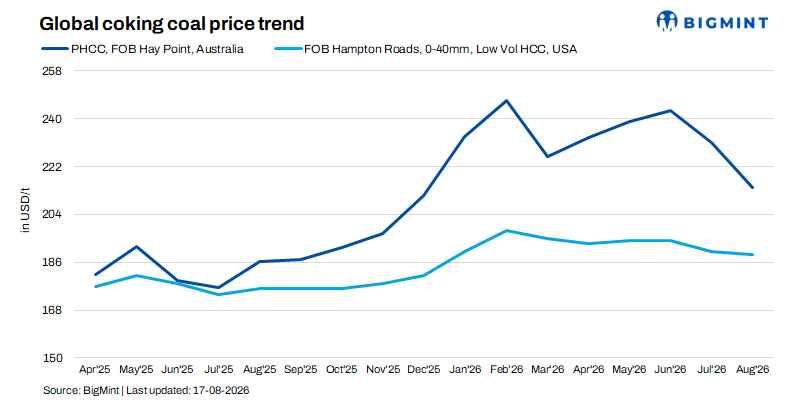
Australian premium HCC consequently climbed to around $224.90/t FOB Australia, while delivered China prices reached about $244/t. Premium cargoes were being discussed around $240-245/t CFR China.
The significance is not merely the benchmark increase. China has re-emerged as the marginal buyer of premium seaborne coking coal.
India could return into a stronger market
Indian buying remains relatively restrained, but early signs of post-monsoon procurement are emerging.
Interest has started to surface for October-arrival cargoes, while some traders are taking small positions ahead of an expected seasonal improvement in steel and coke demand.
This creates an important timing risk for Indian consumers. When Chinese demand was weak, Indian buyers had greater negotiating leverage over Australian cargoes. If Indian restocking accelerates through September while Chinese demand remains firm, both markets could increasingly compete for the same premium Australian supply.
That could provide greater durability to the current recovery in HCC prices.
US coal gains relative competitiveness
Stronger Australian prices are also improving the relative economics of North American coking coal, with US low-vol HCC at about $191/t FOB USEC, and high-vol A grade near $156.5/t. Several US and Canadian cargoes were available to Indian buyers, with some cokemakers showing interest because of quality characteristics and relative pricing.
Freight, however, remains the key constraint. US-India dry bulk freight is around $53/t, making delivered economics highly sensitive to the widening or narrowing of the Australian-US price differential.
US met coal availability has also improved as production from restarted and newly commissioned mines enters the export market. This could prevent Atlantic prices from matching the speed of any Australian rally.
PCI tightens alongside coking coal
Australian LV PCI was around $162/t FOB Australia, while comparable delivered China values were near $167/t. Mid-vol PCI into India was around $162/t CFR. Chinese domestic PCI availability has tightened, increasing demand for Russian and Australian cargoes.
For India, Russia remains the most important seaborne PCI source. August-loading mid-tier material was indicated around $160-162/t CFR India, while September indications moved towards $162-165/t. The firmer forward structure suggests suppliers are beginning to anticipate stronger post-monsoon Indian requirements.
Met coke still lags the raw material rally
Chinese coke producers face rising coking coal costs while operating margins remain under pressure. Production cuts have therefore intensified, with producers attempting to tighten supply and improve their ability to secure higher coke prices.
The demand side may become more supportive later in August as blast furnaces restart and hot metal production increases.
However, weak steel profitability remains the key constraint. Mills are reluctant to accept materially higher coke costs while finished steel demand remains uncertain. Seaborne coke has shown somewhat firmer indications. Indonesian 65/63 CSR coke was around $285/t FOB, with equivalent material near $310/t CFR India.
India’s domestic market remains softer. BF-grade coke held at INR 35,300/t ex-Jajpur and INR 33,500/t ex-Gandhidham as cautious procurement and weak monsoon-period steel demand offset rising replacement costs.
Outlook
China’s supply constraints have brought seaborne buyers back into the market just as India approaches its post-monsoon procurement cycle. If Indian restocking strengthens while Chinese demand remains active, competition for Australian HCC could intensify further.
PCI could follow the same pattern, particularly if Chinese domestic supply remains constrained. Met coke remains the key balancing factor. Producers face higher feedstock costs, but steelmakers are still resisting higher coke prices. For now, the strongest signal remains upstream: coking coal and PCI are tightening, while met coke continues to lag.
Leave a Reply