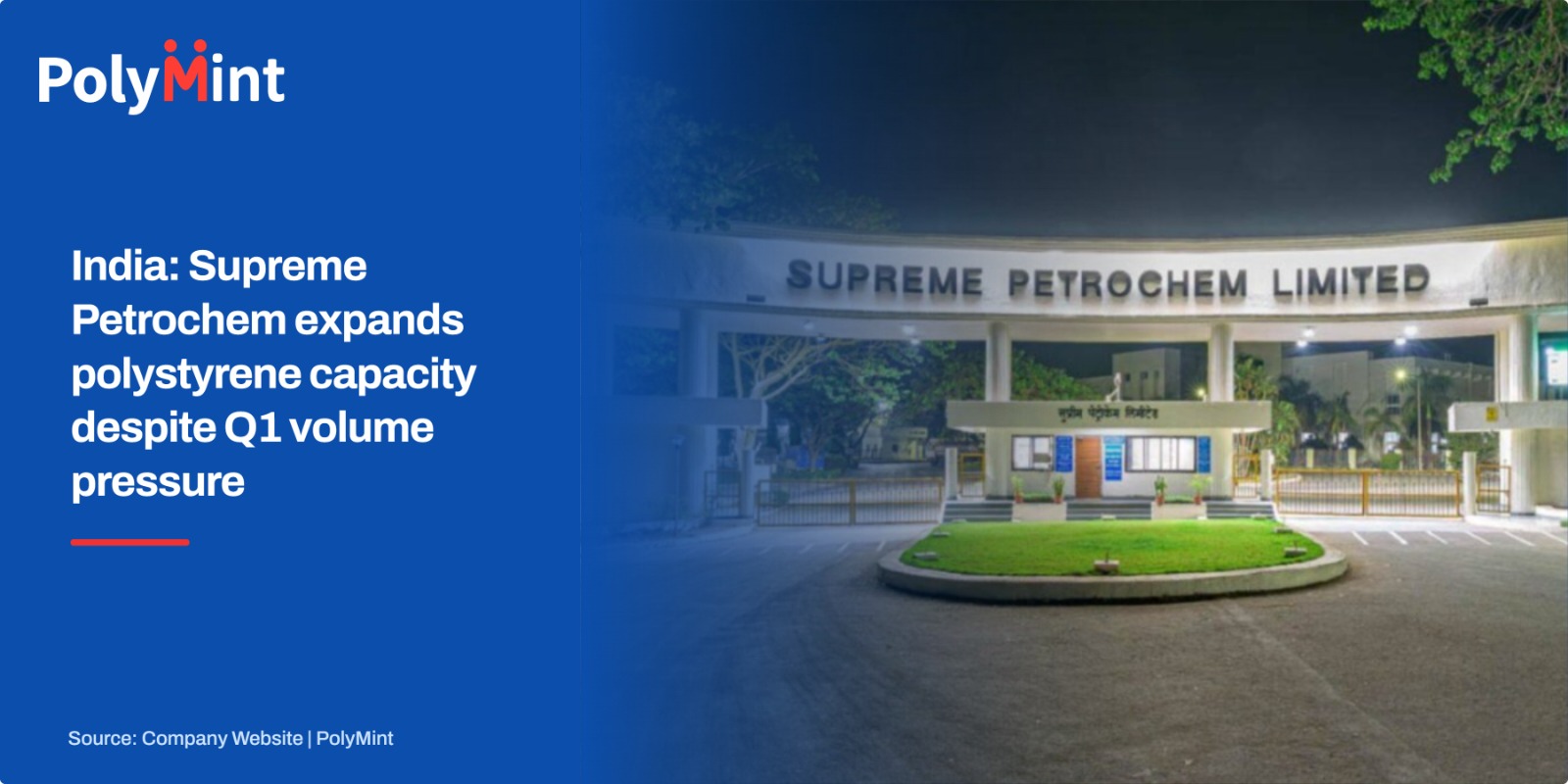
- 80,000 TPA line to lift capacity to 380,000 TPA
- Q1 sales volumes fall 24.5% amid export disruptions
Supreme Petrochem Ltd is expanding its polystyrene capacity despite weak Q1 volumes, with the company betting on future appliance-sector demand and export opportunities. The board has approved an 80,000 tonnes per annum (TPA) polystyrene line at Amdoshi, Maharashtra, taking total capacity to 380,000 TPA by March 2029. The project will cost ₹325 crore and be funded through internal accruals. Existing polystyrene capacity is operating at around 80% utilisation.

The expansion comes as Q1 FY27 sales volumes declined 24.5% y-o-y to 70,842 tonnes, mainly because of negligible exports and weaker non-OEM demand. However, revenue from operations rose 22.1% to ₹1,693 crore, while operating EBITDA surged 188% to ₹331 crore, lifting the margin to 19.53%.
The sharp divergence between volumes and profitability highlights the importance of product spreads in the company’s earnings. Management indicated that GPPS spreads widened from around $200/t to above $300/t, while HIPS spreads rose from the usual $275-300/t range to more than $400/t at times. These exceptional deltas supported margins despite lower volumes, but also make Q1 profitability difficult to sustain if spreads normalise.
Supply and trade flows
West Asia disruptions created significant supply-chain challenges during April-June. Disruptions to Gulf cargo movements and styrene monomer availability, combined with higher freight rates and limited vessel availability, sharply reduced exports.
The company arranged alternative styrene supplies and maintained domestic customer deliveries, but exports remained minimal. This shifted the company’s focus towards domestic customers.
Management expects to increase EPS exports, particularly to Europe, once shipping conditions improve. This could provide an additional outlet for production as new capacity comes on stream.
Capacity strategy
The polystyrene expansion is part of a broader ₹900 crore capex programme, including EPS, XPS and compounding projects. The company has completed its EPS Phase-II expansion and is increasing compounding capacity from 50,000 TPA to 80,000 TPA.
The strategy indicates a shift towards greater scale and value-added products while maintaining financial flexibility. The company remains debt-free, and the new polystyrene project will be financed through internal accruals.
The biggest risk is normalisation of styrene-polystyrene spreads, which could reduce margins from the exceptional Q1 levels. Raw-material availability and freight remain additional risks. Prolonged disruption in West Asia could constrain styrene supplies and exports, while higher imports could increase competitive pressure on domestic producers. More importantly, the 24.5% decline in sales volumes shows that capacity growth will need to be matched by demand recovery.
Outlook
Through FY27, domestic demand is likely to remain the company’s primary volume support while export recovery will depend on shipping conditions, freight economics and styrene availability.
By March 2029, the additional 80,000 TPA line would raise polystyrene capacity by about 27%. The key market test will be whether appliance-sector demand and export opportunities can absorb this incremental capacity as the unusually wide Q1 spreads gradually normalise.
The expansion strengthens Supreme Petrochem’s long-term supply position, but the immediate earnings outlook remains more dependent on spreads, raw-material availability and volume recovery than on capacity additions alone.
Leave a Reply