- Black Sea disruptions, freight inflation continue supporting CIS billet offers
- Asian billet prices soften as weak buying pressures mills
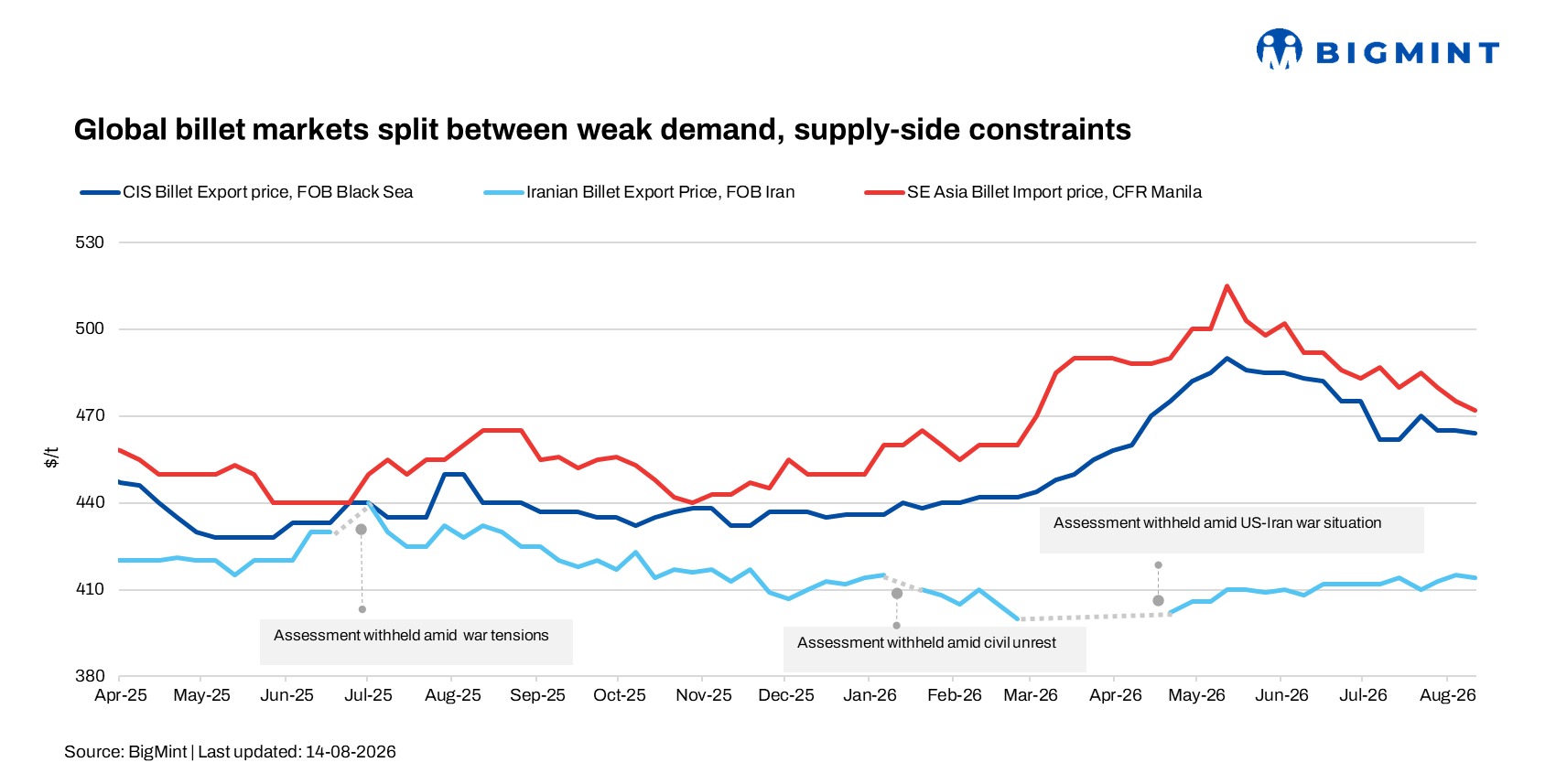
Global billet markets remained mixed during the week ended 14 August. Asian prices softened on weak seasonal demand and limited buying interest, while CIS offers held firm amid limited availability and higher Black Sea freight. Middle East billet sentiment remained supported by shipping disruptions, geopolitical risks, and tighter feedstock availability.
In Turkiye, imported scrap remained broadly stable despite a $1/t w-o-w increase in US HMS 80:20 bulk to $376/t CFR, as weak steel demand capped mill buying. Rebar prices held at $578-580/t FOB, while Turkish 3SP billet export prices edged up $2/t w-o-w to around $530-532/t FOB, supported by firmer input costs.
Asian billet market
Asian billet markets softened slightly during the week ended 14 August as subdued seasonal demand, limited buying interest, and cautious trading weighed on export prices. However, mills largely maintained firm offers, supported by elevated raw material costs, limiting the downside. Rebar markets remained broadly stable, underpinned by declining inventories and expectations of stronger construction activity in September.
Chinese domestic billet prices remained range-bound at RMB 2,930-2,940/t during the week, closing unchanged w-o-w at RMB 2,940/t ($434/t) on 14 August. Market sentiment improved on lower social inventories and better regional sales, while SHFE rebar futures rose RMB 7/t w-o-w to RMB 3,015/t ($445/t). Meanwhile, EAF mills continued to curb production amid negative margins, whereas some blast furnace mills resumed operations following scheduled maintenance.
Chinese billet export offers eased to $448/t FOB China, according to BigMint’s assessment, down $5/t w-o-w. Leading mills’ attempts to raise offers by $3-5/t failed to gain traction as weak buying interest, mixed export demand, and competitive offers from other origins weighed on market sentiment. However, firm raw material costs continued to limit further downside.
A Southeast Asia-based trader said, “At the moment, billet prices are around $445-450/t FOB China. Offers to Turkiye are in the range of $500-505/t CFR, while Saudi Arabia is another $5-10/t higher due to the current volatile situation.”
In Asia, a Chinese-origin 3SP billet deal was concluded at $482-484/t CFR Manila during the mid-week. Meanwhile, 5SP billet offers remained around $482-485/t CFR, although tradable levels were heard at $475/t CFR as traders lowered prices to generate business through short-selling, while mills continued to maintain firmer offers. Across Southeast Asia, open-origin 5SP billet bids stood at $470-472/t CFR against offers near $484-485/t CFR — the persistent bid-offer gap. Indonesian billet offers, however, remained firm at $458-460/t FOB.
Buying interest across key import markets remained subdued. Chinese 3SP billet offers to Taiwan eased to $466-470/t CFR, while demand for semis in East Africa and Turkiye stayed limited.
Meanwhile, Vietnam’s Nha Be Steel commenced construction of a 150,000 tpy billet plant to strengthen raw material security and improve production competitiveness.
CIS billet market
CIS billet export sentiment remained stable during the week ended 14 August, although trading activity stayed muted as limited export availability, weak buying interest, and mounting logistics challenges continued to restrict transactions. Escalating security risks in the Black Sea pushed freight and insurance costs higher, further widening the gap between sellers’ expectations and buyers’ workable levels.
Russian billet offers for September production were heard at $464-465/t FOB Black Sea, largely unchanged w-o-w, with producers showing little urgency to sell. Most mills preferred to offer October shipments, allowing more time to assess the evolving logistics and security situation. Freight to Turkiye increased to around $35-40/t, up by an estimated $8-10/t in recent weeks, as shipowners remained cautious about operating in Russian Black Sea and Azov ports.
The higher logistics burden lifted Russian billet offers to Turkiye to around $500-505/t CFR, compared with $500/t CFR a week earlier. However, Turkish buyers remained on the sidelines, with bids around $490/t CFR, resulting in no fresh bookings. Meanwhile, Russian producers continued to prioritise domestic sales, supported by favourable weather conditions and firmer local demand, further tightening export availability.
Middle East billet market
Middle East billet sentiment remained firm during the week, with disrupted shipping routes, geopolitical uncertainty, and limited availability keeping regional supply tight. In Iran, export activity remained subdued due to religious observances and uncertainty around regional trade routes. Iranian billet export prices held at $412-415/t FOB, while buyers in Iraq and Afghanistan continued to target lower levels. Iranian rebar offers were reported at around $435-440/t Exw, while export indications reached $450-455/t FOB Bandar Abbas.
In the UAE, billet shortages continued to disrupt re-roller operations, with some producers operating below 50% capacity due to insufficient feedstock. Billet available to UAE buyers remained firm at $640-650/t CPT, broadly unchanged from last month. Despite the wide price gap, UAE buyers continued to prioritise reliable delivery over cheaper origin offers as vessel availability and shipping schedules remained uncertain.
Meanwhile, Egypt’s Industrial Development Authority opened bidding for eight new billet production licenses, representing a combined capacity of 2.8-3 mnt/year. The licenses comprise four units of 500,000 t/year and four units of 200,000 t/year, supporting Egypt’s efforts to increase domestic billet production and reduce dependence on imported semis.


Leave a Reply