- India’s refined copper capacity to reach 1.5 mnt
- Concentrate imports rise amid tightening global supplies
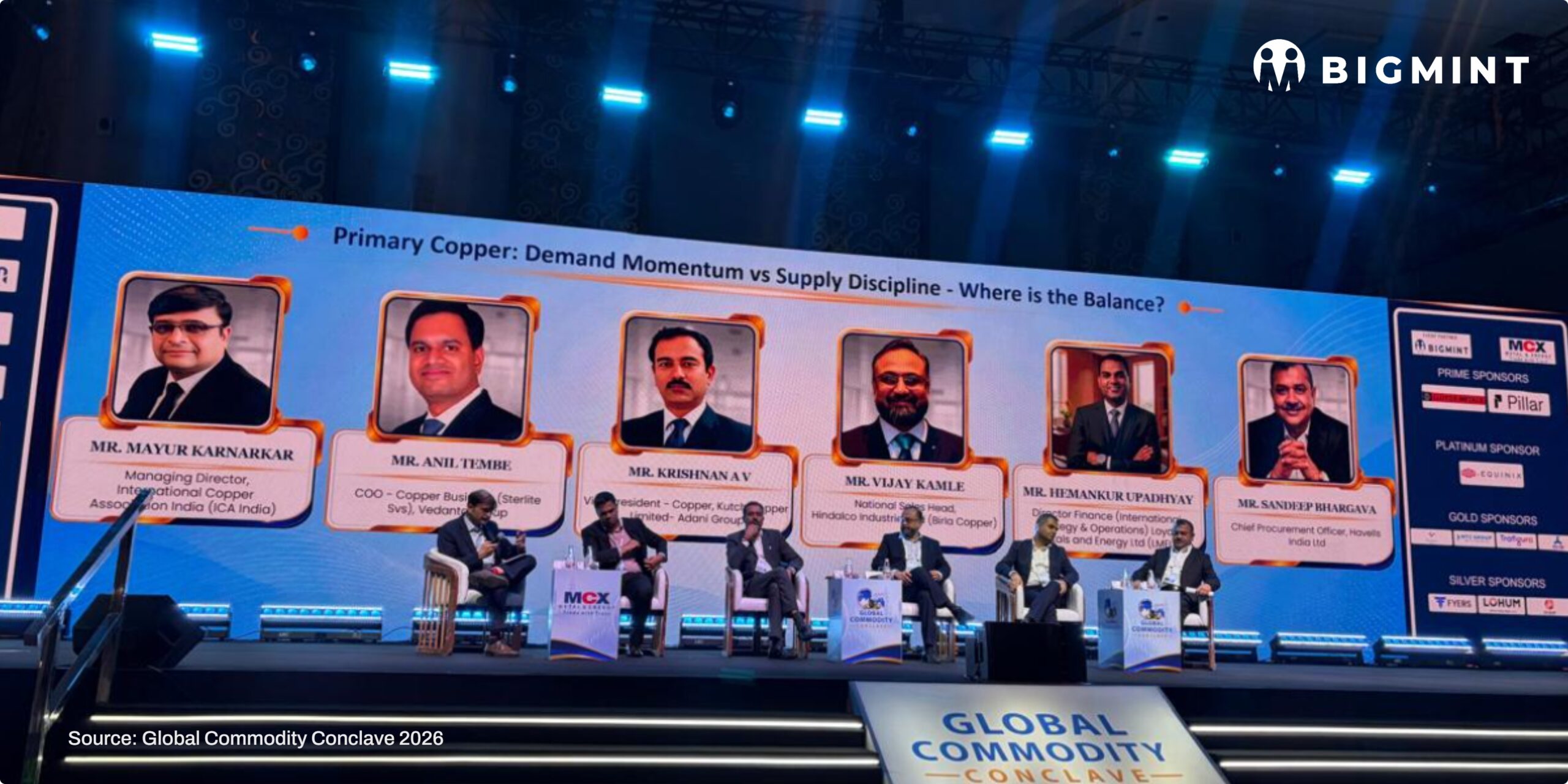
The Global Commodity Conclave (GCC) 2026, hosted by MCX with BigMint as the Event Partner, is being held from 12-14 August 2026 at the Jio World Convention Centre, Mumbai. Speaking at the session “India’s Copper Demand Outlook: Can Domestic Supply Keep Pace?”, panelists highlighted that India’s copper demand is entering a structurally stronger phase, driven by infrastructure, power transmission, renewables, electric vehicles and data centres.
India’s copper demand growth outpaces GDP
India’s copper consumption is estimated at around 2 million tonnes (mnt) in 2026 and is projected to reach around 3 mnt by 2030, with demand growing at 9.5-10% annually, well above GDP growth of 7-7.4%. While new smelting capacity is expected to improve domestic refined copper availability and reduce dependence on refined copper imports, securing adequate copper concentrate remains a key challenge as India’s refining capacity expands.
Per-capita copper consumption has increased to around 1.2 kg in 2025, including primary and secondary copper, but remains well below the global average of more than 4 kg, indicating significant headroom for long-term growth. Construction, infrastructure and industrial applications remain the key demand drivers, while renewables, EVs and data centres-currently accounting for around 6-7% of demand-are expected to grow faster.
India currently has around 1.5 mnt of refined copper capacity, against actual production of around 0.7-0.8 mnt. New capacity and ramp-ups are expected to significantly improve domestic availability over the next 24–30 months.
Hindalco plans to add around 300,000 tonnes (t) of smelting capacity over the next 2-3 years, alongside rod-mill expansion. Meanwhile, the new copper smelter discussed at the GCC has around 500,000 t of copper metal capacity and is ramping up towards design-feed parameters.
The capacity additions could materially narrow India’s refined copper deficit. However, strong demand growth means a substantial portion of incremental domestic output could be absorbed internally.
Refined copper imports likely to moderate
India currently imports around 0.3-0.5 mnt of refined copper annually. As domestic capacity ramps up, refined copper imports are expected to decline, although they are unlikely to disappear completely.
The key shift could be in the composition of India’s import dependence. As domestic smelting capacity rises, the country could move from importing refined copper to increasingly importing copper concentrate as feedstock for domestic smelters.
Concentrate availability emerges as key supply risk
Concentrate availability remains the biggest strategic challenge for India’s copper sector. With limited domestic resources and Hindustan Copper Ltd (HCL) being the only primary copper mining company, Indian smelters remain heavily dependent on overseas concentrate.
India’s copper concentrate imports increased from around 0.87 mnt in 2021 to 1.44 mnt in 2025, a CAGR of around 13%. Imports reached around 0.60 mnt in the first four months of 2026, up 62% y-o-y.
The challenge will intensify as new smelters ramp up. Global concentrate supply is also tightening due to disruptions and policy risks in major producing regions, including Chile, Indonesia and the DRC, while uncertainty around Cobre Panamá remains another supply-side risk.
Long-term offtake agreements and overseas mining investments will therefore be critical. Recent discussions around sourcing concentrate from Chile underline the growing focus on securing overseas resources.
Industry seeks government support for overseas mining
Industry participants called for stronger government support to help Indian companies secure overseas copper resources. Suggested measures include state-backed risk guarantees, government-to-government agreements, logistics support and 15-20-year project financing.
The long development cycle of copper mines makes such support important, with greenfield projects potentially taking around 15-17 years from discovery to production.
Indian companies are also expected to increasingly pursue minority investments and long-term offtake agreements with overseas miners to secure concentrate supplies. Such investments will need to be aligned with the policies of resource-rich countries, some of which may prefer exports of refined or semi-processed copper rather than concentrates.
TC/RCs hit smelter economics in 2026
The sharp decline in treatment and refining charges (TC/RCs) has emerged as a major challenge for global copper smelters in 2026. Concentrate availability has tightened while smelting capacity has expanded, pushing TC/RCs to historically low levels.
This is particularly important for India, where expanding smelters will remain dependent on imported concentrate. Lower TC/RCs are compressing traditional smelting margins, forcing producers to focus on plant efficiency, lower operational leakages, supply-chain optimisation and higher by-product recovery.
Recycling to gain importance in India’s copper supply mix
Secondary copper is expected to become an increasingly important source of supply. Recycling currently accounts for around 40% of India’s copper consumption, with the share expected to rise to 42-43% over the next decade.
However, recycled copper’s contribution within primary production remains around 5%, with the industry targeting around 20% over the next 10 years and potentially 25-30% or higher over the longer term.
The major challenge is collection. Industrial scrap generation can be only 3-5% of a producer’s output, making reverse logistics difficult, particularly for smaller consumers. A significant portion of the recycling ecosystem also remains informal.
EPR to drive greater copper circularity
Extended Producer Responsibility (EPR) could accelerate formalisation by improving traceability and encouraging greater recovery of copper from end-of-life products. However, effective implementation will require coordination among producers, consumers, recyclers and the informal sector.
At the same time, India needs greater downstream processing capacity. Rising cathode availability alone will not be sufficient if shortages persist in products such as copper tubes and other fabricated products.
Outlook
India is moving towards greater refined copper self-sufficiency, but this will not eliminate import dependence; rather, the dependency is likely to shift towards copper concentrate. Meeting the projected 3 mnt demand by 2030 will therefore require simultaneous expansion of refining, overseas resource access, downstream processing and recycling.
With historically low TC/RCs, securing concentrate and improving smelter economics will remain the key challenges, while recycling and EPR can provide an increasingly important secondary source of copper. The ability to build an integrated domestic and overseas supply chain will determine how effectively India meets its rapidly rising copper requirements.
The Global Commodity Conclave (GCC) 2026, hosted by MCX and partnered by BigMint

Leave a Reply