- Domestic coal prices rise amid tight availability due to monsoon
- Trade remains need based despite improved buying interest
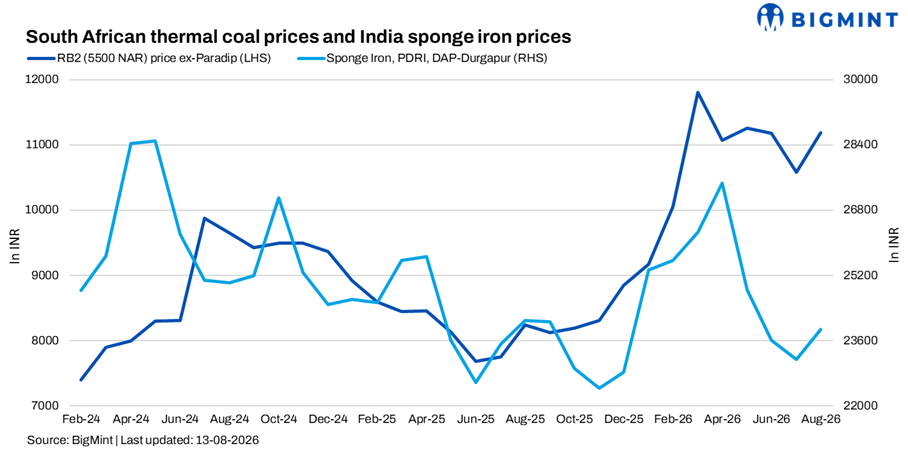
South African thermal coal prices at Indian ports increased further w-o-w on 13 August 2026, supported by stronger demand from overseas markets, firmer international energy indicators, and improving buying interest from India’s sponge iron sector. However, domestic coal remained the preferred fuel for many consumers, limiting the recovery in import demand. BigMint assessed RB2 (5,500 NAR) ex-Paradip at INR 11,450/t, up INR 300/t w-o-w, while RB2 ex-Vizag rose INR 650/t to INR 11,350/t. RB3 at both ports increased INR 200/t w-o-w to INR 9,400/t.
Port inventories decline sharply
India’s thermal coal inventories at major ports declined by about 15% w-o-w to 11.79 mnt as on 9 August from 13.86 mnt in the previous week. The drawdown was driven by stronger evacuation of existing cargoes across most major ports, while fresh arrivals remained insufficient to offset offtake.
The sharp inventory decline indicates increased movement of imported coal, although it does not necessarily signal a broad-based recovery in import demand. Consumers continued to procure imported cargo selectively, while domestic coal availability remained an important alternative.

International demand supports South African offers
Market participants said South African coal prices strengthened as demand from overseas markets increased, with expectations of additional buying from Asian markets also supporting sentiment. Firmer energy-related indices and higher gas prices added to the broader upward movement in coal offers.
Indian buyers also reported a modest improvement in demand from the sponge iron sector. However, several local sponge iron producers continued to resist higher South African coal prices because they held sufficient domestic coal stocks.
Trading activity remained selective at elevated levels. A buyer purchased RB3 from Goa at around INR 9,100/t, while RB3 offers at Mangalore were heard at no less than INR 9,000/t. A 2,000 t RB2 cargo was also purchased from Mangalore at around INR 10,900/t during the previous week.
One sponge iron producer reported using a blend comprising around 40% South African RB3, 40% RB2, and 20% Indonesian 4,200 GAR coal, reflecting continued interest in optimising fuel economics despite higher import prices.
Domestic coal prices strengthen further
Indian domestic non-coking coal prices strengthened further amid tight availability and firmer price expectations. BigMint assessed 5,000 GCV coal ex-Bilaspur at INR 6,750/t on 11 August 2026, up INR 250/t w-o-w, while 4,500 GCV coal increased INR 150/t w-o-w to INR 5,150/t. Market participants said constrained availability and monsoon-related disruptions continued to affect coal grades and supply consistency, prompting traders to maintain firmer offers.
Sponge iron demand improves
The sponge iron market showed stronger sentiment across major regions during the week. PDRI ex-works Raipur increased INR 500/t w-o-w to INR 25,950/t, while PDRI DAP-Durgapur rose INR 900/t to INR 24,750/t as on 13 August.
In eastern India, limited sponge iron availability following maintenance shutdowns at some plants supported seller confidence. After relatively slow demand in the previous week, buyers became more active, allowing producers to raise offers and secure sales at higher levels.
However, purchasing remained largely need-based. Some buyers moderated bookings after prices increased, while producers continued to face margin pressure from higher raw material costs.
The improvement in sponge iron demand provided some support to imported coal enquiries, but the response remained measured as consumers continued comparing imported coal with available domestic supplies.
Outlook
South African coal import demand is likely to remain selective as higher international offers compete with domestic coal stocks. However, stronger sponge iron demand, lower port inventories, and continued buying interest from overseas markets could keep portside prices supported. Any further rise in international energy indicators or freight costs may add to replacement costs, while sustained improvement in Indian sponge iron demand could encourage additional requirement-based imports.
Leave a Reply