- High-grade ore demand remains firm on limited availability
- Import vessel from Australia to arrive at Krishnapatnam by weekend
Karnataka’s iron ore prices remained stable w-o-w during 7-13 August 2026, with market activity subdued as sellers largely focused on clearing pending orders. Fresh spot transactions remained limited, while firm finished steel and sponge iron prices, along with expectations of higher non-coking coal costs, provided underlying support to the raw material market.
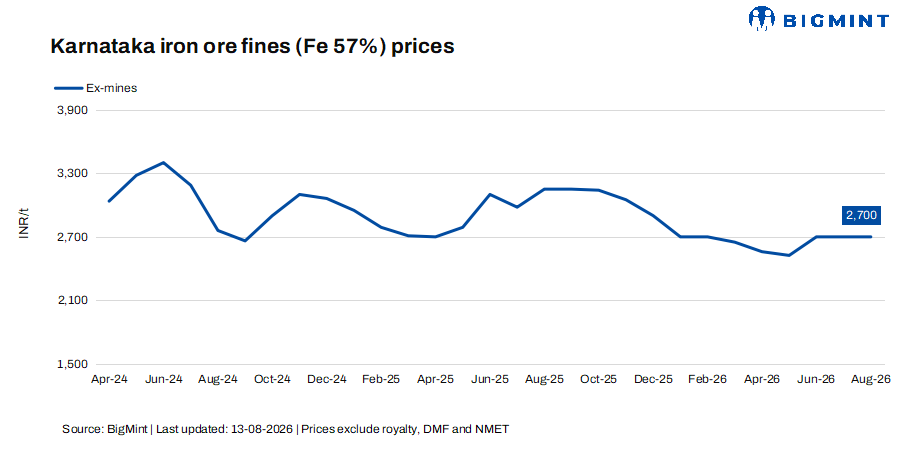
BigMint’s assessment for Fe 57% iron ore fines remained unchanged w-o-w at INR 2,700/t ($28/t) ex-mines. Demand for lower-grade material remained weak amid ample availability, with only a few buyers actively procuring. Meanwhile, Fe 62% fines remained stable at INR 5,000/t ($52/t) ex-mines, supported by tight availability and comparatively stronger buying interest.
High-grade ore continued to attract better demand as buyers preferred higher-quality material to improve furnace efficiency and manage production costs. However, limited availability also restricted fresh transactions. Miners remained focused on dispatching material sold through earlier auctions, keeping spot market activity subdued during the week.
Auction activity remained limited, particularly for lower-grade material. Buyer participation was weak in lower-grade auctions, while high-grade material continued to receive better acceptance. Rainfall further reduced buying activity as higher moisture levels and difficult mine access made lifting material from mines more challenging.
The subdued procurement environment has kept the market largely balanced. Buyers have continued to procure according to immediate production requirements rather than build inventories. This has prevented tighter high-grade availability from translating into a sharper price increase.
Firm finished steel prices have also helped underpin the raw material market. Higher steel realisations have supported sponge iron margins and reduced pressure on producers to lower raw material buying prices. However, monsoon-related weakness in construction activity continues to keep downstream procurement cautious, limiting the impact of firm steel prices on fresh iron ore demand.
The Union government’s Mines and Minerals (Development and Regulation) Amendment Bill, 2026, has provided an additional positive sentiment factor for the mining industry. The Bill proposes inserting Section 9D into the Mines and Minerals (Development and Regulation) Act, 1957, restricting state governments from imposing taxes, cess or other levies on mineral rights or mineral-bearing lands except under conditions or restrictions prescribed by the central government.
Despite support from downstream markets, buyers remain cautious about elevated raw material prices. A buyer said, “Iron ore buying interest remained limited as pellets were available at more competitive prices.” The buyer also highlighted difficulties in lifting material from mines during the rainy season and expects raw material prices to face downward pressure if demand remains subdued.
Rationale
- Zero (0) trade via e-auction was recorded for Fe 57% in this publishing window and was not taken into consideration. Hence, the T1 trade category was accorded 0% weightage.
- Seventeen (17) offers and indicative prices were reported, out of which fourteen (12) were considered as T2 trades. These were accorded 100% weightage.
Iron ore import bookings regain momentum: Iron ore import bookings in Karnataka have regained momentum after a couple of months. An Indian steel maker has booked Australian fines cargo for Fe 57% grade with expected arrival in the next couple of days, according to sources. Prior to this, the mill had been importing Brazilian cargo earlier this year. A drop in global iron ore prices has likely prompted the shift to imports.
C-DRI prices rise by INR 350/t ($3.5/t) w-o-w in Bellary: Bellary’s coal-based direct reduced iron (C-DRI) prices increased by INR 350/t ($3.5/t) w-o-w to INR 27,150/t ($285/t). Tighter spot availability and expectations of higher non-coking coal prices supported sponge iron prices during the week. The increase in sponge iron prices has provided additional support to iron ore values by improving the realisation of downstream steelmakers. However, higher sponge iron prices have not resulted in aggressive iron ore restocking, as buyers remain cautious about steel demand and continue to procure mainly against immediate production requirements.
Karnataka iron ore sales scenario (7- 13 August 2026)

Outlook
Karnataka iron ore prices are expected to remain stable to firm through August, supported by limited high-grade availability, firm sponge iron prices, and higher coal cost expectations. However, weak lower-grade demand, subdued auction activity, pellet competition and monsoon-related logistics constraints may limit significant upside.
Leave a Reply