- India’s share of global ship recycling increased to 35.4% in 2025
- Alang-Sosiya cluster accounts for around 98% of India’s ship recycling
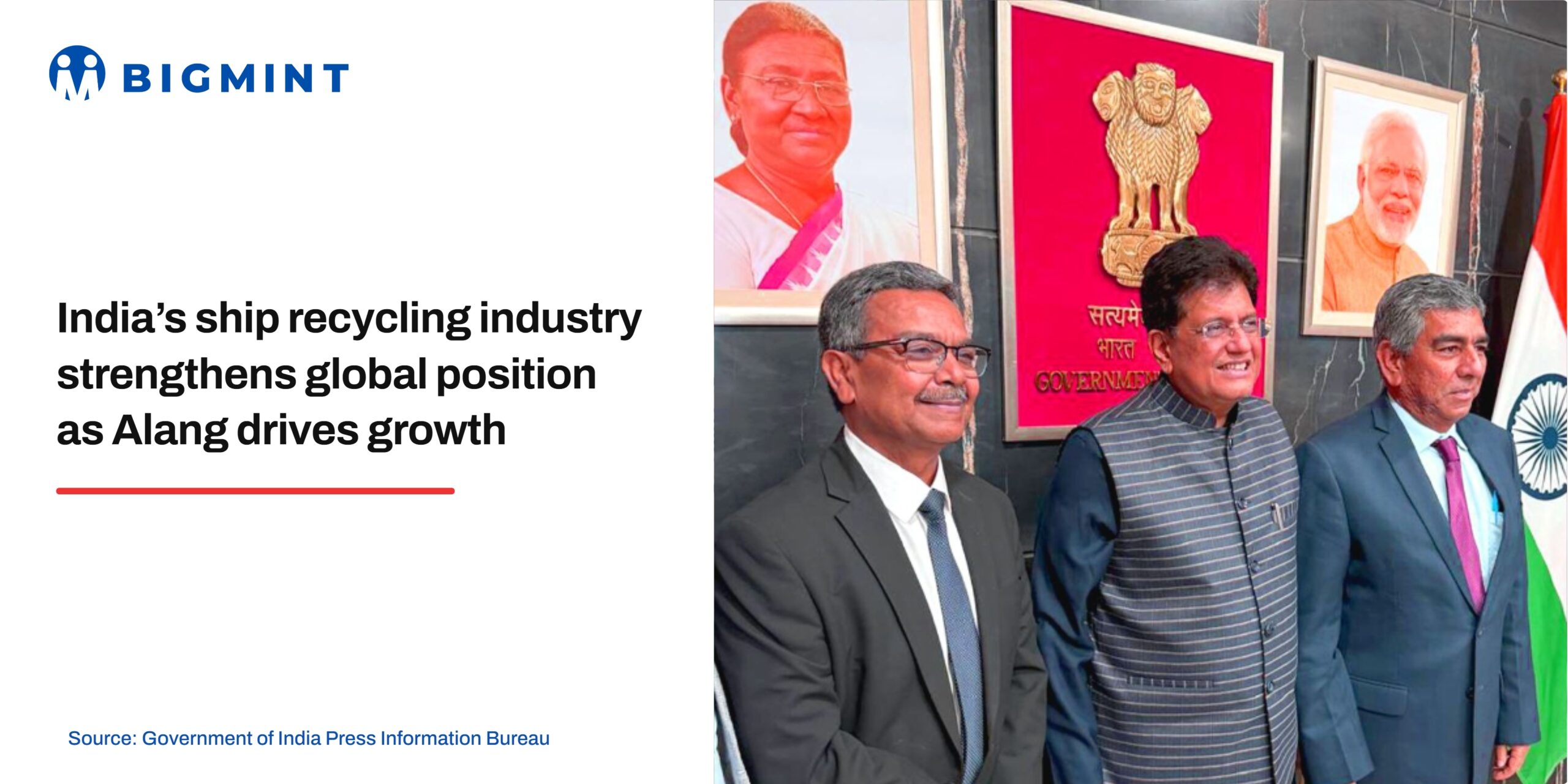
According to official information shared by the Indian Shipowners’ Association (ISA), the Association’s Secretary General and members attended a meeting chaired by the Minister of Commerce and Industry at Udyog Bhawan on 11 August 2026. The meeting was attended by secretaries from several Government of India departments and senior officials, with discussions focusing on India’s ship recycling sector, EU regulations, measures to expand ship recycling and challenges related to the recycling of recovered steel and other materials.
The Alang-Sosiya cluster in Gujarat continues to dominate India’s ship recycling industry, accounting for around 98% of the country’s activity. The cluster has annual recycling capacity of around 6 million GT and produces approximately 3.5 million tonnes (mnt) of steel annually through ship recycling.
The cluster has undergone significant modernisation, with recycling yards adopting engineered plots, impermeable working surfaces, mechanised material-handling equipment, dedicated hazardous-waste storage and improved safety systems.
India is also planning to expand ship recycling capacity to around 9 million light displacement tonnes (LDT). A master plan for the Alang Ship Recycling Yard has been prepared to support infrastructure development and strengthen the cluster’s competitiveness.

Higher recycling supports domestic scrap availability
The expansion of ship recycling has growing significance for India’s ferrous scrap market. Recovered steel from end-of-life vessels provides an important source of metallic input for domestic steelmakers while reducing dependence on primary raw materials.
Ship recycling also supports the circular economy through the recovery and reuse of steel and other materials. The sector has linkages with downstream industries including re-rolling mills, transportation, equipment suppliers and waste-management services.
With India’s scrap consumption expected to increase over the coming years, higher ship recycling activity could provide an additional source of domestic ferrous scrap, particularly for secondary steelmakers.
Regulatory framework strengthens compliance
India’s ship recycling industry is operating under a more structured regulatory framework through the Ship Recycling Act, 2019, Ship Recycling Rules, 2021 and Ship Recycling Regulations, 2026. The framework covers yard authorisation, ship recycling plans, hazardous-material management, worker safety and compliance monitoring.
The regulatory framework is aligned with the Hong Kong International Convention for the Safe and Environmentally Sound Recycling of Ships, which entered into force on 26 June 2025. India has provided INR 53.5 crore in financial assistance for yard modernisation, helping 115 facilities achieve compliance with the convention.
Meanwhile, around 35 ship recycling yards at Alang have applied for EU green-listing, with inspections initiated by the European side. Two Indian facilities have been included in the draft 16th European List of Ship Recycling Facilities.
Credit scheme links recycling with shipbuilding
The Ship-breaking Credit Note Scheme under the Ship Building Financial Assistance Scheme 2.0 aims to encourage shipowners to recycle vessels at compliant Indian yards while supporting domestic shipbuilding.
Under the scheme, shipowners can receive a credit note equivalent to 40% of the recycled ship’s scrap value. The credit can be used towards payment of up to 5% of the value of a new vessel built at an Indian shipyard.
Outlook
India’s ship recycling industry is entering a phase of capacity expansion, infrastructure modernisation and stronger regulatory compliance. Rising recycling volumes and closer alignment with international standards are expected to support the competitiveness of Indian yards.
For the ferrous scrap market, higher ship recycling volumes could provide an increasingly important source of domestically recovered steel. As India’s steelmakers increase their reliance on recycled metallics, the expansion of organised ship recycling could strengthen domestic scrap availability and support the country’s broader circular steelmaking objectives.
Leave a Reply