- Installed capacity reaches 300.8 mnt/y, washed coal just 2.7% of total production
- Merchant operators dominate capacity, public sector share around 28%
- Washeries turning into coal preparation plants offering specification-based products
Data Deep Dive: India’s coal-beneficiation industry has expanded into a processing network with nearly 301 million tonnes per annum (mnt/year) of listed raw-coal capacity, yet official data show washed coal continues to account for only a small fraction of domestic coal production.
Installed washery capacity measures raw-coal throughput, while official production statistics measure only the clean-coal fraction recovered after beneficiation. Washery capacity measures the volume of raw coal that plants can process, while official production data record only the clean-coal fraction recovered after middlings and rejects are separated.
Steelmakers, power producers and coal-conversion projects increasingly require specification-based fuels rather than raw coal, making operational throughput, combustible recovery and product quality more representative indicators than installed capacity.
Capacity concentrates around India’s coal and steel belt
BigMint’s FY26 plant database identifies 114 coal washeries and beneficiation facilities with aggregate listed raw-coal processing capacity of 300.8 mnt/y. Capacity is concentrated around India’s eastern and central coalfields, reflecting the geographical overlap between coal reserves and major steel, sponge iron, cement and thermal power clusters.
Chhattisgarh alone accounts for 138.9 mnt, or 46.2% of the listed national capacity. Odisha contributes 54.358 mnt (18.1%), while Jharkhand accounts for 53.62 mnt (17.8%). Together, the three states hold 246.878 mnt, equivalent to 82.1% of India’s listed washery capacity. Including Maharashtra raises the concentration to 94.4%, highlighting the close relationship between beneficiation facilities, coal production and downstream industrial demand.

Chhattisgarh has developed into India’s largest merchant washery cluster, where facilities process raw coal into multiple products serving sponge iron plants, cement producers, captive power stations and thermal utilities. Rather than producing only washed coal, merchant washeries generate higher-grade clean coal, middlings, lower-grade fractions and rejects, with plant economics determined by the combined value of each product stream.
Odisha’s beneficiation network is more closely integrated with mine-mouth industrial development around Talcher, Angul, Jharsuguda and Ib Valley, supporting the state’s coal, steel, aluminium and power sectors. Jharkhand, meanwhile, remains India’s principal coking-coal beneficiation base, where washeries linked to BCCL, CCL, Tata Steel and SAIL process coal to lower ash content suitable for metallurgical coke blends.
Private operators dominate installed capacity
Private companies account for the largest share of India’s listed washery capacity, although the industry’s ownership structure is more balanced than generally perceived. Private merchant washeries account for 171.116 mnt, or 56.9% of listed capacity, while private captive facilities contribute another 45.012 mnt (15%). Combined private-sector capacity therefore reaches 216.128 mnt, representing 71.9% of the national total. Coal India subsidiaries account for 53.780 mnt, while state-owned producers, utilities and other central public-sector enterprises contribute a combined 30.890 mnt, taking the public-sector share to 28.1%.

Within the merchant segment, capacity is concentrated among a small number of operators. Aryan Coal Beneficiation has aggregate listed capacity of 72.49 mnt, accounting for around 42.4% of India’s private merchant washery capacity. Hind Maha Mineral (14.85 mnt), KJSL (10.9 mnt), Hind Energy & Coal Beneficiation (10.77 mnt) and GCMPL (8 mnt) are the next-largest operators.
CIL’s washery portfolio remains concentrated in the country’s coking coal belt. BCCL and CCL together account for 36.08 mnt, or around two-thirds of Coal India’s listed washery capacity, reflecting the concentration of domestic coking coal resources in the Jharia, Bokaro and Ramgarh coalfields.
Installed capacity and effective production
India’s listed washery network has expanded rapidly, but official production data indicate that the country’s effective clean-coal system remains comparatively small.
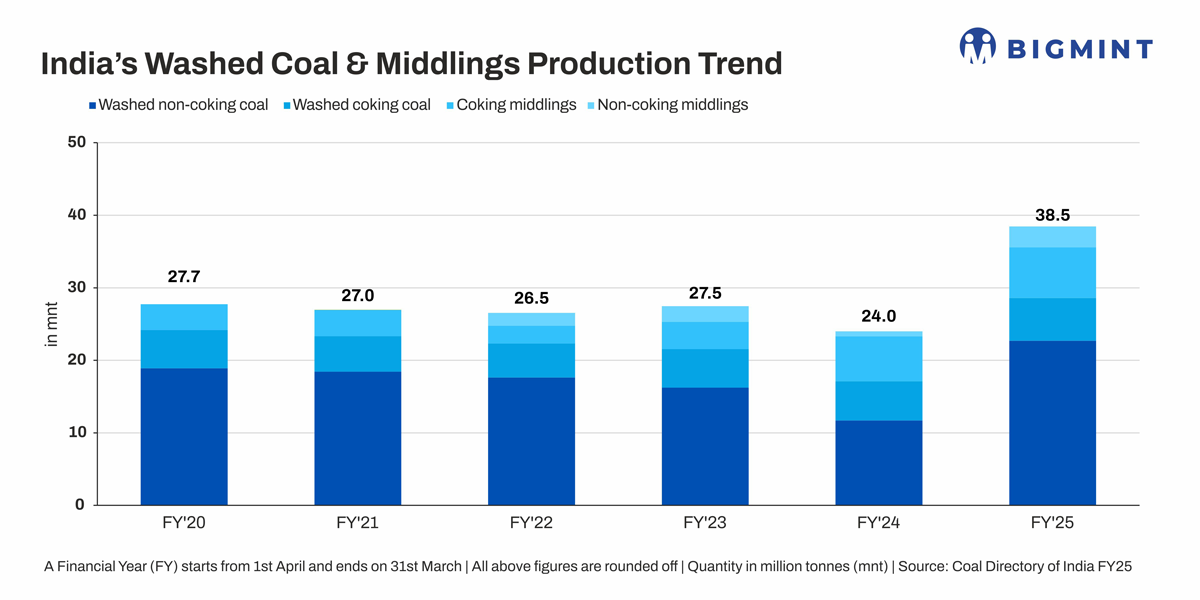
Combined production of washed coking and non-coking coal increased from 17.113 mnt in FY24 to 28.59 mnt in FY25. Washed coking coal production rose to 5.903 mnt from 5.397 mnt, while washed non-coking coal output almost doubled to 22.687 mnt from 11.716 mnt. Production of coking middlings increased to 6.98 mnt from 6.193 mnt, while non-coking middlings recovered to 2.89 mnt from 0.691 mnt.
Despite the sharp increase, washed coal represented only a small proportion of India’s overall coal industry. Against raw-coal production of 1,047.52 mnt in FY25, total washed coal output accounted for only 2.7% of national production, even though the country has listed washery capacity of 300.8 mnt/y.

During beneficiation, part of the raw feed is separated into middlings and rejects, meaning clean coal production will always be materially lower than raw coal throughput. The two datasets therefore measure different stages of the process and cannot be compared directly to estimate capacity utilisation.
For example, a washery with 5 mnt of raw coal processing capacity operating at 80% utilisation would process 4 mnt of raw coal. If clean coal recovery were 60%, the plant would produce only 2.4 mnt of washed coal, even though operational utilisation remained high. Comparing clean coal production with installed feed capacity would therefore understate actual plant utilisation.
Official production statistics include washeries belonging to coal producing companies, while BigMint’s FY26 capacity database covers a broader universe of captive and merchant beneficiation facilities. Some listed plants may also be temporarily idle, operating below rated throughput or processing coal intermittently in response to market conditions.
Operational raw coal throughput, clean coal recovery, plant availability and the commercial utilisation of middlings and rejects provide a more accurate measure of how effectively beneficiation assets are being deployed. Washery economics increasingly depend on maximising value across every product stream rather than producing the highest possible volume of clean coal.
Coal quality shapes beneficiation demand
India’s growing focus on beneficiation reflects the quality of its coal resource as much as the size of its reserves. As of April 2025, India held 400,715.45 mnt of geological coal resources, of which 361,647.82 mnt, or 90.25%, comprised non-coking coal, including high-sulphur grades. Prime coking coal accounted for only 5,443.41 mnt, or 1.36% of total resources, while medium coking coal represented 7.52% and blendable or semi-coking coal only 0.45%.
The limited availability of domestic coking coal explains why beneficiation occupies different positions across India’s major coal-consuming industries. For steelmakers, washing is essential for reducing ash content and increasing the usable share of domestic coking coal in metallurgical blends. India imported 57.58 mnt of coking coal during FY25 because indigenous production remains insufficient both in quantity and quality to meet blast furnace requirements. Beneficiation therefore increases the value of domestic coal rather than eliminating import dependence.
In the power sector, the economics differs. Coal washing becomes commercially viable when improvements in delivered calorific value, lower freight costs, reduced ash handling and more consistent boiler performance outweigh beneficiation costs and combustible losses. Merchant washeries also create additional value by separating a single raw coal feed into multiple products serving sponge iron plants, cement producers, captive power stations and thermal utilities.
Beneficiation increasingly supports specification-based fuel markets, improves railway efficiency by reducing the movement of inert material and provides more consistent feedstocks for thermal generation, steelmaking and emerging coal-conversion technologies.
From coal cleaning to coal preparation
Demand from steelmaking, thermal power generation and coal-conversion projects is increasing the requirement for specification-based coal products rather than untreated run-of-mine coal. The commercial objective is no longer to produce coal with the lowest possible ash content, but to deliver specification-compliant products while maximising recovery, transport efficiency and value across every output stream.
Coal washing does not create additional energy. It separates part of the inert mineral matter from raw coal, concentrating more of the combustible material into the clean coal stream. Depending on feed characteristics, washeries employ combinations of crushing and screening, jigs, heavy-media baths and cyclones, spiral concentrators, froth flotation, dry deshaling and water-recovery systems to produce products suited to different industrial applications.
The commercial challenge lies in balancing coal quality with combustible recovery. Excessive ash reduction can divert valuable combustible material into middlings and rejects, reducing overall resource utilisation even if clean coal quality improves. Beneficiation, therefore, seeks to achieve the required product specification rather than the lowest possible ash content, while maximising value from all product streams.
Steelmakers require washed domestic coking coal to improve metallurgical blends, thermal power stations seek more consistent fuel quality and lower ash handling costs, while sponge iron producers, cement plants and captive power stations utilise different fractions recovered from the same raw coal feed. Rather than producing a single premium product, modern washeries increasingly function as multi-product processing facilities supplying multiple industrial consumers simultaneously.
Under Mission Coking Coal, the Ministry of Coal aims to increase domestic raw coking coal production to 140 mnt by FY30 while expanding coking coal washing capacity to 58 mnt/y, from around 30 mnt/y currently. Coal India plans to commission eight coking coal washeries with combined capacity of 21.5 mnt by FY30, while modernising ageing BCCL and CCL facilities and monetising four older BCCL washeries through the Mine Developer and Operator (MDO) route. The programme seeks to increase the usable share of domestic coking coal rather than simply expand mining output.
Coal preparation is also becoming increasingly relevant to India’s coal-conversion programme. Coal gasification, coal-to-chemicals and synthetic fuel projects require feedstock with controlled characteristics, including particle size, ash content, moisture, sulphur, ash-fusion temperature and reactivity. While feed specifications vary by technology, gasification projects depend on consistent coal quality rather than untreated run-of-mine coal. Washeries are therefore likely to evolve into broader coal-preparation facilities capable of supplying specification-based products for gasification, methanol, synthetic fuels, chemicals, syngas and hydrogen projects.
Outlook
The expansion of listed washery capacity to 300.8 mnt has created a sizeable processing network, but its strategic value depends on how effectively that capacity is utilised to improve coal quality, increase combustible recovery and produce specification-compliant fuels for different industries.
Expanding domestic steel production, greater emphasis on fuel quality in thermal power generation and the development of coal-conversion projects are increasing demand for specification-based coal products.
The industry’s performance will therefore be measured less by processing capacity and more by operational throughput, clean-coal recovery, specification-based products, logistics efficiency, secondary product utilisation and delivered-energy economics. These metrics, rather than nameplate capacity alone, will determine the washery sector’s contribution to India’s long-term energy security.
Leave a Reply