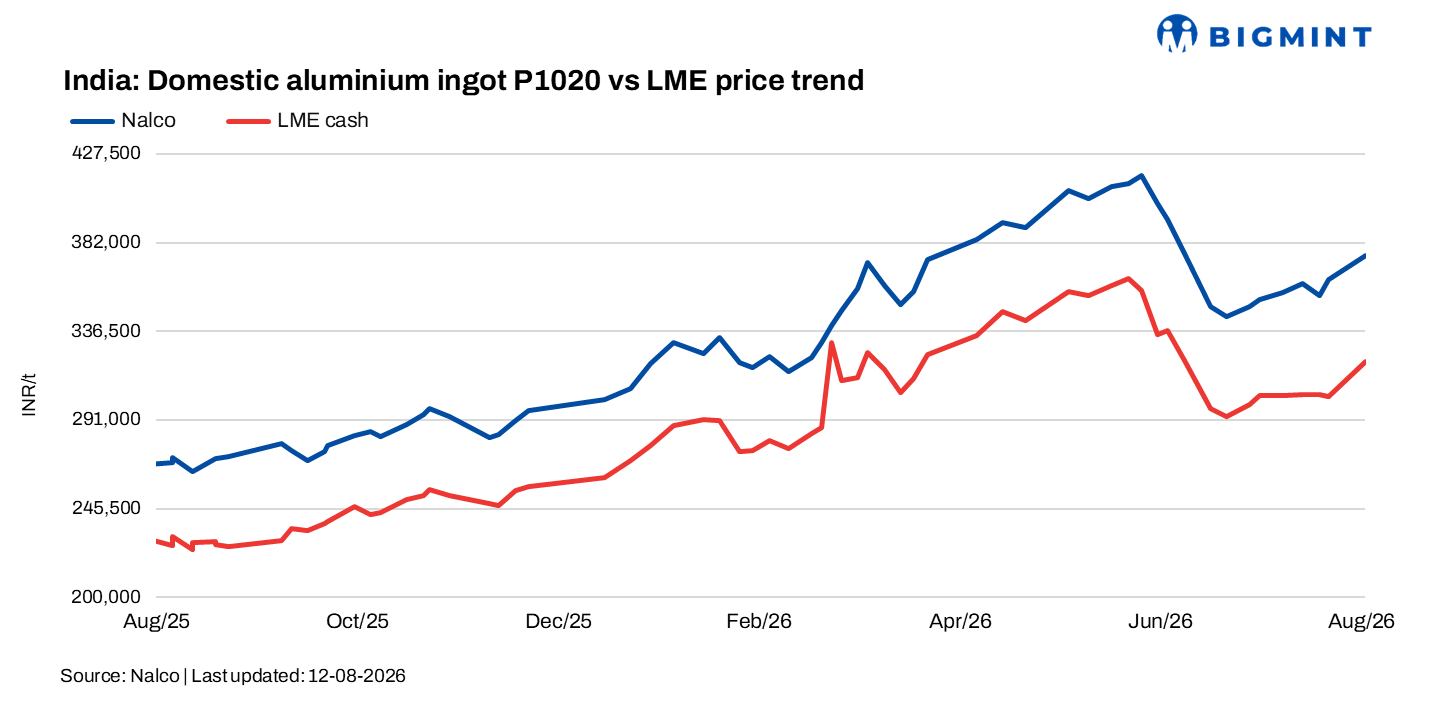
- LME prices rise by 1.4% d-o-d, inventories fall by 0.6%
- Domestic demand remains subdued amid monsoon
National Aluminium Company Ltd. (NALCO) has raised its IE10 aluminium ingot price by INR 11,900/t, or 3.3%, to INR 375,200/t, effective 12 August 2026 from INR 363,300/t on 1 August. The latest price rise follows a hike of INR 8,400/t on 1 August.
Global aluminium market provides support
The LME three-month aluminium contract stood at $3,364/t on 11 August, up 1.39% d-o-d and 5.7% from 31 July. Exchange stocks fell 0.59% d-o-d to 254,900 t, adding to the supportive market conditions.
Supply remains relatively tight. China’s aluminium output is capped by its capacity ceiling. Power-related risks and disruptions outside China are also limiting supply growth. However, rising Indonesian output and exports are adding fresh supply to the market.
Overall, higher global prices and declining exchange stocks appear to have provided the main support for NALCO’s latest price hike.
Price hike comes despite subdued domestic demand
Domestic demand for aluminium has remained subdued so far in August, with the ongoing monsoon season continuing to weigh on consumption across key end-user sectors. Most buyers have restricted purchases to immediate requirements, with limited interest in inventory building despite the recent uptrend in domestic and global aluminium prices. Notably, domestic aluminium premiums remained steady at around $330/t in the week ended 7 August 2026, indicating stable physical market conditions.
Outlook remains cautiously positive
NALCO’s latest increase points to a stronger pricing environment than seen in late July, when prices were reduced. Firm LME prices and falling exchange stocks are providing support. The near-term outlook for Indian aluminium prices remains positive, but volatility is likely to continue. Further inventory declines and steady demand could push prices higher.
Conversely, weaker Chinese demand, rising global supply or a correction in LME prices could reduce the upward momentum. Domestic buyers are therefore likely to remain cautious and focus on short-term requirements.
Leave a Reply