- Export volume rises 16% y-o-y, while value increases 10%
- US remains largest destination, with shipments rising 32%
Vietnam exported 168,429 tonnes (t) of pepper worth $1.08 billion during January-July, up 16.1% in volume and 10.1% in value from a year ago. Export growth was supported by stronger shipments to major markets, although volume growth outpaced value growth during the period.
Strong demand from major markets
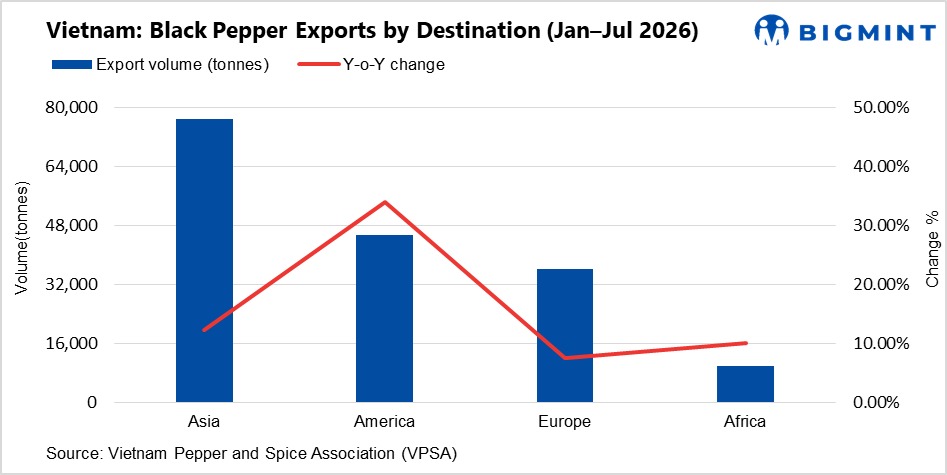
Asia remained the largest destination, with shipments rising 12.3% y-o-y to 76,845 tonnes and accounting for 45.6% of total exports. Exports to America increased 34% to 45,470 t, while shipments to Europe and Africa rose 7.5% to 36,140 t and 10% to 9,964 t, respectively.
The US remained the largest individual market, with exports rising 31.8% to 40,712 t. Shipments to China increased 55.8% to 17,110 t, while exports to Thailand and the Netherlands surged 88.7% to 6,913 t and 48.8% to 6,136 t, respectively. In contrast, exports to Germany and India declined 18.1% and 26.4%.
Vietnamese companies also imported 48,812 t of pepper worth $279.3 million during the period, up 55.1% in volume and 43% in value. Imports from Cambodia, the largest supplier, jumped 256.9% to 25,413 t, accounting for 52.1% of total imports.
Pepper continued to outperform other major spices. Cinnamon exports fell 1% to 73,085 t, with value declining 0.6% to $186.5 million, while star anise exports dropped 9.1% to 8,434 t, with value down 6.2% to $33.4 million.
Supply constraints shift industry focus
Vietnam’s pepper industry has limited scope to expand planted acreage after more than two decades as a leading global exporter. Land scarcity, competition from other crops, and tighter international requirements, including the EU Deforestation Regulation, are increasing pressure on the sector.
At the same time, EU alerts related to Vietnamese pepper and spices declined to 22 cases in the first half of the year from 34 cases a year earlier. Pepper-specific alerts fell to three from five, indicating improvements in quality control, pesticide residue management and compliance awareness.
With production growth increasingly constrained, the industry is shifting away from reliance on higher output and low pricing towards quality, branding and value addition. Exporters are being encouraged to develop certified raw-material zones, strengthen farmer partnerships, improve pesticide residue controls and traceability, and meet technical requirements in importing markets. The sector is also focusing on regenerative agriculture, circular-economy practices, lower emissions and efficient water use.
Outlook
Pepper prices are expected to remain broadly stable in the near term in the absence of major geopolitical shocks. US-bound exports are also expected to remain stable over the medium and long term.
Strong demand from key markets is supporting export growth, while the sharp rise in imports highlights the increasing importance of imported raw material in Vietnam’s pepper trade. With limited scope for acreage expansion, quality, compliance, traceability and value addition are expected to remain increasingly important for sustaining the sector’s growth.
Leave a Reply