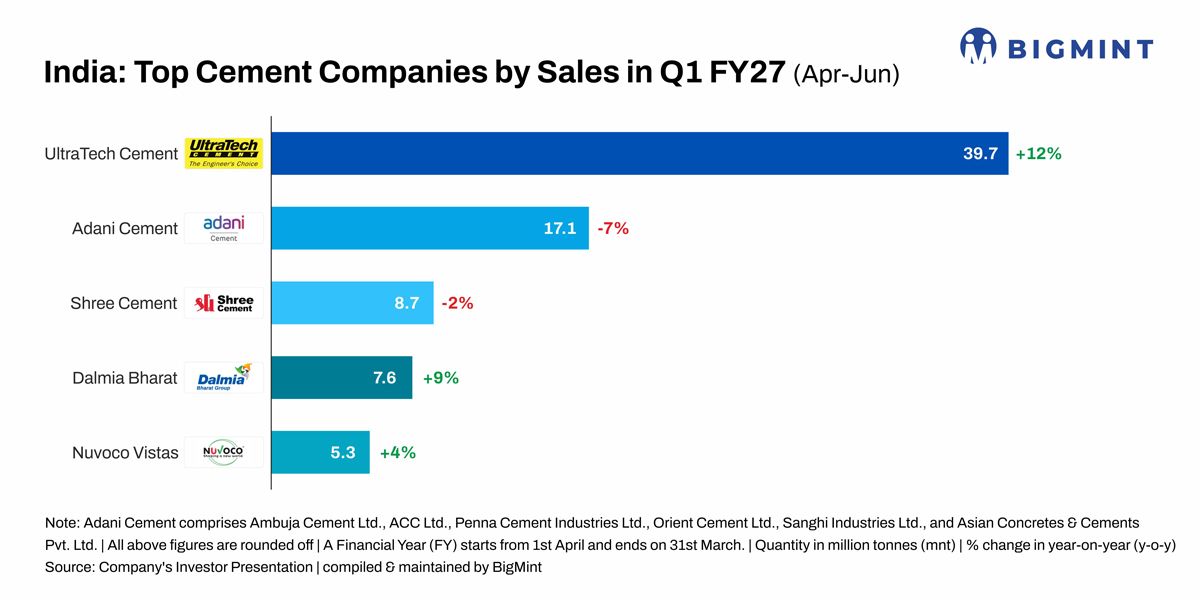
- Sales decline 8% q-o-q on seasonal slowdown, demand remains above year-ago levels
- Higher imported pet coke, coal and raw material costs compress profitability
- Dispatches to rise in Q2 FY’27 due to capacity additions during FY’26 and FY’27
Morning Brief: India’s five largest listed cement producers sold 78.44 million tonnes (mnt) in Q1FY’27, up 5% y-o-y from 74.85 mnt a year earlier, supported by continued infrastructure spending, housing demand and improving project execution. However, sales declined 8% q-o-q from 85.16 mnt in Q4FY’26 as monsoon-related seasonality slowed construction activity and cement dispatches. UltraTech Cement, Dalmia Bharat and Nuvoco Vistas reported year-on-year volume growth during the quarter, while Adani Cement and Shree Cement recorded lower dispatches.
Industry profitability weakened despite higher cement sales as rising fuel, raw material and imported input costs offset the benefits of stronger demand. EBITDA per tonne declined 3% y-o-y at UltraTech Cement, 13% at Adani Cement, 19% at Shree Cement and 16% at Dalmia Bharat, while Nuvoco Vistas was the only major producer to improve profitability, with EBITDA per tonne increasing 6% y-o-y. Imported pet coke prices increased to US$150/t in Q1FY’27 from US$108/t a year earlier, while imported non-coking coal prices rose to US$126/t from US$99/t and Indonesian coal prices increased to INR 10,320/t from INR 7,720/t. Raw material costs also increased, although lower logistics and power costs partly offset the rise in manufacturing expenses.

The increase in manufacturing costs reflected both higher global fuel prices and supply-chain disruptions. Shree Cement said geopolitical tensions in West Asia disrupted imports of pet coke and Omani gypsum, delaying contracted pet coke shipments and forcing a shift from lower-cost pet coke to higher-cost coal. Pet coke’s share in the company’s fuel mix declined to 9% in Q1FY’27 from 54% a year earlier, while coal usage increased to 74% from 26%.
The greater use of lower-quality coal reduced clinker conversion efficiency, increased clinker consumption and raised manufacturing costs, illustrating the broader cost pressures faced across the industry. The company said imported pet coke supplies have started normalising and expects fuel costs to stabilise over the coming quarters, provided geopolitical conditions do not deteriorate further.

Company updates
UltraTech Cement remained the industry’s largest producer, with cement sales increasing 12% y-o-y to 39.7 mnt, despite a 1% q-o-q decline. The company commissioned 8.7 mnt/year of additional capacity during the quarter, taking grey cement capacity to 205.5 mnt/year, and remains on track to exceed 242 mnt/year by FY’28. Management expects stable pricing and infrastructure-led demand to support growth, although higher fuel and packaging costs are likely to increase operating costs in Q2FY’27.
Adani Cement reported a 7% y-o-y decline in cement sales to 17.1 mnt, reflecting a deliberate reduction in lower-margin institutional sales and a greater focus on trade and premium products. The company remains on track to increase installed cement capacity to 119 mnt/year by the end of FY’27 while continuing cost optimisation and operational efficiency initiatives to offset imported fuel inflation.
Shree Cement reported cement sales of 8.74 mnt, down 2% y-o-y, while operational EBITDA declined to INR 1,272 crore and EBITDA per tonne fell to INR 1,111 from INR 1,339 a year earlier. The company attributed the decline to higher manufacturing costs following disruptions to imported pet coke and Omani gypsum supplies, which forced greater reliance on higher-cost coal and reduced clinker conversion efficiency. Management said imported pet coke supplies have started normalising and expects fuel costs to stabilise if geopolitical conditions remain unchanged.
Dalmia Bharat increased cement sales 9% y-o-y to 7.6 mnt, supported by improving construction activity, stronger premium product sales and stable regional pricing. The company completed the acquisition of JP Cement assets and expects installed cement capacity to increase to around 67 mnt/year by Q3FY’28 through ongoing expansion projects.
JK Cement reported the strongest volume growth among major producers, with cement sales increasing 18% y-o-y to 6.6 mnt, supported by higher dispatches from recently commissioned capacity in central India. Expansion projects remain on track to raise installed cement capacity to 40 mnt/year by FY’28, although the company expects higher fuel costs to increase operating expenses in Q2FY’27.
Outlook
We expect India’s cement demand to strengthen after the ongoing monsoon season as infrastructure projects, housing construction and commercial real estate activity regain momentum. Capacity additions commissioned during FY’26 and FY’27 are expected to support higher dispatches during the second half of the fiscal year, while stable pricing and continued government capital expenditure should underpin cement consumption.
Margins, however, are likely to remain driven by input costs rather than demand. The normalisation of imported pet coke supplies, movements in imported coal prices, diesel costs and other raw material inputs will determine the pace of profitability recovery across the sector. Producers are expected to continue focusing on renewable energy, premium cement sales, logistics optimisation and operating efficiencies to offset cost inflation, while higher utilisation of newly commissioned capacity should support earnings as construction activity accelerates after the monsoon.
Leave a Reply