- Sales tax changes disrupt domestic scrap procurement, local supply
- Monsoon disruptions curb mill operations, weaken downstream demand
Pakistan’s imported shredded scrap market remained subdued during the week as buyers resisted higher offers amid weak steel demand, monsoon slowdown, and sufficient mill inventories. Rising freight costs and tighter availability supported supplier offers, but limited buying interest kept workable levels below asking prices.
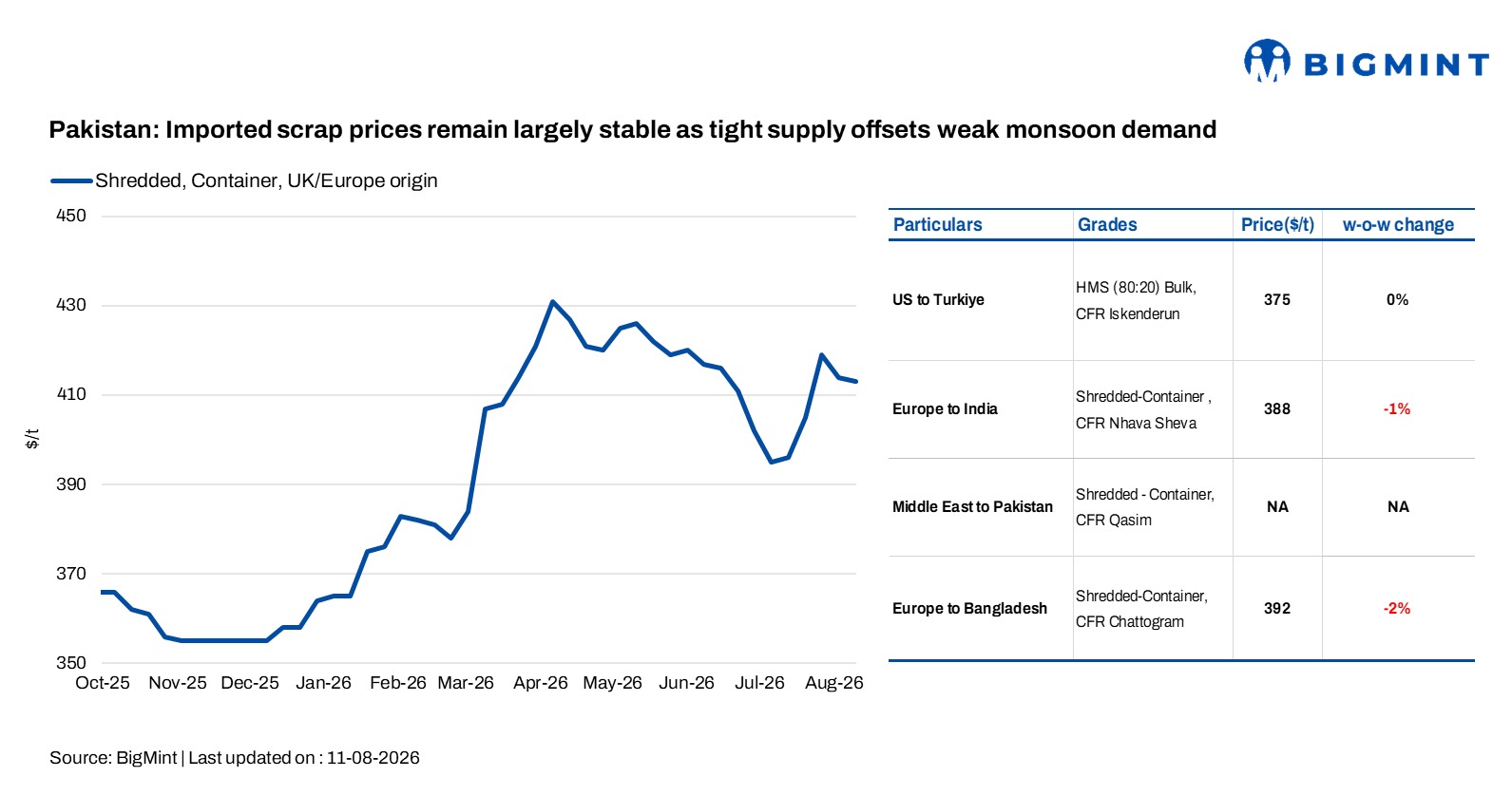
BigMint assessed shredded scrap at around $413/t CFR Port Qasim, down $1/t w-o-w. Firm supplier offers and elevated freight costs prevented a sharper decline despite weaker domestic demand, while cautious buying amid subdued rebar demand continued to cap market activity.
Market updates
Around 8,000 t of European-origin shredded scrap has been booked at $412-425/t CFR Qasim since last Tuesday, 4 August.
UK-origin shredded scrap was offered at $415-420/t CFR Qasim, with some suppliers targeting $420-422/t. Reported deals were concluded at $412-417/t, depending on quality and shipment status. A 2,500 t UK-origin booking cargo was concluded at $412-414/t CFR, while 500 t of on-water UK shredded was sold at $425/t CFR. EU-origin material was also booked at around $418/t CFR for 500 t. The premium for on-water cargoes over booking material was around $10-15/t.
A major Peshawar-based steel mill said domestic rebar demand remained weak due to rains, transporters’ strikes and high transportation costs. The mill noted EU shredded scrap at around $412-415/t CFR, while local scrap prices fell by PKR 5,000-6,000/t ($18-22/t) w-o-w. The mill also reported buying 3,000 t of EU-origin shredded scrap at $412/t CFR Qasim.
Fresh shredded scrap offers were heard at $414-416/t CFR, while some suppliers were quoting up to $420/t CFR. An arrived cargo deal at $417/t CFR was also reported. Market participants said elevated freights, including war-related surcharges, continued to raise replacement costs and limited suppliers’ willingness to lower offers.
Domestic market
Domestic scrap prices were heard at PKR 145,000-148,000/t ($523-534/t), while rebar and billet were around PKR 245,000-250,000/t ($883-901/t) and PKR 220,000-225,000/t ($793-812/t), respectively. Heavy monsoon rainfall, particularly in Punjab, continued to weigh on construction activity and finished steel demand.

A Karachi-based steelmaker said the revised sales tax mechanism has disrupted local scrap procurement, as higher tax costs have discouraged yards from supplying material. As a result, mills relying on domestic scrap have adopted a wait-and-watch approach, while import-dependent mills remain largely insulated.
Under the revised policy, effective retrospectively from 1 July, steelmakers using over 70% imported scrap will pay the lowest electricity-linked sales tax of PKR 5/unit, compared with PKR 30/unit for local scrap users and PKR 35/unit for captive power-based producers, effectively favouring imported scrap consumption.
Mills were also carrying sufficient inventories following substantial purchases in recent weeks, reducing urgency for September cargoes. Meanwhile, Karachi Port congestion and limited container movement continued to complicate deliveries to consuming mills.
Heavy rainfall has further reduced mill operating rates to around 30-35%, while sales remained at only 40-45% of normal levels, sharply reducing local scrap demand.
Outlook
Pakistan’s imported scrap market is likely to remain cautious, as weak construction demand and high mill inventories limit overall buying. Lower domestic scrap usage could provide some support to import interest, but rain-related disruptions and slower downstream demand are likely to offset any improvement in buying appetite and limit scope for price increases.

Leave a Reply