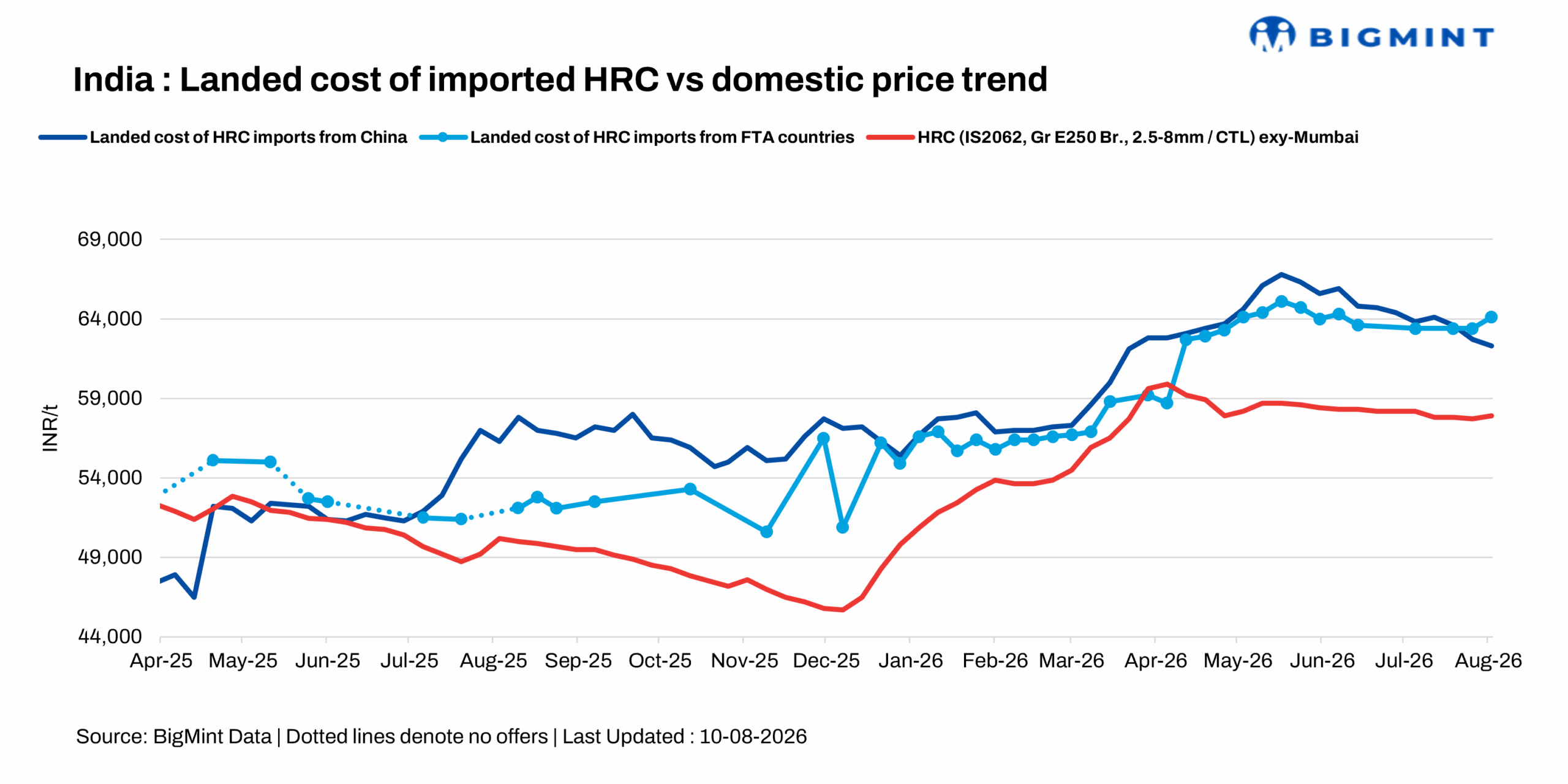
- Import landed costs stay INR 7,400-7,800/t above domestic HRC
- July bulk HRC imports rise 37% m-o-m
Domestic hot-rolled coil (HRC) prices remained significantly below import parity as of 10 August 2026, with landed import costs from FTA and non-FTA origins estimated at INR 65,300-65,700/t, ($685-689/t) compared with the domestic benchmark of INR 58,000/t ($609/t) ex-Mumbai. The resulting gap leaves limited scope for low-priced imports to pressure the domestic market, while elevated freight and subdued downstream demand continue to influence buying decisions.
Import parity remains above domestic prices
The FOB price of HRC from non-FTA countries was assessed at around $495/t on 10 August. With freight estimated at around $50/t, the CFR value works out to approximately $545/t.
After adding 7.5% basic customs duty (BCD) and 0.75% cess, the import value rises to around $590/t. At an assumed exchange rate of INR 95/$, this translates to approximately INR 56,126/t.
The 11.5% safeguard duty and 1.15% cess add roughly $75/t, taking the import cost to around $665/t, or approximately INR 63,260/t. After adding port handling charges of around INR 2,000/t, the landed cost of non-FTA HRC is estimated at approximately INR 65,260/t.
For FTA origins, CFR offers were heard at around $595/t. With BCD exempted under the FTA and the 11.5% safeguard duty plus 1.15% cess adding roughly $75/t, the landed cost is estimated at approximately INR 65,736/t.
BigMint’s bi-weekly benchmark assessment for HRC (IS 2062, Gr E250, 2.5-8 mm/CTL), ex-Mumbai, stood at INR 58,000/t on 10 August. The assessment is at the distributor-to-dealer level and excludes 18% GST.
Based on these levels, the domestic benchmark is approximately INR 7,400-7,800/t below estimated import landed costs.

Freight raises import costs
Import economics are also being affected by higher freight costs and logistics disruptions.
A market participant said, “Usually freight cost from China to India was $30, now it is $45-55. Weather is very bad at Chinese ports, our vessels are also delayed more than 10-15 days.”
Higher freight and port-related costs could therefore keep import offers elevated even if overseas HRC prices remain comparatively stable.
Bulk HRC imports
India’s bulk HRC imports rose 37% m-o-m to 339,040 tonnes (t) in July from 247,754 t in June, according to BigMint’s vessel line-up data. However, arrivals were 30% lower y-o-y than 484,879 t recorded in July 2025. The sequential increase was primarily driven by export-oriented procurement under the Advance Authorisation Scheme, while imports for the domestic spot market remained limited.
South Korea, China and Indonesia remained the three largest bulk HRC suppliers to India in July, shipping 118,174 t, 99,712 t and 84,361 t, respectively.
Imports from South Korea declined 10% m-o-m, reflecting lower shipments under existing supply arrangements. In contrast, arrivals from China increased 63% over June, while Indonesia emerged as a key supplier during the month.
Market participants indicated that a significant share of HRC imported from South Korea is supplied under long-term contracts between Indian companies and their parent entities.
BigMint understands that HRC imported from Indonesia is largely intended for captive consumption and is not meant for trading in the domestic market.
Domestic market update
BigMint’s bi-weekly benchmark assessment for HRC (IS 2062, E250, 2.5-8 mm, CTL) eased by INR 400/t ($4/t) m-o-m to INR 57,900/t ($607/t) exy-Mumbai in July from INR 58,300/t ($611/t) in June.
Throughout the month, the domestic HRC market remained stable but subdued. Procurement was largely restricted to immediate requirements amid cautious downstream demand and tight liquidity. Longer trade cycles slowed material movement and increased dealer inventories, while steady purchases from OEMs continued to provide the primary source of demand. On the supply side, mills maintained controlled spot availability and firm offer levels, keeping the overall HRC market broadly range-bound.
Outlook
Offers from FTA countries are expected to remain firm in the coming month, while offers from non-FTA origins may remain volatile in the near term. Ongoing disruptions along key sea routes and adverse weather conditions at Chinese ports could keep freight and port-related charges elevated. Meanwhile, domestic HRC prices are likely to remain range-bound, with limited scope for further upside amid subdued demand.
Leave a Reply