- Asia-Mediterranean posts sharpest weekly correction
- Capacity discipline limits downside across key lanes
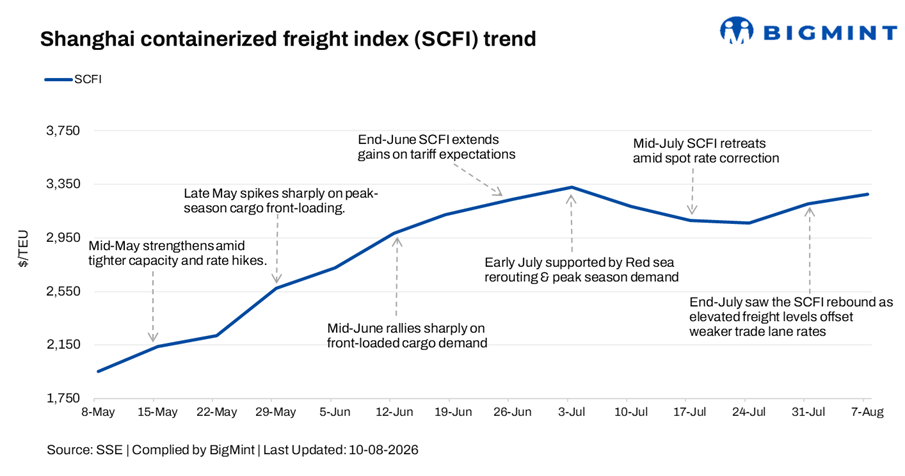
The Shanghai Containerized Freight Index (SCFI) increased 2.18% w-o-w to 3,276.14 on 7 August 2026 from 3,205.97 on 31 July, despite freight rates declining across three of the four major trade lanes assessed. The rise in the composite index indicates that overall freight levels remained supported even as peak-season momentum began to moderate across key corridors. Asia-Mediterranean recorded the steepest weekly fall, followed by Asia-Europe and Asia-US West Coast. In contrast, Asia-US East Coast rates increased, reflecting relatively firmer demand and tighter capacity.
The broader correction indicates that peak-season momentum is beginning to ease, with booking activity moderating and vessel availability improving on several east-west routes. European trades faced greater pressure as softer demand prompted carriers to moderate planned rate increases.
Asia-US East Coast remains comparatively firm
Asia-US East Coast was the only major corridor to register a weekly increase. The divergence from other routes points to relatively stronger cargo demand and tighter effective capacity, helping carriers maintain pricing discipline.
The transpacific market has also benefited from capacity management, although conditions remain uneven between the US East and West Coast trades.

Capacity management cushions freight rates
Carriers continue to manage available capacity through blank sailings and service adjustments, limiting the impact of softer bookings. Port congestion and operational inefficiencies are also keeping effective capacity below nominal fleet availability, particularly at major Asian gateways.
As a result, the current decline appears more consistent with a normalisation of peak-season conditions than a broad-based deterioration in the container freight market.
Outlook
SCFI-linked freight rates are likely to remain under pressure through August, particularly on Asia-Europe and Asia-Mediterranean routes, as booking momentum eases and vessel availability improves. However, carrier capacity discipline, blank sailings and ongoing port inefficiencies should cushion the downside.
Diverging conditions across trade lanes are likely to persist, with the comparatively firm Asia-US East Coast market providing a counterbalance to weakness on European and US West Coast routes.

Leave a Reply