- Shipments to largest market, India, rise 4% m-o-m
- Pakistan, South Korea drive stronger export flows
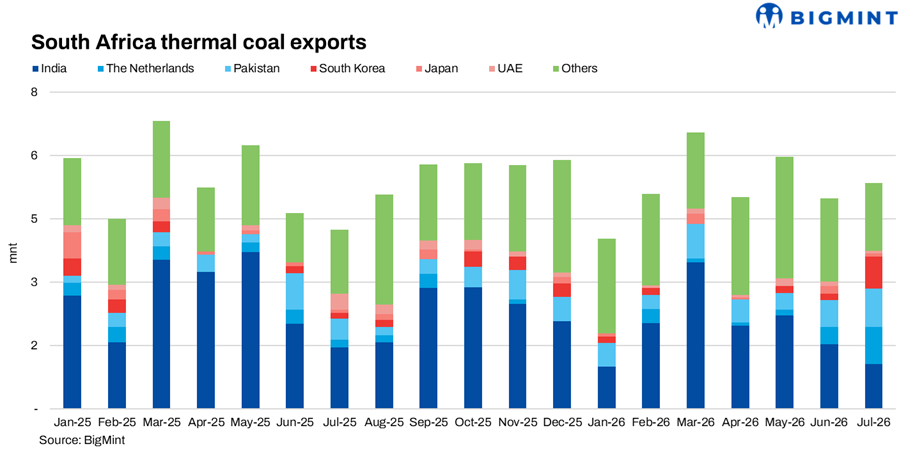
South Africa’s non-coking coal exports increased 7.4% m-o-m to 5.36 mnt in July 2026 from 4.99 mnt in June, while exports rose 26% y-o-y from 4.25 mnt in July 2025. Higher shipments to India, Pakistan, and South Korea supported the m-o-m recovery, although the increase came amid mixed demand across Asian markets. As per BigMint’s assessment, average FOB Richards Bay RB2 (5,500 NAR) prices fell to $88/t in July from $94.43/t in June, but remained 28% above $69/t in July 2025.
Shipments to India rise despite subdued buying
India remained South Africa’s largest recorded destination in July, receiving 1.70 mnt, up 4.3% m-o-m from 1.63 mnt in June and 16% y-o-y from 1.46 mnt in July 2025.
The increase came despite cautious buying by Indian consumers. In July, Indian buyers continued to favour domestic coal because of its availability and competitive pricing, while imported South African coal remained relatively expensive. Sponge iron producers largely restricted purchases to immediate requirements amid weak steel demand and monsoon-related operating constraints.
The increase in July arrivals therefore did not necessarily indicate a broad-based recovery in Indian import demand. Some cargoes were likely linked to earlier procurement decisions, while buyers continued to remain cautious about fresh bookings at elevated import parity levels.
However, the drawdown in Indian port inventories through July also suggests that existing imported cargoes were being steadily evacuated. Port stocks fell from 15.07 mnt in Week 25 to 14.83 mnt in Week 26 and further to 14.15 mnt in Week 28, indicating lower replenishment relative to cargo evacuation at several major ports. This provided some support for July arrivals even as overall import sentiment remained subdued.
Pakistan, South Korea lift export volumes
Pakistan recorded the strongest growth among South Africa’s major destinations. Shipments increased 42% m-o-m to 0.91 mnt in July from 0.64 mnt in June and rose 65% y-o-y from 0.55 mnt in July 2025.
South Korea also emerged as an important outlet, with shipments increasing to 0.75 mnt from 0.32 mnt in June and 0.15 mnt in July 2025. The twofold m-o-m increase indicates a significant shift in South African coal flows towards Asian markets outside India.
China also increased its imports to 0.24 mnt in July from 0.08 mnt in June, while Bangladesh received 0.17 mnt during the month.
However, several destinations recorded lower or no shipments. Vietnam, which received 0.54 mnt in June, recorded no July arrivals. Japan’s shipments fell to 0.07 mnt from 0.40 mnt, while Taiwan’s declined to 0.08 mnt from 0.24 mnt.
The data therefore indicates that South Africa’s July export recovery was concentrated across a smaller group of Asian buyers rather than representing a broad-based increase in global demand.
Lower RB2 prices improve Indian import economics
The decline in Richards Bay prices during July provided some relief to Indian buyers. BigMint’s average FOB RB2 (5,500 NAR) assessment fell by $6.43/t m-o-m to $88/t in July from $94.43/t in June.
Despite the monthly correction, prices remained substantially higher than the $69/t recorded in July 2025. The 28% y-o-y increase continued to keep imported coal less competitive against domestic alternatives for price-sensitive Indian consumers.
The lower July benchmark nevertheless improved replacement economics compared with June. This could support selective buying if Indian sponge iron margins improve and domestic coal availability tightens during the monsoon.
Export flows remain sensitive to Indian demand
The July export data highlights the changing role of India in South Africa’s coal trade. India remained the largest recorded destination, but stronger shipments to Pakistan and South Korea showed that exporters were able to redirect cargoes towards alternative Asian markets.
This is important for Indian buyers because South African suppliers are not solely dependent on India for demand. When Indian procurement weakens, cargoes can increasingly move towards other Asian destinations, potentially limiting the downside in South African prices.
For India, the outlook will therefore depend on the relative economics between domestic and imported coal, sponge iron production, steel demand and freight costs. A sustained improvement in Indian industrial demand could increase South African coal purchases, while comfortable domestic availability and weak sponge iron margins could continue to restrict fresh import bookings.
Leave a Reply