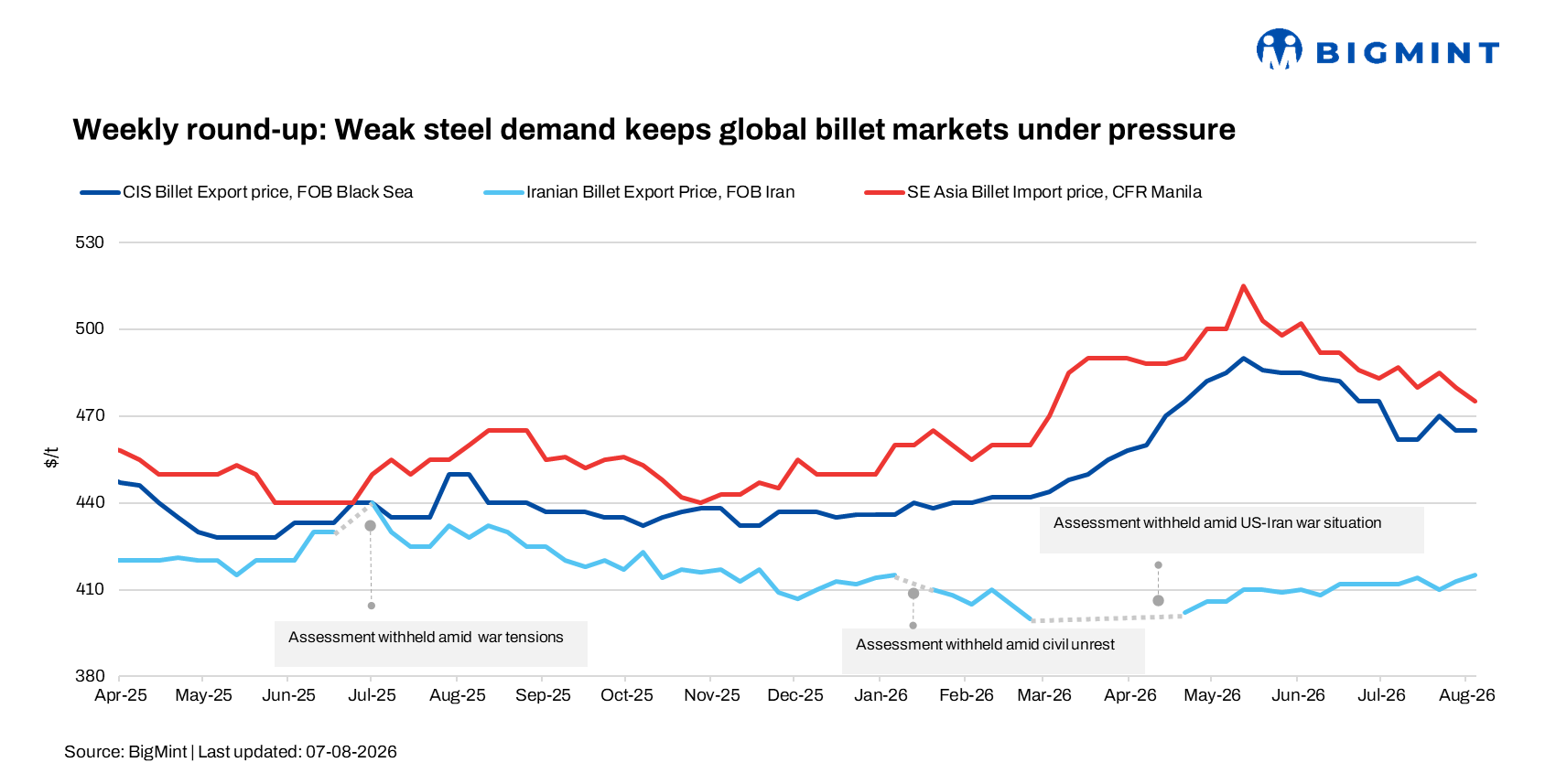
- Chinese billet offers decline as buyers show resistance
- Middle East remains muted on geopolitical uncertainty
Global billet markets remained subdued during the week ended 8 August 2026 as weak downstream steel demand, cautious buying, and geopolitical uncertainty continued to limit trading activity across key regions. Chinese domestic billet prices edged down w-o-w as export activity remained under pressure, and buyers resisted higher offers. In the Middle East, Iranian exports stayed subdued amid uncertainty surrounding the Strait of Hormuz, while Saudi mills continued to face weak finished steel demand despite rising billet and scrap costs.
In Turkiye, US-origin HMS 80:20 prices eased by $2/t w-o-w to $375/t CFR, while domestic rebar offers increased by $5-10/t to $580-600/t exw, supported by limited availability and stronger export sales. Rebar export offers were heard at $578-580/t FOB, keeping the scrap-to-rebar spread above $200/t. Despite improved steel margins, mills continued to procure scrap on a need-based basis, favouring domestic scrap, short-sea cargoes, and billet where commercially viable amid weak finished steel demand.
Asian market
Asian billet markets remained subdued during the week as weak finished steel demand, cautious buying, and compressed mill margins continued to limit trading activity. Most buyers had already covered inventories at higher levels and remained reluctant to make fresh purchases, keeping bid-offer gaps wide.
Chinese 3SP billet export offers for September shipment fell by $4-5/t to $450-452/t FOB, with workable levels heard around $440-445/t FOB. Meanwhile, Indonesia’s major steel mills lowered their billet offers by $4/t to $456/t FOB for October shipment, following softer Chinese offers and subdued regional demand.
In contrast, Chinese domestic billet and rebar prices edged higher during the week ended, supported by firmer raw material costs and improved sentiment, although weak demand and rising inventories limited gains.
BigMint assessed domestic billet at RMB 2,940/t ($436/t), up RMB 20/t ($4/t) w-o-w, while SHFE rebar futures rose to RMB 3,008/t ($446/t) from RMB 3,004/t. Higher iron ore and coke prices, along with speculative buying, supported prices.
In Southeast Asia, buying interest remained cautious. 5SP billet bids were heard at $465-470/t CFR, against offers of $475-485/t CFR. Philippines buyers mainly targeted China-origin material, with offers at $475/t CFR Manila and bids around $465/t CFR. Chinese billet was also available at around $470-475/t CFR Thailand, but interest remained limited as buyers compared imported material with cheaper domestic alternatives.
Vietnamese demand was mixed, with northern mills relatively active in securing cargoes while southern buyers adopted a wait-and-see approach. Recent purchases were estimated at around $475-478/t CFR Vietnam, with reported volumes ranging from 50,000-100,000 t.
Despite subdued sentiment, market participants increasingly viewed current prices as approaching a floor. Firmer Chinese futures and recovering raw material costs could limit further price cuts, while potential year-end restocking may provide additional support.
Turkiye
Despite the partial recovery in rebar offers, Turkish mills remained under pressure from persistently weak finished steel demand, prompting cautious procurement. Producers continued to favour domestic scrap, short-sea cargoes, and billet whenever economically viable, as these alternatives offered more attractive financing conditions while rebar inventories remained elevated.
According to BigMint’s assessment, 3SP/equivalent billet remained stable w-o-w at around $530/t FOB Turkiye. Meanwhile, imported billet prices increased by $10/t w-o-w to around $500/t CFR Turkiye. Despite the rise in import billet prices, billet continued to remain a viable alternative to deep-sea scrap for some mills, supported by flexible procurement options. With most mills having completed their August procurement programmes and suppliers unwilling to offer further discounts, deep-sea scrap purchases remained limited to immediate requirements, leaving the market in a wait-and-watch mode.
Middle East
Middle East billet markets remained subdued as geopolitical uncertainty, seasonal demand weakness, and elevated raw material costs continued to shape regional trade flows.
Iran’s billet export market remained largely quiet, with offers stable at $412-415/t FOB. Buyers showed interest but remained cautious amid uncertainty over the Strait of Hormuz, disrupted shipping activity, summer holidays, and weak global steel demand. Market participants expect export opportunities to improve for Q4 shipments if a ceasefire or shipping arrangement is reached.
In contrast, Iran’s domestic billet market remained relatively active. Around 75,000 t, or nearly 90% of the 85,000 t offered on the Iranian Mercantile Exchange, was traded. However, seasonal holidays, power shortages, and weak downstream steel demand are expected to keep domestic activity subdued through August.
Saudi Arabia’s long steel market remained under pressure amid weak seasonal construction demand and intense competition among domestic producers. Rebar offers were heard at SAR 2,400-2,800/t ($640-747/t) DAP, with smaller mills offering aggressive discounts to secure limited orders.
Meanwhile, Saudi domestic billet prices increased to around $600-650/t exwfrom $580-585/t previously, supported by higher scrap costs and tighter availability. Local scrap prices have reportedly risen by around SAR 50/t ($13/t) in recent weeks.
Despite firm raw material costs, weak finished steel demand kept Saudi mills under margin pressure, particularly smaller producers. Regional shipping routes remained operational through Saudi western ports, although limited imported semis availability and elevated logistics risks continued to influence procurement decisions.


Leave a Reply