- RVSF network expands rapidly but remains regionally concentrated
- Nearly 4 mnt of ELV scrap potential remains outside formal ecosystem
- Policy support, EPR targets could accelerate organised scrap recovery
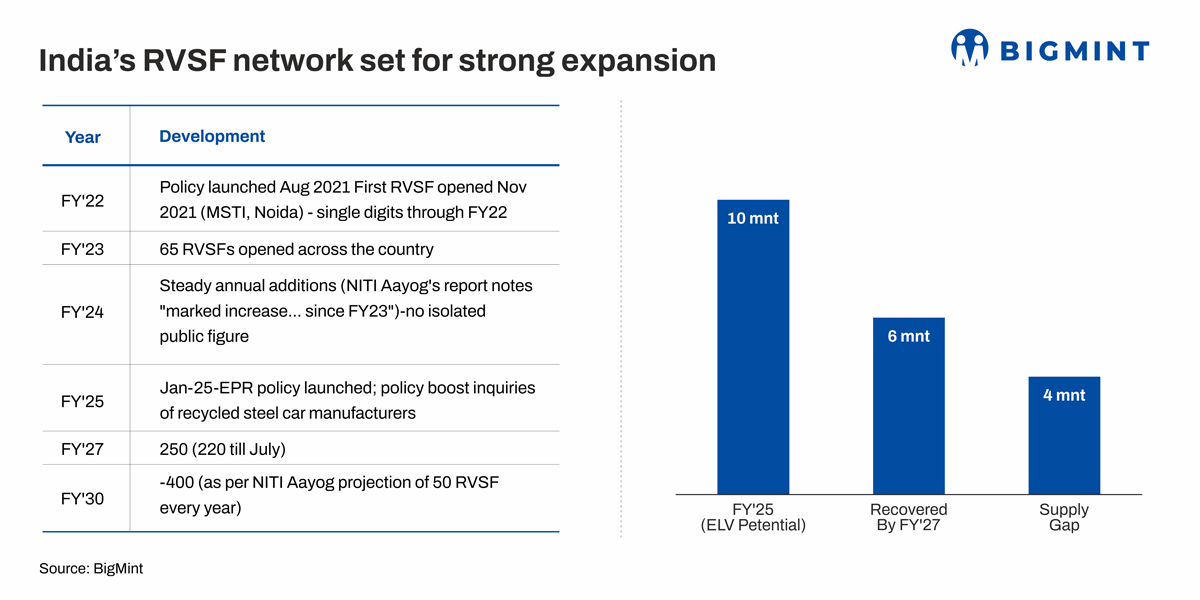
Data deep dive: The Registered Vehicle Scrapping Facility (RVSF) ecosystem has expanded steadily since the Vehicle Scrappage Policy was introduced. In FY22, only a single-digit number of RVSFs were operational following the policy launch in August 2021 and the opening of the first RVSF in Noida in November 2021. By FY23, the cumulative number of RVSFs had reached approximately 65 nationwide, reflecting the initial phase of implementation across the country. During FY24, the network continued to grow, with NITI Aayog describing a “marked increase” in operational facilities, although no specific year-end figure was reported.
In FY25, the focus shifted from infrastructure expansion to operational activity, with RVSFs scrapping approximately 72,000 end-of-life vehicles (ELVs), accounting for nearly 25% of the informal sector’s scale. As of 1 September 2025 (FY26), India had 117 operational RVSFs, while a total of 178 facilities had been approved across 21 states and Union Territories. Looking ahead to FY27, NITI Aayog projects a requirement of 227 RVSFs by 2027, highlighting a shortfall of 49 facilities compared with the existing approved infrastructure.
Current RVSF Landscape (as of July’2026)

India’s RVSF network remains highly concentrated, with Uttar Pradesh emerging as the clear leader, accounting for 81 approved facilities, including 50 operational and 31 approved-only sites—representing over two-fifths of the country’s total RVSF approvals. Haryana ranks second with 26 facilities, reflecting the rapid expansion of organised vehicle recycling in the northern region. Gujarat and Maharashtra follow with 12 and 10 facilities, respectively, highlighting their growing role in the formal scrappage ecosystem. Collectively, these four states account for 129 of India’s 200 approved RVSFs (64.5%), underscoring a significant regional concentration of recycling infrastructure.
The remaining 64 facilities are distributed across other states, indicating that while the RVSF ecosystem is expanding nationwide, its development remains uneven, with a few states emerging as early hubs for organised end-of-life vehicle recycling and future ferrous scrap generation.
North India emerges as leading RVSF hub
Uttar Pradesh, Haryana, and Rajasthan have emerged as India’s leading RVSF hubs due to a combination of strong policy support, high end-of-life vehicle potential, and strategic geographic advantages.
This year, the Union Cabinet’s approval of the INR 9,585 crore vehicle replacement scheme for Delhi-NCR marks a significant step toward accelerating India’s organised vehicle scrappage ecosystem. The two-year programme targets the replacement of over 2 lakh commercial vehicles, with older BS-III vehicles mandated to be scrapped through RVSFs, while BS-IV vehicles can be scrapped or relocated outside NCR.
Supported by financial incentives such as interest subvention, fuel vouchers, and tax concessions, the scheme is expected to substantially increase ELV inflows, improve RVSF utilisation, and boost the availability of high-quality domestic ferrous scrap. This initiative is likely to strengthen the circular economy, reduce dependence on imported steel scrap, and further establish Delhi-NCR as the leading hub for organised vehicle recycling and scrap generation in India.
Major OEMs sign MoUs to drive PARIVARTAN scheme rollout
Following the launch of the PARIVARTAN vehicle replacement scheme, leading commercial vehicle manufacturers quickly partnered with the Ministry of Road Transport & Highways (MoRTH) to support its implementation. Ashok Leyland and Switch Mobility became the first OEMs to sign MoUs on 15 June this year, committing to offer an 8% discount on eligible trucks and buses. This was followed by Daimler India Commercial Vehicles (BharatBenz) on 23 June, while Volvo Eicher Commercial Vehicles (VECV), Force Motors, and Pinnacle Mobility Solutions joined on 29 June, taking the participating OEMs to nine companies representing over 95% of India’s truck and bus market.
The programme was further strengthened on 7 July when Olectra Greentech and Montra Electric (TI Clean Mobility) signed MoUs, extending the scheme’s coverage to electric commercial vehicle manufacturers and reinforcing industry-wide support for fleet modernisation and organised vehicle scrappage.
Despite significant ELV potential, actual scrap recovery remains well below opportunity

According to MoRTH deregistered vehicle data and BigMint analysis, India had the potential to generate over 10 mnt of ferrous scrap from ELVs in FY25. However, BigMint projects that India’s steel scrap generation will reach 39 mnt in FY27, comprising 15.6 mnt of post-consumer scrap and 21.7 mnt of prompt (new) scrap. Within the old scrap segment, EOL scrap is estimated at 8.5 mnt, of which ELV-derived scrap is expected to contribute around 6 mnt, representing nearly 70% of total EOL scrap generation.
This comparison indicates a gap of nearly 4 mnt between the estimated ELV scrap potential (10 mnt) and the projected recoverable ELV scrap (6 mnt). The shortfall suggests that a substantial volume of end-of-life vehicles continues to remain outside the organised recycling ecosystem.
One of the primary reasons for this is the uneven development of RVSFs across India. While Uttar Pradesh has emerged as the leading hub due to strong policy implementation, a large vehicle base, and concentration of scrapping infrastructure, many other states continue to have limited RVSF capacity, weaker collection networks, and slower enforcement of vehicle deregistration and scrappage policies. Bridging this infrastructure and policy gap across the country will be critical to unlocking the remaining ELV scrap potential and improving domestic scrap availability.
Outlook FY30
NITI Aayog roadmap suggests ~400 RVSFs by FY30
By the end of the current financial year, India’s RVSF network is expected to reach around 250 facilities. Based on NITI Aayog’s roadmap of adding approximately 50 new RVSFs annually, the total network could expand to around 400 facilities by FY30. This expansion is expected to strengthen the country’s organised vehicle recycling infrastructure and improve the collection and processing of end-of-life vehicles.
EPR framework to support India’s circular economy
The government has introduced Extended Producer Responsibility (EPR) provisions for the automobile sector to promote circularity and increase the use of recycled materials. Under the policy, automakers are required to ensure that at least 8% of the steel used in vehicle manufacturing is sourced from recycled steel. This requirement is expected to increase progressively, with the recycled steel share targeted to reach 13-15% by 2030, driving higher demand for quality steel scrap and strengthening the domestic recycling ecosystem.
Leave a Reply