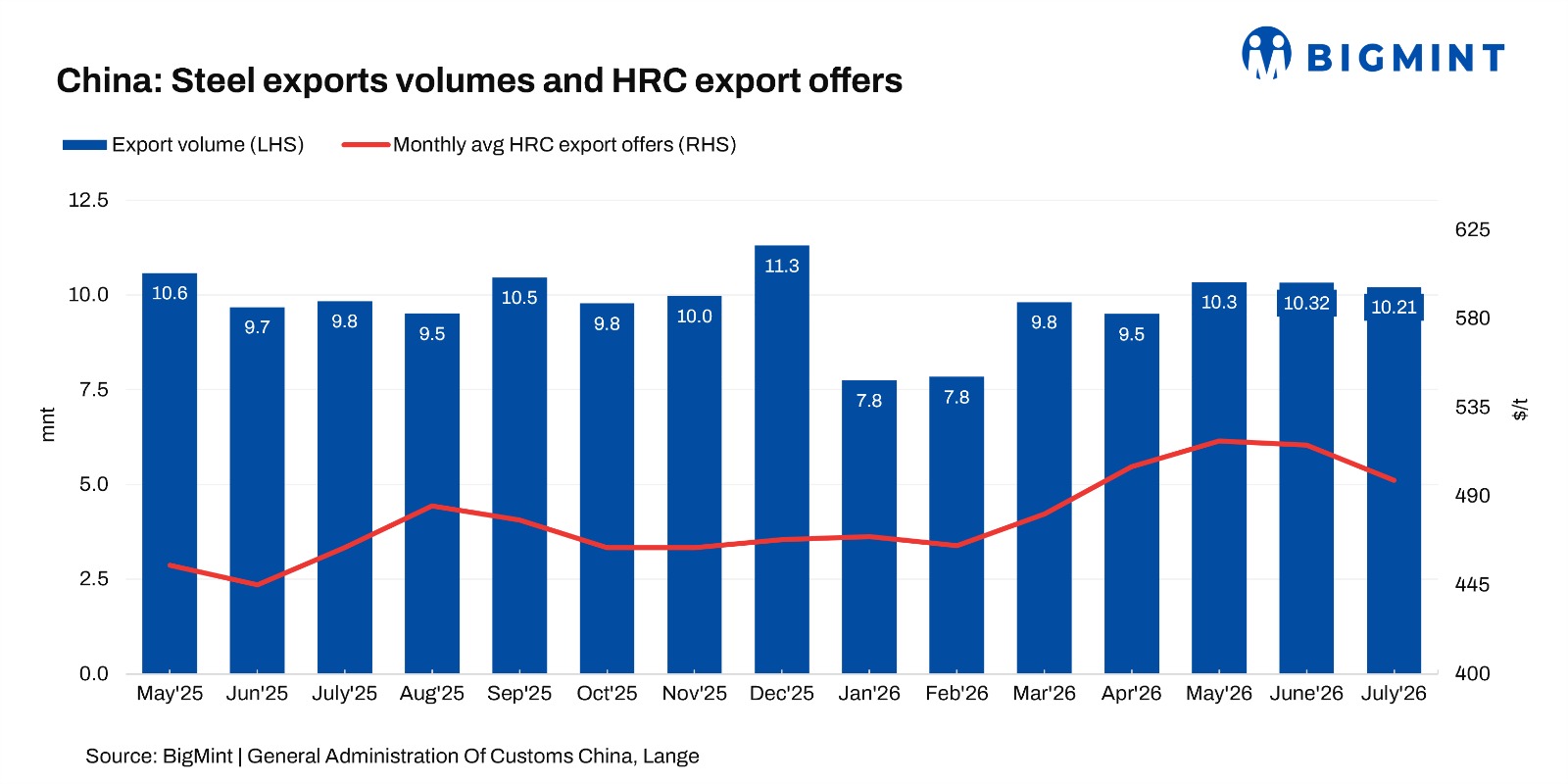
- July exports remain above 10-mnt mark
- Trade barriers weigh on long-term export outlook
China exported 10.121 million tonnes (mnt) of steel in July 2026, up 2.9% y-o-y, reflecting stronger monthly shipments despite an increasingly challenging global trade environment. However, cumulative exports during January-July 2026 declined 4.4% y-o-y to 64.995 mnt, as weaker overseas demand, expanding trade barriers and demand diversion continued to weigh on export performance.
The implementation of new export licence policies, new steel regulations in Europe and the US, and fresh trade remedy investigations by multiple countries continued to suppress export growth. These factors, together with the traditional overseas off-season and the end of the previous stockpiling cycle, remained a drag on shipments.
Despite these headwinds, China’s stable price advantage in international markets and the continued expansion of global manufacturing supported end-user steel demand, helping exports register a modest y-o-y increase in July and remain above the 10 mnt mark.
Price competitiveness continues to support exports
China’s price competitiveness remained the key driver of exports despite tightening trade restrictions worldwide. Chinese hot-rolled coil (HRC) export prices remained significantly below competing overseas offers, allowing exporters to retain their pricing advantage. Average Chinese HRC FOB offers down by $18/t to around $498/t in July from $516/t in June.
Rising overseas supply intensifies competition
Recovery in overseas crude steel production continued to accelerate, while higher domestic steel self-sufficiency in importing countries increasingly diverted demand towards local supply. Rising operating rates at steel mills across Southeast Asia, Europe and North America continued to release additional domestic supply, creating sustained competitive pressure on China’s export market share.
Trade protectionism remains major headwind
Global trade protectionism continued to intensify during July. Brazil initiated an anti-dumping investigation into welded carbon steel pipes from China on 6 July, while South Korea launched an anti-dumping investigation into tinplate on 10 July. South Africa initiated anti-dumping investigations into flat rolled iron, non-alloy steel and other alloy steel products on 10 and 15 July, alongside a safeguard investigation into imported cold-rolled steel. Vietnam also initiated an anti-dumping investigation into prestressed steel products from China on 27 July.
These new investigations, together with earlier trade remedy measures and punitive tariffs, continued to restrict exports of affected steel products.
Outlook
China’s steel exports are expected to remain under pressure in August, with a significant rebound unlikely. Total exports are expected to fluctuate around 10 mnt, while structural divergence across products and export destinations is likely to become more pronounced.
Although the stable domestic-to-international price spread may continue to support exports, the combination of rising overseas supply, seasonally weaker demand and escalating trade frictions is expected to limit growth. Market participants are expected to closely monitor the pace of overseas restocking, implementation of new tariffs and changes in international steel price spreads to assess whether export orders begin to recover.
Leave a Reply