- Sponge iron, scrap prices increase amid tighter availability
- Billet and rebar prices rise on higher production costs
South India’s steel value chain strengthened during the week ended 7 August, supported by higher sponge iron and scrap prices, improved procurement by secondary steelmakers and tighter merchant availability. Rising input costs lifted billet and rebar prices across the region, while buying activity remained largely need-based. Although finished steel demand remained moderate, firm raw material fundamentals continued to support market sentiment.
Sponge iron & melting scrap
Sponge iron prices in the Bellary cluster increased by INR 300-400/t w-o-w, supported by improved buying interest from steelmakers and tightening merchant market availability. Procurement activity from induction furnace-based billet and long steel producers strengthened during the week, while limited spot supplies enabled manufacturers to increase offer prices. The current P-DRI prices are hovering around INR 26,300/t as on 7 August 2026.
The upward trend was further supported by constrained material availability, as several sponge iron producers had already committed substantial quantities through advance bookings, while others continued to prioritize captive consumption. The resulting demand-supply imbalance kept the market firm and supported higher transaction levels.
Iron ore pellet (Fe-63%) prices remained largely stable at around INR 9,750/t ex-Bellary. Pellet manufacturers maintained prices as they had already secured adequate order bookings over the past few weeks. Moreover, a few producers limited fresh offers in the spot market due to an overbooked order position, keeping merchant availability relatively tight.
Imported RB2 coal prices increased marginally by INR 200-300/t w-o-w, with current offers hovering around INR 10,750/t plus taxes ex-Gangavaram. The rise was mainly attributed to firm import costs and steady procurement from sponge iron manufacturers, although overall buying activity remained largely need-based.
Meanwhile, domestic melting scrap prices rose by around INR 300/t week-on-week, with current offers hovering around INR 31,100/t as on 7 Aug 206, supported by improved demand from steelmakers and higher prices of alternative metallic raw materials, particularly sponge iron. The strengthening sponge iron market encouraged scrap suppliers to gradually revise their offers upward.
In the imported market, Australia-origin HMS 80:20 scrap was offered at around $330-335/t CFR Chennai. However, trading activity remained subdued as buyers and sellers failed to bridge the $10-15/t gap between bid and offer prices. Most market participants preferred to wait for better price alignment before concluding fresh bookings.

Billet
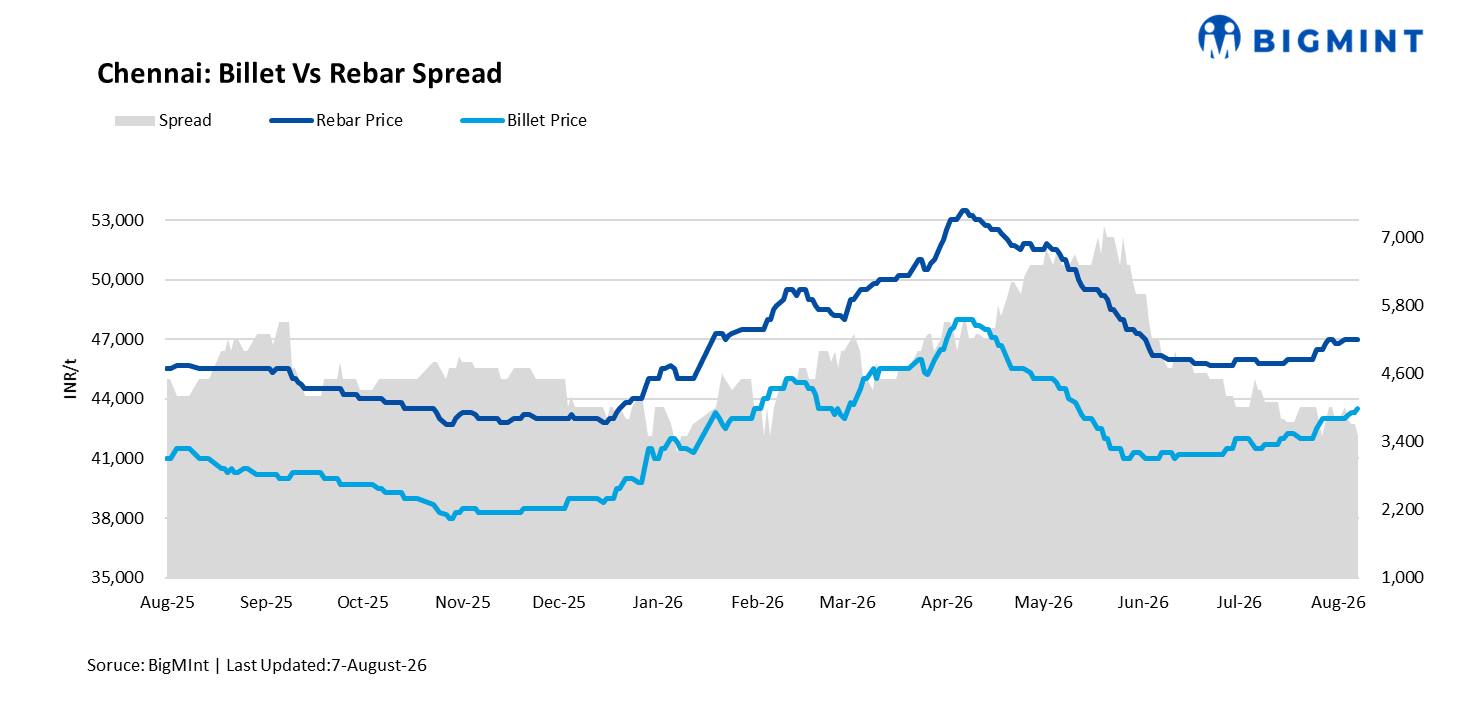
MS billet prices across southern India increased by around INR 300-500/t w-o-w, supported by the rise in raw material costs, particularly sponge iron and melting scrap. The increase in input costs pushed up overall production expenses, prompting billet manufacturers to revise their offers upward to maintain sustainable conversion margins.
Higher sponge iron prices, coupled with the recent increase in domestic and imported scrap values, significantly impacted billet production costs. As a result, most mills passed on a part of the increased cost burden to buyers, while procurement activity remained largely need-based.
The current conversion spread from HMS 80:20 melting scrap to MS billet is hovering at around INR 12,400/t in the Chennai market, indicating that billet producers continue to maintain healthy conversion margins despite the increase in raw material prices. Stable operating rates and controlled production also supported the current pricing trend.
Demand for billets from re-rolling mills and long steel manufacturers remained steady during the week. Market participants continued to procure material based on immediate production requirements, while avoiding large inventory build-ups amid uncertainty over finished steel demand.
On the export front, one small shipment of MS billets was dispatched from Chennai Port to the Philippines during the week. Although the export volume was limited, the shipment reflects continued overseas buying interest in Indian billets and provided marginal support to domestic market sentiment.
Rebar
Induction route rebar prices in southern India increased marginally by INR 200-300/t w-o-w, supported by higher raw material costs, particularly sponge iron and MS billets. The increase in production costs prompted manufacturers to revise their offers despite only moderate demand from end-user segments. Inventory levels at most induction route rebar manufacturers in southern India are currently estimated at around 15-20 days, depending on the scale of production.
Demand from the construction and infrastructure sectors remained stable but largely need-based, as buyers continued to procure limited quantities in line with project requirements. Seasonal buying remained subdued, restricting the scope for any sharp price increase in the induction route rebar market.
Current prices of induction route rebar (12–25 mm, Fe 500) are hovering around INR 44,500-44,700/t ex-Hyderabad and INR 47,000/t ex-Chennai. Market participants indicated that the rise in billet prices also contributed to the upward revision in rebar offers during the week.
Meanwhile, blast furnace (BF) route rebar prices witnessed a stronger increase of around INR 1,000-1,500/t w-o-w in south India, particularly in Hyderabad and Chennai. The price rise was supported by improved procurement activity and tight material availability.
Supply remained constrained as a few integrated steel mills continued to operate at reduced production levels, resulting in lower market availability. The limited supply, coupled with better buying interest, enabled BF-route producers to implement steeper price hikes compared with induction route manufacturers.
As a result, BF-route rebar prices are currently hovering at around INR 53,000/t ex-Chennai as on 7 August.

Outlook
Steel prices are expected to remain largely stable in the short term, with no major upward movement anticipated. Only marginal price fluctuations may be witnessed in the coming weeks, supported by steady demand across the steel value chain, from raw materials to finished products. While raw material costs continue to provide support to prices, moderate procurement activity and balanced market fundamentals are likely to keep overall steel prices within a narrow range in the near term.
Share on WhatsApp
Official Business Account
Leave a Reply