- Rising fuel and packaging costs likely to pressure Q2FY’27 margins
- Capacity expansion and renewable energy remain key growth drivers
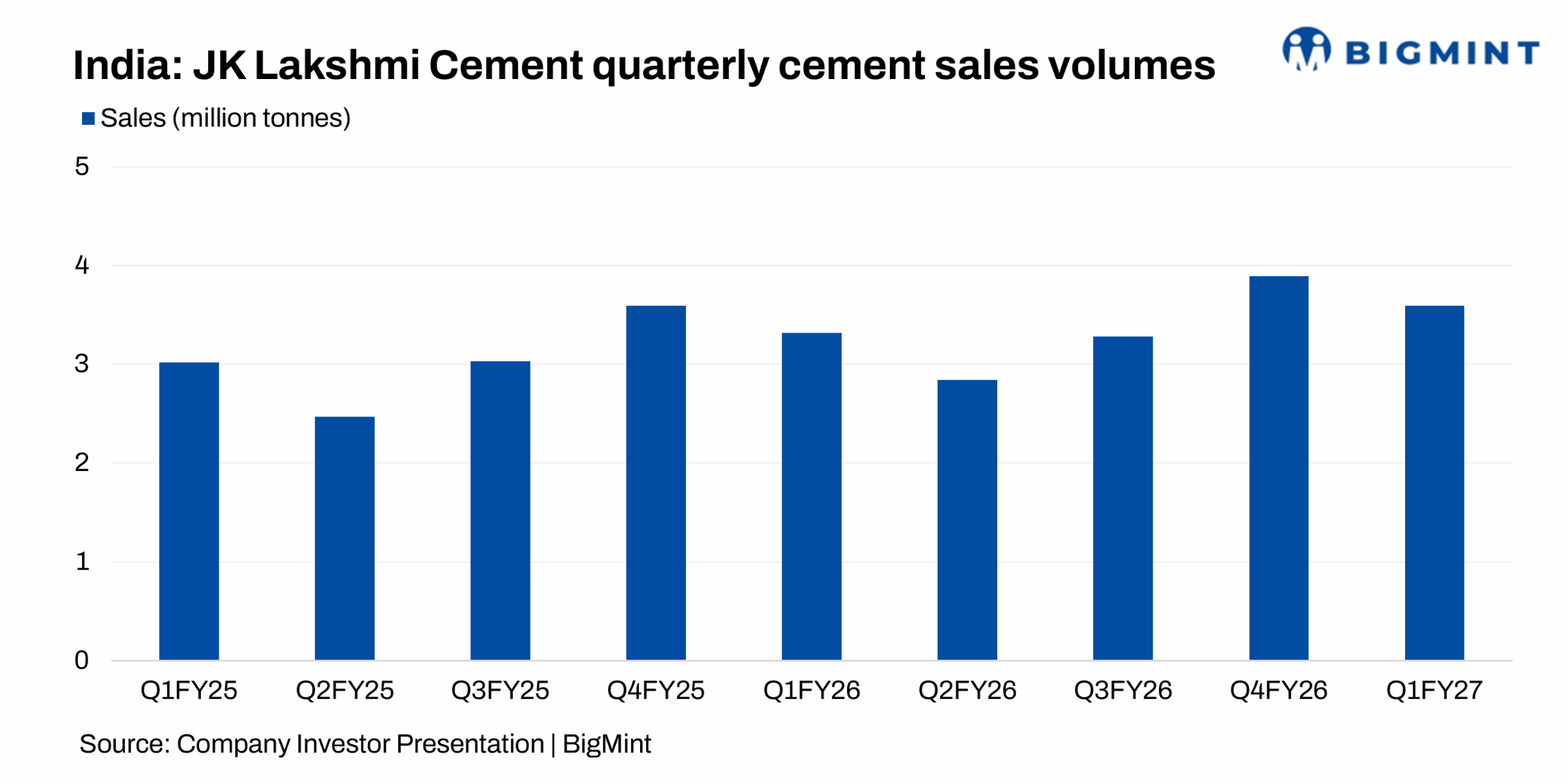
JK Lakshmi Cement reported an 8% y-o-y increase in cement sales volumes to 3.59 mnt in Q1FY27 from 3.32 mnt in Q1FY26, supported by higher dispatches, an improved sales mix and stronger realizations across key markets. However, rising fuel, packaging and raw material costs are expected to pressure margins in the coming quarters. The company reaffirmed its long-term growth strategy through capacity expansion, renewable energy investments and operational efficiency initiatives.
Healthy demand supports realizations
India’s cement demand grew around 8% y-o-y during Q1FY27, supported by infrastructure spending, housing construction and steady economic activity. Industry-wide installed cement capacity increased to nearly 725 mnt, while capacity utilisation remained healthy at around 73-74%.
JK Lakshmi Cement benefited from higher dispatches across its core markets, including Rajasthan, Gujarat, Haryana, Chhattisgarh, western Uttar Pradesh and Mumbai. Around 90% of total sales were generated from these nearby markets, reducing the average lead distance to 368 km in Q1FY27 from 388 km in Q1FY26 and improving freight efficiency.
The company attributed the improvement in realizations to a stronger geographical sales mix and higher non-trade prices in Gujarat, Mumbai, North and East India, while trade prices remained largely stable across most northern markets.
Higher fuel and raw material costs weigh on margins
The company stated that rising fuel costs continue to be the primary challenge for the cement industry.
Fuel cost increased to INR 1.65/ kilocalories (kCal) in Q1FY27 from INR 1.54/kCal in Q4FY26 and is expected to rise further to around INR 1.80-1.85/kCal during Q2FY27 as imported pet coke and coal prices remain elevated following geopolitical disruptions in West Asia.
Besides fuel, packaging costs are expected to increase by around INR 3.5-4 per bag due to higher polymer prices. Costs of explosives, industrial chemicals, gypsum and fly ash also increased during the quarter as seasonal shutdowns at thermal power plants reduced fly ash availability, forcing procurement from distant locations.
The company indicated that operational efficiencies, renewable energy and alternative fuels will partly offset higher input costs. However, further cement price increases across the industry may be required if fuel costs remain elevated.
Trade sales and blended cement remain a strategic focus
JK Lakshmi Cement continues to prioritize higher-margin trade sales as part of its long-term growth strategy.
Although non-trade sales currently account for around 41% of total volumes, the company continues to focus on expanding the trade segment because of its higher profitability. Trade sales largely comprise blended cement products, which improve clinker efficiency and generate better concrete-equivalent returns.
The blended cement share increased to 64% during Q1FY27 from 62% in Q1FY26, supporting lower clinker consumption and improved operational efficiency. The company expects the trade and non-trade sales mix to continue varying across regions depending on customer requirements and market conditions.
Capacity expansion remains on track
JK Lakshmi Cement reaffirmed its long-term target of increasing installed cement capacity to 30 mnt/year by FY30.
- During Q1FY27, the company invested nearly INR 300 crore, while cumulative capital expenditure on the Durg expansion project reached around INR 400 crore.
- The ongoing expansion includes a 2.3 mnt/year clinker line and 4.6 mnt/year grinding capacity, with commissioning targeted by March 2028.
- Major equipment orders have already been placed for the Durg clinker project, grinding units at Patratu and Madhubani, along with other planned projects in eastern and northeastern India.
- The company retained its capex guidance of around INR 1,500 crore during FY27, INR 2,000 crore in FY28, and INR 1,500 crore thereafter. Installed cement capacity is expected to increase to around 18 mnt/year by the end of FY27.
Renewable energy, logistics optimisation strengthen cost competitiveness
Improving energy efficiency remains central to the company’s cost optimization strategy.
Renewable energy contributed 49% of total power consumption during Q1FY27, supported by 129 MW of solar capacity, 45 MW of waste heat recovery (WHR), 4 MW of wind power and 74 MW of thermal power.
The company also announced a 42 MW captive solar power project, expected to become operational by the end of FY27. The project is expected to procure power at an effective tariff of around INR 5.85/unit, compared with the current grid tariff of nearly INR 7.50/unit, resulting in estimated savings of around INR 1.65/unit.
In addition, JK Lakshmi Cement plans to install a 28 MW Battery Energy Storage System (BESS) to maximize renewable power utilization and reduce dependence on grid electricity. The company also continued developing railway siding infrastructure to improve logistics efficiency and support future capacity utilization.
Outlook
The company expects domestic cement demand to remain healthy through the remainder of FY27, supported by infrastructure spending and housing activity. However, higher fuel, packaging and raw material costs are likely to keep margin pressure elevated in the near term. Continued investments in capacity expansion, renewable energy, logistics optimization and premium products are expected to strengthen operating efficiency and support long-term profitable growth.
Leave a Reply