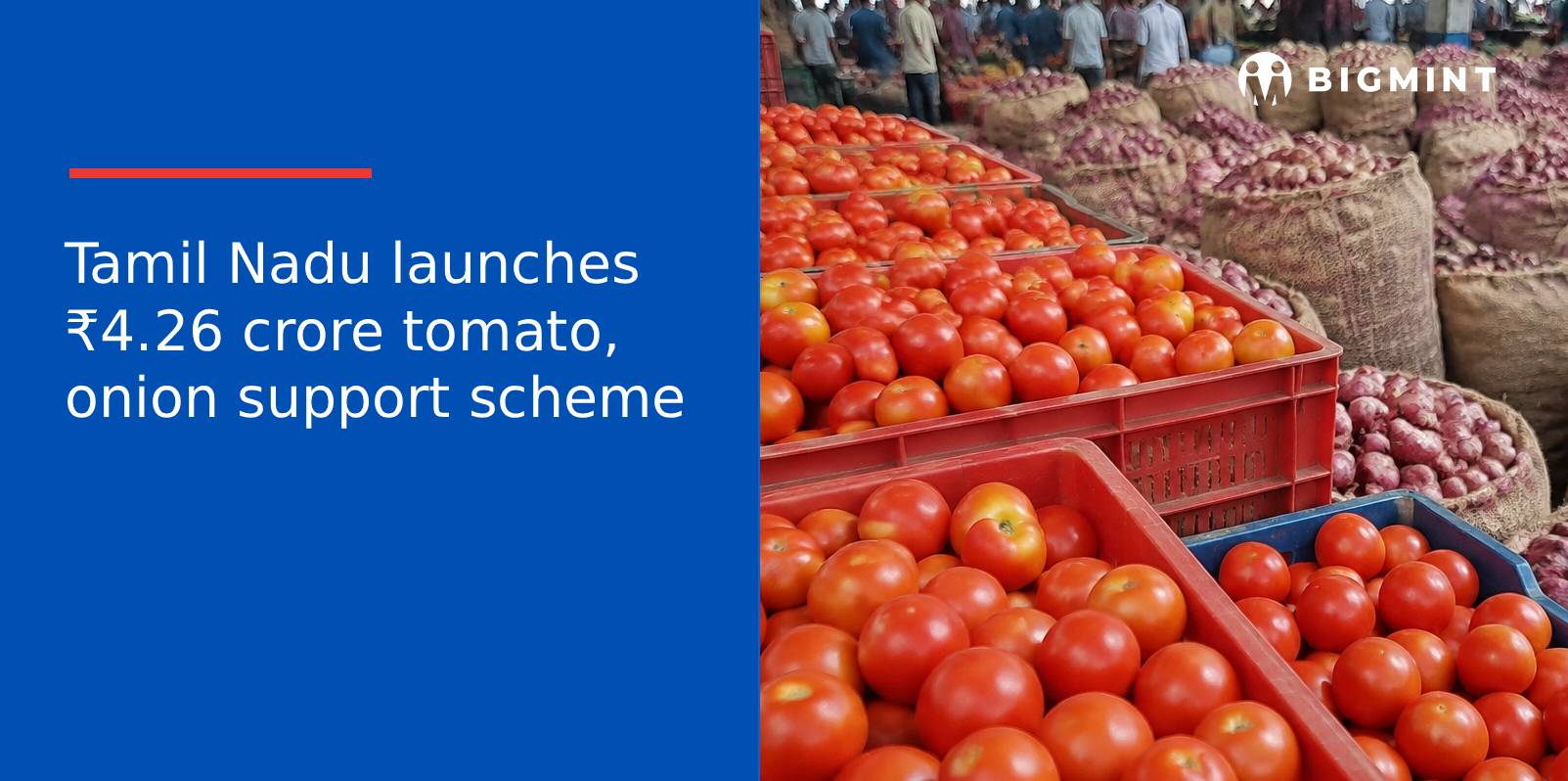
- Tamil Nadu creates ₹4.26 crore MIS-PSRF fund to support growers during price crashes
- Government also allocates ₹63.5 crore to promote green manure crops and improve soil health
The Tamil Nadu government has announced a Market Intervention Scheme – Price Stabilisation Revolving Fund (MIS-PSRF) with a state fund of ₹4.26 crore to protect tomato and onion farmers from sharp price declines. The initiative aims to provide relief to growers during periods of excess arrivals, when market prices often fall below production costs.
The scheme will be modelled on the Market Intervention Scheme (MIS) implemented for mangoes by the Union government. The state government is assessing whether to undertake direct procurement of produce or compensate farmers for the price gap between production costs and prevailing market rates.
Tomato and onion markets remain highly sensitive to supply fluctuations due to their perishable nature. Seasonal production peaks, weather disruptions, and sudden changes in arrivals often result in significant price swings, impacting farmer profitability. The proposed intervention fund is expected to provide a support mechanism during periods of market distress.
Along with price support measures, the state government has allocated ₹63.5 crore to promote green manure cultivation to improve soil fertility and reduce dependence on chemical fertilisers.
Under the initiative, seeds of sun hemp, daincha, and kolinji will be distributed to farmers for cultivation across nearly 1 lakh acres, while another 22,000 acres will be covered through multi-grain crop seeds. Farmers will receive a subsidy of ₹3,000 per acre for incorporating these crops into the soil.
Outlook
Tamil Nadu’s intervention scheme could provide a cushion for tomato and onion growers during periods of oversupply and weak market prices. However, the impact will depend on timely implementation, procurement efficiency, and the scale of market intervention.
With vegetable prices increasingly influenced by weather uncertainty and supply-demand imbalances, state-level stabilisation mechanisms are likely to gain importance in managing price volatility and improving farmer income stability.
Leave a Reply