- US steelmakers seek lower shredded scrap purchase prices in August negotiations
- Rhine River restrictions increase freight and transportation costs
Export ferrous scrap markets remained mixed in the week ended 7 August, as firm US domestic demand and tighter scrap availability in Europe supported export prices, while weak steel consumption continued to pressure Brazil. Higher freight costs and logistics disruptions underpinned the market, but cautious mill procurement and subdued finished steel demand kept overall trading activity muted across major export regions.
US
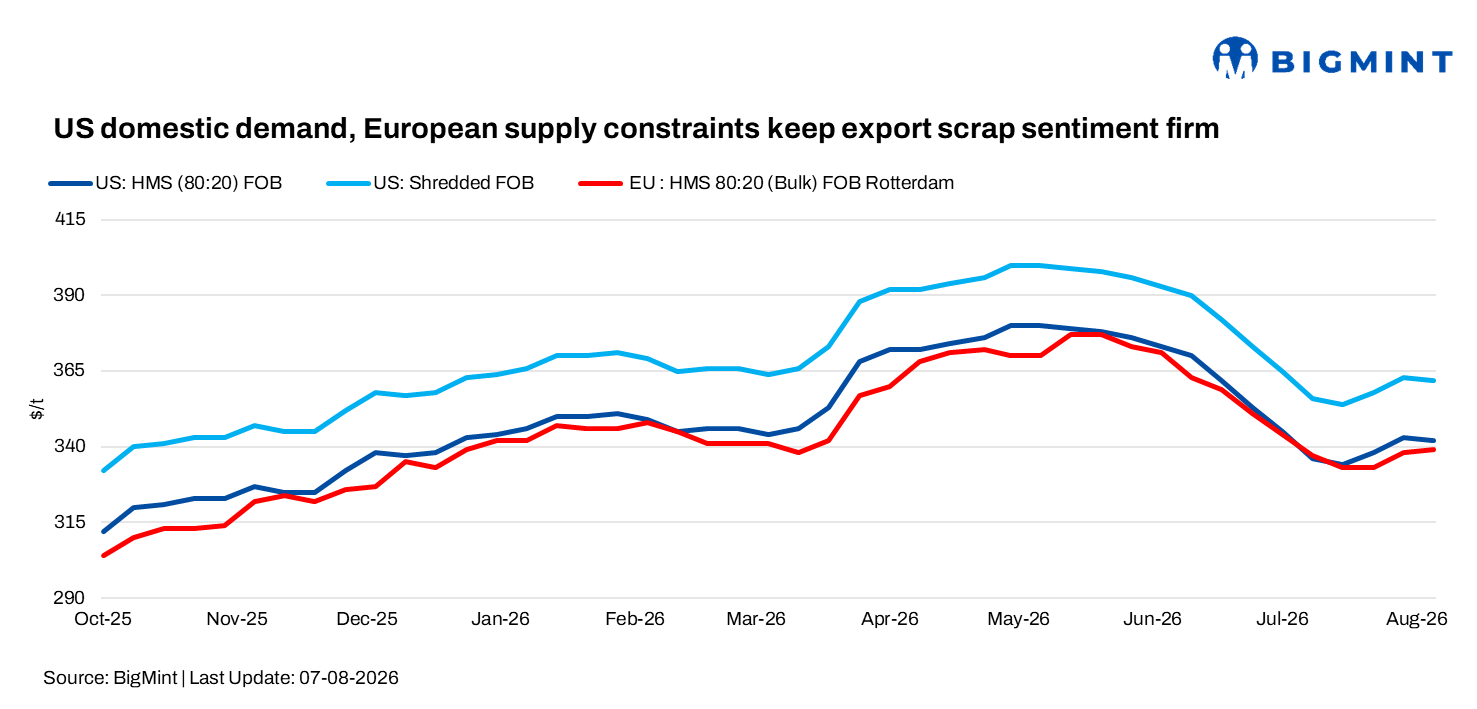
US East Coast FOB HMS 80:20 and shredded scrap prices remained stable w-o-w at $343/t and $363/t, respectively, as export sentiment stayed supported despite cautious overseas buying.
US ferrous scrap price negotiations for August deliveries began with steelmakers targeting a $10/lt reduction in shredded scrap, while keeping high-grade scrap bids unchanged from July levels. Initial bids placed shredded scrap at $415-420/lt DAP Midwest ($408-413/t) and $405-410/lt DAP Southeast ($399-404/t), while busheling remained at $460-465/lt DAP in both regions ($453-458/t). Plate and structural scrap held at $405/lt DAP ($399/t), and HMS remained at $370-372/lt DAP Midwest ($364-366/t) and $375/lt DAP Southeast ($369/t), pending final settlements.
Scrap suppliers resisted the proposed cuts, citing strong steel mill profitability, firm domestic HRC prices of $1,175-1,185/st ($1,295-1,306/t) exw Indiana, and supportive export markets. Meanwhile, Turkish HMS 80:20 import prices remained at $376/t CFR, continuing to support US export sentiment and limiting downside pressure on domestic scrap prices. Market participants expect prolonged negotiations as mills seek lower obsolete scrap prices while dealers resist further reductions.
A market participant commented, “US-origin scrap availability remains limited as stronger domestic consumption continues to absorb most scrap generation. Even Canadian suppliers are diverting material into the US market due to better demand, so while offers are available on paper, actual export cargo availability remains scarce.”

Europe
Benelux ferrous scrap exporters maintained firm offers during the week, supported by tightening scrap availability, higher freight costs, and logistics disruptions caused by low water levels on the Rhine River. However, export trading remained mixed as weak demand from key destinations limited fresh business.
Demand from Turkiye slowed, with mills remaining cautious due to weak long steel demand and continued preference for domestic scrap, short-sea cargoes, and imported billet. As a result, Benelux HMS 80:20 export prices eased slightly to $333/t FOB Rotterdam, while HMS 80:20 stood to $335-340/t FOB. Dockside purchase prices also strengthened to around Euro 370-380/t ($427-438/t), reflecting tighter scrap availability and higher inland logistics costs.
Meanwhile, low water levels on the Rhine, Danube, and Oder rivers continued to restrict inland vessel capacity and sharply increase freight costs, tightening scrap supply across Europe and supporting exporters’ firm pricing stance.
Brazil
Brazil’s ferrous scrap market remained stable during the week, although weak domestic steel demand continued to weigh on sentiment. Market participants said scrap prices have declined by around BRL 100-150/t ($20-29/t) over the past month, with no fresh significant reductions reported this week, despite continued pressure from steel mills.
HMS 80:20 at BRL 750-800/t ($147-157/t) FOT, turnings at BRL 650-700/t ($127-137/t) FOT, and clean steel scrap at BRL 900-950/t ($176-186/t) FOT, all unchanged w-o-w.
Export sentiment also remained subdued due to limited overseas demand. HMS 80:20 at $280-285/t FOB and shredded scrap at $315-310/t FOB, both stable from the previous week.

Leave a Reply