- Potential Australian export disruptions underpin iron ore rebound
- CMRG-Rio contract talks, Port Hedland strike concerns lift sentiment
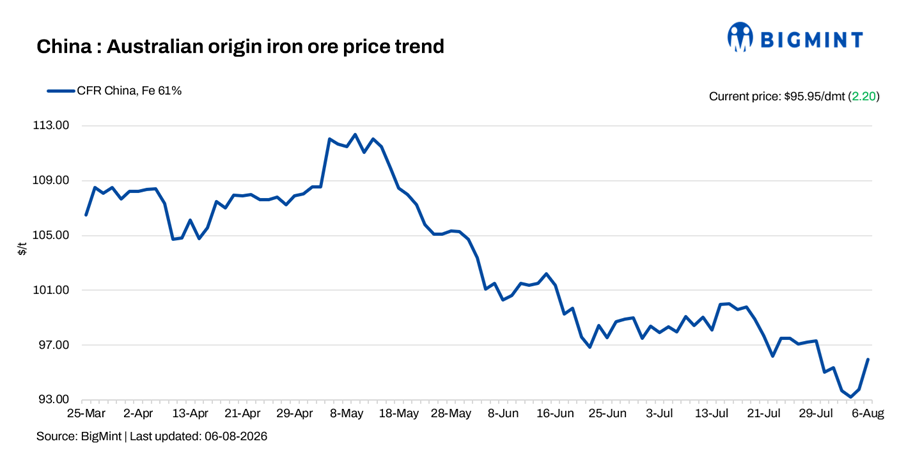
Iron ore fines (Fe 61%) spot prices rebounded sharply by $2.2/dmt d-o-d to $95.95/dmt CFR North China on 6 August 2026, recovering after recent weakness as supply-side concerns and stronger futures improved market sentiment.
The recovery was primarily supported by reports that China Mineral Resources Group (CMRG) had advised certain Chinese steel mills to suspend negotiations with Rio Tinto for September-loading iron ore cargoes and beyond until annual long-term contract discussions are concluded. The move could temporarily tighten seaborne supply, lifting futures and spot sentiment. Over the longer term, as an outcome it can strengthen China’s bargaining position in annual contract negotiations and help stabilise raw material procurement costs.
Additional support stemmed from concerns over potential disruptions to Australian iron ore exports after unions representing workers at BHP’s Port Hedland operations announced a two-day protected industrial action scheduled for 8-9 August, following eight months of unsuccessful wage negotiations, as per SteelDaily. Port Hedland, one of the Pilbara’s major export terminals, forms part of the world’s largest bulk iron ore export hub. While BHP has implemented contingency measures to maintain essential port operations and shipments by Fortescue and Hancock Prospecting are expected to continue unaffected, the strike risk injected a supply premium into the market.
Demand-side indicators also improved alongside the rally in futures. Demand for medium-grade fines had already been strengthening before the latest price increase, and the sharp rise has pushed most mainstream medium-grade seaborne ores back into import-profit territory, encouraging buying interest. Trades were also reported stronger activity in the portside market. Meanwhile, lump premiums remained elevated, while expectations of a third consecutive round of coke price cuts this week could improve blast furnace economics and reduce mills’ dependence on lump ore, providing additional support to fines consumption.
Market fundamentals also strengthened, with daily consumption of imported sintering fines among 64 Chinese blast furnace steel mills increasing 7.2% w-o-w to 598,200 t, reflecting healthier raw material demand. However, physical seaborne trading remained relatively slow as abundant port inventories and cautious procurement by steel mills continued to cap buying activity despite the recovery in prices.
DCE iron ore futures: Iron ore futures for September 2026 on the Dalian Commodity Exchange (DCE) rose by RMB 14/t d-o-d to RMB 716.5/t on 7 August, supported by supply disruption concerns and improving market sentiment.

Leave a Reply